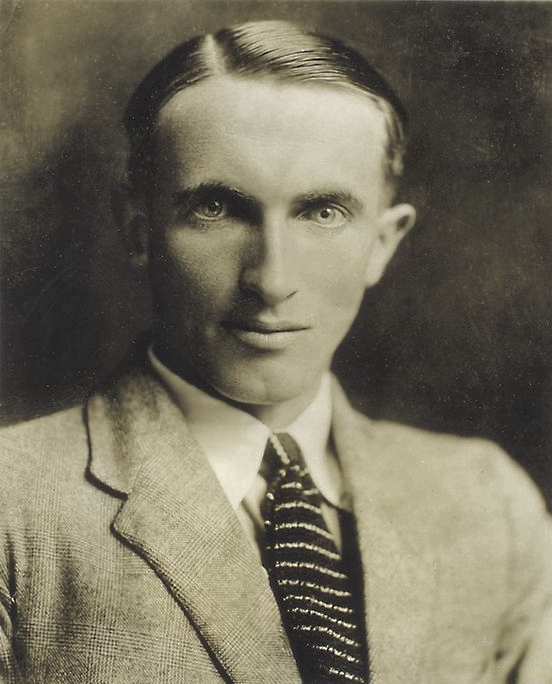
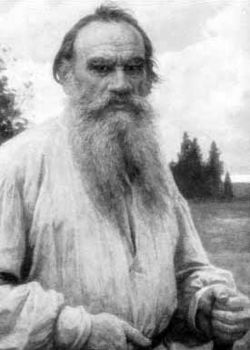
• Life is not always fair. It simply is not. There is tragedy, there is comedy and finally there is making peace, cause frankly sometimes thats all that one can do. Make peace. Find peace. Like Ivan Dmitritch Aksyokof. Its one of those pieces of fiction that will need a box of tissues to go with.


    God sees truth, but waits

    By Count Leo Tolstoy

    images (4)

    IN the town of VladĂ­mir lived a young merchant named IvĂĄn DmĂ­tritch AksyĂłnof. He had two shops and a house of his own.

    AksyĂłnof was a handsome, fair-haired, curly-headed fellow, full of fun, and very fond of singing. When quite a young man he had been given to drink, and was riotous when he had had too much, but after he married he gave up drinking, except now and then.

    One summer AksyĂłnof was going to the NĂ­zhny Fair, and as he bade good-bye to his family his wife said to him, ‘IvĂĄn DmĂ­tritch, do not start to-day; I have had a bad dream about you.’

    AksyĂłnof laughed, and said, ‘You are afraid that when I get to the fair I shall go on the spree.’

    His wife replied: ‘I do not know what I am afraid of; all I know is that I had a bad dream. I dreamt you returned from the town, and when you took off your cap I saw that your hair was quite grey.’

    AksyĂłnof laughed. ‘That’s a lucky sign,’ said he. ‘See if I don’t sell out all my goods, and bring you some presents from the fair.’

    So he said good-bye to his family, and drove away.

    When he had travelled half-way, he met a merchant whom he knew, and they put up at the same inn for the night. They had some tea together, and then went to bed in adjoining rooms.

    It was not AksyĂłnof’s habit to sleep late, and, wishing to travel while it was still cool, he aroused his driver before dawn, and told him to put in the horses. Then he made his way across to the landlord of the inn (who lived in a cottage at the back), paid his bill, and continued his journey.

    When he had gone about twenty-five miles, he stopped for the horses to be fed. AksyĂłnof rested awhile in the passage of the inn, then he stepped out into the porch and, ordering a samovĂĄr[1] to be heated got out his guitar and began to play.

    Suddenly a trĂłyka[2] drove up with tinkling bells, and an official alighted, followed by two soldiers. He came to AksyĂłnof and began to question him, asking him who he was and whence he came. AksyĂłnof answered him fully, and said, ‘Won’t you have some tea with me?’ But the official went on cross-questioning him and asking him, ‘Where did you spend last night? Were you alone, or with a fellow-merchant? Did you see the other merchant this morning? Why did you leave the inn before dawn?’

    AksyĂłnof wondered why he was asked all these questions, but he described all that had happened, and then added, ‘Why do you cross-question me as if I were a thief or a robber? I am travelling on business of my own, and there is no need to question me.’

    Then the official, calling the soldiers, said, ‘I am the police-officer of this district, and I question you because the merchant with whom you spent last night has been found with his throat cut. We must search your things.’

    They entered the house. The soldiers and the police-officer unstrapped AksyĂłnof’s luggage and searched it. Suddenly the officer drew a knife out of a bag, crying, ‘Whose knife is this?’

    AksyĂłnof looked, and seeing a blood-stained knife taken from his bag, he was frightened.

    ‘How is it there is blood on this knife?’

    AksyĂłnof tried to answer, but could hardly utter a word, and only stammered: ‘I — I don’t know — not mine.’

    Then the police-officer said, ‘This morning the merchant was found in bed with his throat cut. You are the only person who could have done it. The house was locked from inside, and no one else was there. Here is this bloodstained knife in your bag, and your face and manner betray you! Tell me how you killed him, and how much money you stole?’

    AksyĂłnof swore he had not done it; that he had not seen the merchant after they had had tea together; that he had no money except eight thousand roubles[3] of his own, and that the knife was not his. But his voice was broken, his face pale, and he trembled with fear as though he were guilty.

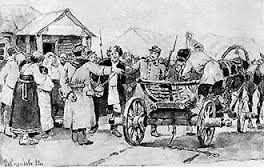
    The police-officer ordered the soldiers to bind AksyĂłnof and to put him in the cart. As they tied his feet together and flung him into the cart, AksyĂłnof crossed himself and wept. His money and goods were taken from him, and he was sent to the nearest town and imprisoned there. Enquiries as to his character were made in VladĂ­mir. The merchants and other inhabitants of that town said that in former days he used to drink and waste his time, but that he was a good man. Then the trial came on: he was charged with murdering a merchant from RyazĂĄn, and robbing him of twenty thousand roubles.

    His wife was in despair, and did not know what to believe. Her children were all quite small; one was a baby at her breast. Taking them all with her, she went to the town where her husband was in gaol. At first she was not allowed to see him; but, after much begging, she obtained permission from the officials, and was taken to him. When she saw her husband in prison-dress and in chains, shut up with thieves and criminals, she fell down, and did not come to her senses for a long time. Then she drew her children to her, and sat down near him. She told him of things at home, and asked about what had happened to him. He told her all, and she asked, ‘What can we do now?’

    ‘We must petition the Tsar not to let an innocent man perish.’

    His wife told him that she had sent a petition to the Tsar, but that it had not been accepted.

    AksyĂłnof did not reply, but only looked downcast.

    Then his wife said, ‘It was not for nothing I dreamt your hair had turned grey. You remember? You should not have started that day.’ And passing her fingers through his hair, she said: ‘VĂĄnya dearest, tell your wife the truth; was it not you who did it?’

    ‘So you, too, suspect me!’ said AksyĂłnof, and hiding his face in his hands, he began to weep. Then a soldier came to say that the wife and children must go away; and AksyĂłnof said good-bye to his family for the last time.

    When they were gone, AksyĂłnof recalled what had been said, and when he remembered that his wife also had suspected him, he said to himself, ‘It seems that only God can know the truth, it is to Him alone we must appeal, and from Him alone expect mercy.’

    And AksyĂłnof wrote no more petitions; gave up all hope, and only prayed to God.

    AksyĂłnof was condemned to be flogged and sent to the mines. So he was flogged with a knout, and when the wounds made by the knout were healed, he was driven to Siberia with other convicts.

    For twenty-six years AksyĂłnof lived as a convict in Siberia. His hair turned white as snow and his beard grew long, thin, and grey. All his mirth went; he stooped; he walked slowly, spoke little, and never laughed, but he often prayed.

    In prison AksyĂłnof learnt to make boots, and earned a little money, with which he bought The Lives of the Saints. He read this book when there was light enough in the prison; and on Sundays in the prison-church he read the lessons and sang in the choir; for his voice was still good.

    The prison authorities liked AksyĂłnof for his meekness, and his fellow-prisoners respected him: they called him ‘Grandfather,’ and ‘The Saint.’ When they wanted to petition the prison authorities about anything, they always made AksyĂłnof their spokesman, and when there were quarrels among the prisoners they came to him to put things right, and to judge the matter.

    No news reached AksyĂłnof from his home, and he did not even know if his wife and children were still alive.

    One day a fresh gang of convicts came to the prison. In the evening the old prisoners collected round the new ones and asked them what towns or villages they came from, and what they were sentenced for. Among the rest AksyĂłnof sat down near the new-comers, and listened with downcast air to what was said.

    One of the new convicts, a tall, strong man of sixty, with a closely-cropped grey beard, was telling the others what he had been arrested for.

    ‘Well, friends,’ he said, ‘I only took a horse that was tied to a sledge, and I was arrested and accused of stealing. I said I had only taken it to get home quicker, and had then let it go; besides, the driver was a personal friend of mine. So I said, “It’s all right.” “No,” said they, “you stole it.” But how or where I stole it they could not say. I once really did something wrong, and ought by rights to have come here long ago, but that time I was not found out. Now I have been sent here for nothing at all. . . . Eh, but it’s lies I’m telling you; I’ve been to Siberia before, but I did not stay long.’

    ‘Where are you from?’ asked some one.

    ‘From VladĂ­mir. My family are of that town. My name is MakĂĄr, and they also call me SemyĂłnitch.’

    AksyĂłnof raised his head and said: ‘Tell me, SemyĂłnitch, do you know anything of the merchants AksyĂłnof, of VladĂ­mir? Are they still alive?’

    ‘Know them? Of course I do. The AksyĂłnofs are rich, though their father is in Siberia: a sinner like ourselves, it seems! As for you, Gran’dad, how did you come here?’

    AksyĂłnof did not like to speak of his misfortune. He only sighed, and said, ‘For my sins I have been in prison these twenty-six years.’

    ‘What sins?’ asked MakĂĄr SemyĂłnitch.

    But AksyĂłnof only said, ‘Well, well — I must have deserved it!’ He would have said no more, but his companions told the new-comer how AksyĂłnof came to be in Siberia: how some one had killed a merchant and had put a knife among AksyĂłnof’s things, and AksyĂłnof had been unjustly condemned.

    When MakĂĄr SemyĂłnitch heard this, he looked at AksyĂłnof, slapped his own knee, and exclaimed, ‘Well this is wonderful! Really wonderful! But how old you’ve grown, Gran’dad!’

    The others asked him why he was so surprised, and where he had seen AksyĂłnof before; but MakĂĄr SemyĂłnitch did not reply. He only said: ‘It’s wonderful that we should meet here, lads!’

    These words made AksyĂłnof wonder whether this man knew who had killed the merchant; so he said ‘Perhaps, SemyĂłnitch, you have heard of that affair or maybe you’ve seen me before?’

    ‘How could I help hearing? The world’s full of rumours. But it’s long ago, and I’ve forgotten what I heard.’

    ‘Perhaps you heard who killed the merchant?’ asked AksyĂłnof.

    MakĂĄr SemyĂłnitch laughed, and replied, ‘It must have been him in whose bag the knife was found! If some one else hid the knife there, “He’s not a thief till he’s caught,” as the saying is. How could any one put a knife into your bag while it was under your head? It would surely have woke you up?’

    When AksyĂłnof heard these words, he felt sure this was the man who had killed the merchant. He rose and went away. All that night AksyĂłnof lay awake.

    He felt terribly unhappy, and all sorts of images rose in his mind. There was the image of his wife as she was when he parted from her to go to the fair. He saw her as if she were present; her face and her eyes rose before him; he heard her speak and laugh. Then he saw his children, quite little, as they were at that time: one with a little cloak on, another at his mother’s breast. And then he remembered himself as he used to be — young and merry. He remembered how he sat playing the guitar in the porch of the inn where he was arrested, and how free from care he had been. He saw, in his mind, the place where he was flogged, the executioner, and the people standing around; the chains, the convicts, all the twenty-six years of his prison life, and his premature old age. The thought of it all made him so wretched that he was ready to kill himself.

    ‘And it’s all that villain’s doing!’ thought AksyĂłnof. And his anger was so great against MakĂĄr SemyĂłnitch that he longed for vengeance, even if he himself should perish for it. He kept repeating prayers all night, but could get no peace. During the day he did not go near MakĂĄr SemyĂłnitch, nor even look at him.

    A fortnight passed in this way. AksyĂłnof could not sleep at nights, and was so miserable that he did not know what to do.

    One night as he was walking about the prison he noticed some earth that came rolling out from under one of the shelves on which the prisoners slept. He stopped to see what it was. Suddenly MakĂĄr SemyĂłnitch crept out from under the shelf, and looked up at AksyĂłnof with frightened face. AksyĂłnof tried to pass without looking at him, but MakĂĄr seized his hand and told him that he had dug a hole under the wall, getting rid of the earth by putting it into his high-boots, and emptying it out every day on the road when the prisoners were driven to their work.

    ‘Just you keep quiet, old man, and you shall get out too. If you blab they’ll flog the life out of me, but I will kill you first.’

    AksyĂłnof trembled with anger as he looked at his enemy. He drew his hand away, saying, ‘I have no wish to escape, and you have no need to kill me; you killed me long ago! As to telling of you — I may do so or not, as God shall direct.’ Next day, when the convicts were led out to work, the convoy soldiers noticed that one or other of the prisoners emptied some earth out of his boots. The prison was searched, and the tunnel found. The Governor came and questioned all the prisoners to find out who had dug the hole. They all denied any knowledge of it. Those who knew, would not betray MakĂĄr SemyĂłnitch, knowing he would be flogged almost to death. At last the Governor turned to AksyĂłnof, whom he knew to be a just man, and said:

    ‘You are a truthful old man; tell me, before God, who dug the hole?’

    MakĂĄr SemyĂłnitch stood as if he were quite unconcerned, looking at the Governor and not so much as glancing at AksyĂłnof. AksyĂłnof’s lips and hands trembled, and for a long time he could not utter a word. He thought, ‘Why should I screen him who ruined my life? Let him pay for what I have suffered. But if I tell, they will probably flog the life out of him and maybe I suspect him wrongly. And, after all, what good would it be to me?’

    ‘Well, old man,’ repeated the Governor, ‘tell us the truth: who has been digging under the wall?’

    AksyĂłnof glanced at MakĂĄr SemyĂłnitch, and said ‘I cannot say, your honour. It is not God’s will that I should tell! Do what you like with me; I am in your hands.’

    However much the Governor tried, AksyĂłnof would say no more, and so the matter had to be left.

    That night, when AksyĂłnof was lying on his bed and just beginning to doze, some one came quietly and sat down on his bed. He peered through the darkness and recognized MakĂĄr.

    ‘What more do you want of me?’ asked AksyĂłnof. ‘Why have you come here?’

    MakĂĄr SemyĂłnitch was silent. So AksyĂłnof sat up and said, ‘What do you want? Go away, or I will call the guard!’

    MakĂĄr SemyĂłnitch bent close over AksyĂłnof, and whispered, ‘IvĂĄn DmĂ­tritch, forgive me!’

    ‘What for?’ asked AksyĂłnof.

    ‘It was I who killed the merchant and hid the knife among your things. I meant to kill you too, but I heard a noise outside; so I hid the knife in your bag and escaped out of the window.’

    AksyĂłnof was silent, and did not know what to say. MakĂĄr SemyĂłnitch slid off the bed-shelf and knelt upon the ground. ‘IvĂĄn DmĂ­tritch,’ said he, ‘forgive me! For the love of God, forgive me! I will confess that it was I who killed the merchant, and you will be released and can go to your home.’

    ‘It is easy for you to talk,’ said AksyĂłnof, ‘but I have suffered for you these twenty-six years. Where could I go to now? . . . My wife is dead, and my children have forgotten me. I have nowhere to go. . . .’

    MakĂĄr SemyĂłnitch did not rise, but beat his head on the floor. ‘IvĂĄn DmĂ­tritch, forgive me!’ he cried. ‘When they flogged me with the knout it was not so hard to bear as it is to see you now . . . yet you had pity on me, and did not tell. For Christ’s sake forgive me, wretch that I am!’ And he began to sob.

    When AksyĂłnof heard him sobbing he, too, began to weep.

    ‘God will forgive you!’ said he. ‘Maybe I am a hundred times worse than you.’ And at these words his heart grew light, and the longing for home left him. He no longer had any desire to leave the prison, but only hoped for his last hour to come.

    In spite of what AksyĂłnof had said, Maker SemyĂłnitch confessed his guilt. But when the order for his release came, AksyĂłnof was already dead.

    tolstoy2

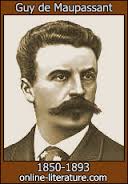
  • Honesty is the best policy. I mean what even if some wise men believe that its the straightest of trees that are felled first. This one piece of fiction by the dear French writer Maupassant reinstates that very belief.

    The Diamond Necklace

    By Guy de maupassant

    images (2)

    The girl was one of those pretty and charming young creatures who sometimes are born, as if by a slip of fate, into a family of clerks. She had no dowry, no expectations, no way of being known, understood, loved, married by any rich and distinguished man; so she let herself be married to a little clerk of the Ministry of Public Instruction.

    She dressed plainly because she could not dress well, but she was unhappy as if she had really fallen from a higher station; since with women there is neither caste nor rank, for beauty, grace and charm take the place of family and birth. Natural ingenuity, instinct for what is elegant, a supple mind are their sole hierarchy, and often make of women of the people the equals of the very greatest ladies.

    Mathilde suffered ceaselessly, feeling herself born to enjoy all delicacies and all luxuries. She was distressed at the poverty of her dwelling, at the bareness of the walls, at the shabby chairs, the ugliness of the curtains. All those things, of which another woman of her rank would never even have been conscious, tortured her and made her angry. The sight of the little Breton peasant who did her humble housework aroused in her despairing regrets and bewildering dreams. She thought of silent antechambers hung with Oriental tapestry, illumined by tall bronze candelabra, and of two great footmen in knee breeches who sleep in the big armchairs, made drowsy by the oppressive heat of the stove. She thought of long reception halls hung with ancient silk, of the dainty cabinets containing priceless curiosities and of the little coquettish perfumed reception rooms made for chatting at five o’clock with intimate friends, with men famous and sought after, whom all women envy and whose attention they all desire.

    When she sat down to dinner, before the round table covered with a tablecloth in use three days, opposite her husband, who uncovered the soup tureen and declared with a delighted air, “Ah, the good soup! I don’t know anything better than that,” she thought of dainty dinners, of shining silverware, of tapestry that peopled the walls with ancient personages and with strange birds flying in the midst of a fairy forest; and she thought of delicious dishes served on marvellous plates and of the whispered gallantries to which you listen with a sphinxlike smile while you are eating the pink meat of a trout or the wings of a quail.

    She had no gowns, no jewels, nothing. And she loved nothing but that. She felt made for that. She would have liked so much to please, to be envied, to be charming, to be sought after.

    She had a friend, a former schoolmate at the convent, who was rich, and whom she did not like to go to see any more because she felt so sad when she came home.

    But one evening her husband reached home with a triumphant air and holding a large envelope in his hand.

    “There,” said he, “there is something for you.”

    She tore the paper quickly and drew out a printed card which bore these words:

       The Minister of Public Instruction and Madame Georges Ramponneau
       request the honor of M. and Madame Loisel's company at the palace of
       the Ministry on Monday evening, January 18th.

    Instead of being delighted, as her husband had hoped, she threw the invitation on the table crossly, muttering:

    “What do you wish me to do with that?”

    “Why, my dear, I thought you would be glad. You never go out, and this is such a fine opportunity. I had great trouble to get it. Every one wants to go; it is very select, and they are not giving many invitations to clerks. The whole official world will be there.”

    She looked at him with an irritated glance and said impatiently:

    “And what do you wish me to put on my back?”

    He had not thought of that. He stammered:

    “Why, the gown you go to the theatre in. It looks very well to me.”

    He stopped, distracted, seeing that his wife was weeping. Two great tears ran slowly from the corners of her eyes toward the corners of her mouth.

    “What’s the matter? What’s the matter?” he answered.

    By a violent effort she conquered her grief and replied in a calm voice, while she wiped her wet cheeks:

    “Nothing. Only I have no gown, and, therefore, I can’t go to this ball. Give your card to some colleague whose wife is better equipped than I am.”

    He was in despair. He resumed:

    “Come, let us see, Mathilde. How much would it cost, a suitable gown, which you could use on other occasions—something very simple?”

    She reflected several seconds, making her calculations and wondering also what sum she could ask without drawing on herself an immediate refusal and a frightened exclamation from the economical clerk.

    Finally she replied hesitating:

    “I don’t know exactly, but I think I could manage it with four hundred francs.”

    He grew a little pale, because he was laying aside just that amount to buy a gun and treat himself to a little shooting next summer on the plain of Nanterre, with several friends who went to shoot larks there of a Sunday.

    But he said:

    “Very well. I will give you four hundred francs. And try to have a pretty gown.”

    The day of the ball drew near and Madame Loisel seemed sad, uneasy, anxious. Her frock was ready, however. Her husband said to her one evening:

    “What is the matter? Come, you have seemed very queer these last three days.”

    And she answered:

    “It annoys me not to have a single piece of jewelry, not a single ornament, nothing to put on. I shall look poverty-stricken. I would almost rather not go at all.”

    “You might wear natural flowers,” said her husband. “They’re very stylish at this time of year. For ten francs you can get two or three magnificent roses.”

    She was not convinced.

    “No; there’s nothing more humiliating than to look poor among other women who are rich.”

    “How stupid you are!” her husband cried. “Go look up your friend, Madame Forestier, and ask her to lend you some jewels. You’re intimate enough with her to do that.”

    She uttered a cry of joy:

    “True! I never thought of it.”

    The next day she went to her friend and told her of her distress.

    Madame Forestier went to a wardrobe with a mirror, took out a large jewel box, brought it back, opened it and said to Madame Loisel:

    “Choose, my dear.”

    She saw first some bracelets, then a pearl necklace, then a Venetian gold cross set with precious stones, of admirable workmanship. She tried on the ornaments before the mirror, hesitated and could not make up her mind to part with them, to give them back. She kept asking:

    “Haven’t you any more?”

    “Why, yes. Look further; I don’t know what you like.”

    Suddenly she discovered, in a black satin box, a superb diamond necklace, and her heart throbbed with an immoderate desire. Her hands trembled as she took it. She fastened it round her throat, outside her high-necked waist, and was lost in ecstasy at her reflection in the mirror.

    Then she asked, hesitating, filled with anxious doubt:

    “Will you lend me this, only this?”

    “Why, yes, certainly.”

    She threw her arms round her friend’s neck, kissed her passionately, then fled with her treasure.

    The night of the ball arrived. Madame Loisel was a great success. She was prettier than any other woman present, elegant, graceful, smiling and wild with joy. All the men looked at her, asked her name, sought to be introduced. All the attaches of the Cabinet wished to waltz with her. She was remarked by the minister himself.

    She danced with rapture, with passion, intoxicated by pleasure, forgetting all in the triumph of her beauty, in the glory of her success, in a sort of cloud of happiness comprised of all this homage, admiration, these awakened desires and of that sense of triumph which is so sweet to woman’s heart.

    She left the ball about four o’clock in the morning. Her husband had been sleeping since midnight in a little deserted anteroom with three other gentlemen whose wives were enjoying the ball.

    He threw over her shoulders the wraps he had brought, the modest wraps of common life, the poverty of which contrasted with the elegance of the ball dress. She felt this and wished to escape so as not to be remarked by the other women, who were enveloping themselves in costly furs.

    Loisel held her back, saying: “Wait a bit. You will catch cold outside. I will call a cab.”

    But she did not listen to him and rapidly descended the stairs. When they reached the street they could not find a carriage and began to look for one, shouting after the cabmen passing at a distance.

    They went toward the Seine in despair, shivering with cold. At last they found on the quay one of those ancient night cabs which, as though they were ashamed to show their shabbiness during the day, are never seen round Paris until after dark.

    It took them to their dwelling in the Rue des Martyrs, and sadly they mounted the stairs to their flat. All was ended for her. As to him, he reflected that he must be at the ministry at ten o’clock that morning.

    She removed her wraps before the glass so as to see herself once more in all her glory. But suddenly she uttered a cry. She no longer had the necklace around her neck!

    “What is the matter with you?” demanded her husband, already half undressed.

    She turned distractedly toward him.

    “I have—I have—I’ve lost Madame Forestier’s necklace,” she cried.

    He stood up, bewildered.

    “What!—how? Impossible!”

    They looked among the folds of her skirt, of her cloak, in her pockets, everywhere, but did not find it.

    “You’re sure you had it on when you left the ball?” he asked.

    “Yes, I felt it in the vestibule of the minister’s house.”

    “But if you had lost it in the street we should have heard it fall. It must be in the cab.”

    “Yes, probably. Did you take his number?”

    “No. And you—didn’t you notice it?”

    “No.”

    They looked, thunderstruck, at each other. At last Loisel put on his clothes.

    “I shall go back on foot,” said he, “over the whole route, to see whether I can find it.”

    He went out. She sat waiting on a chair in her ball dress, without strength to go to bed, overwhelmed, without any fire, without a thought.

    Her husband returned about seven o’clock. He had found nothing.

    He went to police headquarters, to the newspaper offices to offer a reward; he went to the cab companies—everywhere, in fact, whither he was urged by the least spark of hope.

    She waited all day, in the same condition of mad fear before this terrible calamity.

    Loisel returned at night with a hollow, pale face. He had discovered nothing.

    “You must write to your friend,” said he, “that you have broken the clasp of her necklace and that you are having it mended. That will give us time to turn round.”

    She wrote at his dictation.

    At the end of a week they had lost all hope. Loisel, who had aged five years, declared:

    “We must consider how to replace that ornament.”

    The next day they took the box that had contained it and went to the jeweler whose name was found within. He consulted his books.

    “It was not I, madame, who sold that necklace; I must simply have furnished the case.”

    Then they went from jeweler to jeweler, searching for a necklace like the other, trying to recall it, both sick with chagrin and grief.

    They found, in a shop at the Palais Royal, a string of diamonds that seemed to them exactly like the one they had lost. It was worth forty thousand francs. They could have it for thirty-six.

    So they begged the jeweler not to sell it for three days yet. And they made a bargain that he should buy it back for thirty-four thousand francs, in case they should find the lost necklace before the end of February.

    Loisel possessed eighteen thousand francs which his father had left him. He would borrow the rest.

    He did borrow, asking a thousand francs of one, five hundred of another, five louis here, three louis there. He gave notes, took up ruinous obligations, dealt with usurers and all the race of lenders. He compromised all the rest of his life, risked signing a note without even knowing whether he could meet it; and, frightened by the trouble yet to come, by the black misery that was about to fall upon him, by the prospect of all the physical privations and moral tortures that he was to suffer, he went to get the new necklace, laying upon the jeweler’s counter thirty-six thousand francs.

    When Madame Loisel took back the necklace Madame Forestier said to her with a chilly manner:

    “You should have returned it sooner; I might have needed it.”

    She did not open the case, as her friend had so much feared. If she had detected the substitution, what would she have thought, what would she have said? Would she not have taken Madame Loisel for a thief?

    Thereafter Madame Loisel knew the horrible existence of the needy. She bore her part, however, with sudden heroism. That dreadful debt must be paid. She would pay it. They dismissed their servant; they changed their lodgings; they rented a garret under the roof.

    She came to know what heavy housework meant and the odious cares of the kitchen. She washed the dishes, using her dainty fingers and rosy nails on greasy pots and pans. She washed the soiled linen, the shirts and the dishcloths, which she dried upon a line; she carried the slops down to the street every morning and carried up the water, stopping for breath at every landing. And dressed like a woman of the people, she went to the fruiterer, the grocer, the butcher, a basket on her arm, bargaining, meeting with impertinence, defending her miserable money, sou by sou.

    Every month they had to meet some notes, renew others, obtain more time.

    Her husband worked evenings, making up a tradesman’s accounts, and late at night he often copied manuscript for five sous a page.

    This life lasted ten years.

    At the end of ten years they had paid everything, everything, with the rates of usury and the accumulations of the compound interest.

    Madame Loisel looked old now. She had become the woman of impoverished households—strong and hard and rough. With frowsy hair, skirts askew and red hands, she talked loud while washing the floor with great swishes of water. But sometimes, when her husband was at the office, she sat down near the window and she thought of that gay evening of long ago, of that ball where she had been so beautiful and so admired.

    What would have happened if she had not lost that necklace? Who knows? who knows? How strange and changeful is life! How small a thing is needed to make or ruin us!

    But one Sunday, having gone to take a walk in the Champs Elysees to refresh herself after the labors of the week, she suddenly perceived a woman who was leading a child. It was Madame Forestier, still young, still beautiful, still charming.

    Madame Loisel felt moved. Should she speak to her? Yes, certainly. And now that she had paid, she would tell her all about it. Why not?

    She went up.

    “Good-day, Jeanne.”

    The other, astonished to be familiarly addressed by this plain good-wife, did not recognize her at all and stammered:

    “But—madame!—I do not know—You must have mistaken.”

    “No. I am Mathilde Loisel.”

    Her friend uttered a cry.

    “Oh, my poor Mathilde! How you are changed!”

    “Yes, I have had a pretty hard life, since I last saw you, and great poverty—and that because of you!”

    “Of me! How so?”

    “Do you remember that diamond necklace you lent me to wear at the ministerial ball?”

    “Yes. Well?”

    “Well, I lost it.”

    “What do you mean? You brought it back.”

    “I brought you back another exactly like it. And it has taken us ten years to pay for it. You can understand that it was not easy for us, for us who had nothing. At last it is ended, and I am very glad.”

    Madame Forestier had stopped.

    “You say that you bought a necklace of diamonds to replace mine?”

    “Yes. You never noticed it, then! They were very similar.”

    And she smiled with a joy that was at once proud and ingenuous.

    Madame Forestier, deeply moved, took her hands.

    “Oh, my poor Mathilde! Why, my necklace was paste! It was worth at most only five hundred francs!”

    images (3)

  • From the Indian writers, this one is a memory. K N Daruwalla writes about love in this earthy Love story set in the great rann of kutch. The story has been an inspiration for the Bollywood movie of Refugee. The movie is miss-able, but the story is laudable.

    Love across the salt desert

    By Keki N. Daruwalla

    images (1)

    The Rann of Kutch is a vast, lonely desert, almost impossible to cross. Yet, some people do cross it for reasons of their own. Najab Hussain also crossed the vast desert for a very special reason. What was it?
    1. THE DROUGHT in Kutch had lasted for three successive years. Even when clouds were sighted they passed by, ignoring the stricken country. The monsoons had, so to speak, forgotten to land. The Rann lay like a paralysed monster, its back covered with scab and scar-tissue and dried blister-skin. The earth had cracked and it looked as if chunks of it had been baked in a kiln and then embedded in the soil-crust. The cattle became thin and emaciated. The oxen died. The camel alone survived comfortably, feeding on the bawal, camelthorn. Then one day the clouds rolled in like wineskins and the lightning crackled and the wineskins burst. Though two years have passed since the drought ended, everyone remembers that it ïŹrst rained on the day when Fatimah entered the village. This is how she came.
    * * * * *
    What would he not do for her, the daughter of the spice-seller; she who smelt of cloves and cinnamon, whose laughter had the timbre of ankle-bells, whose eyebrows were like black wisps of the night and whose hair was the night itself? For her he would cross the salt desert! He had stayed the day at Kala Doongar, a black hill capped with basalt, the highest in Kutch. He had set his camel, Allahrakha, free to crop on the bawal trees. At dusk he paid homage to the footprints of the Panchmai Pir on the hilltop. He left some food there and started beating on his thali, according to the custom here. In a few minutes jackals materialised and gobbled up the food. This was auspicious. If they had not turned up he would have cancelled the journey. A lamp was lighted in the Pir’s honour every night on the hilltop and the ïŹ‚ame could be seen on all the way from Khavda. Over a hundred years earlier the Panchmai Pir had trudged these salt wastes serving the people accompanied, as legend had it, by a jackal. Reclusive by habit he used to retire to thorn jungles, where apart from his vulpine companions none else dared to disturb his nocturnal trysts. The custom of feeding the jackals had lingered since then. Najab bowed before the ïŹ‚ame and set out. He left behind the camelthorn shrubs and the area once famous for its savannahs of stunted grass, but now sere and brown as the desert. He had left behind all human habitation, Kuran being the last village.

    For the next three days he would not be seeing any bhungas, those one-room mud-houses, circular at the base, but tapering into conical thatch-roofs at the top. Now only the sand-scapes stretched out before him, mile upon mile. Water splashed in the chagals. With the name of the Pir on his lips Najab Hussain set forth. Najab’s diïŹƒdence was notorious among his friends. He was known to have blushed at the mere mention of a girl. A strangely introverted lad with dreamy eyes, no one had ever associated him with any act of bravado. His father, Aftab, would say, “All that my ancestors and I have acquired during a hundred years, this lad will squander away, not because he is a spendthrift but because he will be too shy to charge money for what he sells!” He had crossed the Rann on four occasions earlier, though he had turned twenty only a month ago. But each time he had either accompanied his father or that wily old smuggler, Zaman, the veteran of a hundred illegal trips to Sind. Each time they had taken tendu leaf worth about ïŹve hundred, and sold it across the border for twelve hundred. But between the pay-oïŹ€ to oïŹƒcials and to the intermediaries who arranged the sale of the biri leaf, to the man who took the camel out to graze and to the friend or relative who harboured them, there was precious little left. It was just enough to buy some used terylene garments or cloves and then it was time to make the long trek across the desert. It was during one of these trips that they had stayed with Kaley Shah, the clove-seller. “He is a distant relative of your mother,” his father told Najab. Kaley Shah was tall, and well-ïŹ‚eshed and his thick-jowled face had a purple tinge about it as if somewhere along the way it had got stuck with a discoloured patch. He always wore a tahmat of black and white checks. Within a day Najab discovered that the fellow was an absolute rogue who drove such a cussed bargain that for the ïŹrst time in his hearing his father started mouthing obscenities. But his daughter Fatimah was a hoor with eyes so bright that they would have lit up the darkness of the underworld. She was taken by this quiet, pleasant young man so ready with his smiles.

    But she could hardly elicit a word out of him. Fatimah had been under pressure to get engaged to someone in the village known for his slurred speech and grotesque stammer. “Just my luck to run into mutes,” she thought. But then, as she caught him staring at her, she laughed back. And in the evening when Fatimah repeated the performance and her face ïŹ‚ooded with excitement as if she dared him to take the next step, he had ïŹ‚ung his arms around her in a reckless, dizzy moment. Yes, he would come again, he told her, and saw her start with disbelief for he seemed to have answered her inarticulated question: Would he come again? This time he would come alone with no father to cramp his style. And as he left he looked behind to ïŹnd her gaze following him, her eyes like a pair of storm lanterns in the dark. Ever since his return Khavda, Najab had been straining to get away. What was there about the Rann that he did not know? He could cross the Rann in the daylight, leave alone starlight, a thing none of his elders had dared to do! And one morning Aftab was woken up by a shout from Zaman. What does that old rogue want, he muttered, rubbing his sleepy eyes. Zaman asked about Najab’s whereabouts. 2. “The boy has been sulking of late but he should be around. Anyway, what business is it of yours?” The old man did not hide his irritation. “Who are you trying to fool, Aftab Mian?” asked the smuggler. “Don’t you know that Allahrakha is also missing?” In these border villages the pattern of life was such that if a man was absent long with his camel, it was taken for granted that he had made a foray across the desert into Pakistan. Aftab went into the mud enclosure where his camel was kept and found it empty. His heart sank.

    He ran into the house to see if the bundles of tendu leaf he had bought by him had been taken by the boy. “Oh, the fool! That son of a fool!” exclaimed Aftab, almost shaking with fury. “He has forgotten to take the leaf with him!” “Who are you trying to fool with all this drama?” called out Zaman who was still standing at the door. “This son of yours is not as innocent as the world believes. He is a pig and the son of a pig.” There was no limit to his chagrin. Zaman was a ‘chief’, the man who kept the Rangers across happy. Any one crossing the Rann without his support was running the gauntlet with the law. And here this ïŹ‚edgling had blundered in without as much as a word to him, or a salaam, or a hundred rupee note! “May Allah bring him safely out of this!” said the old rogue piously. He means just the opposite, thought Aftab. Nothing would please him more than to see Najab turned into carrion with vultures hovering around. “Don’t worry, Zaman, Allah will see him through!” he said testily and banged the door in the smuggler’s face. As Zaman walked oïŹ€, Aftab went in to break the news of their son’s escapade to his wife. She would faint, he thought. He found her crouching with her back against the mud wall. She did not even blink in surprise, once. She just sat there cowering as if he had just slapped her and was about to do so again. Allah! She knew it! She knew it all the time!

    She was waist-deep in this conspiracy along with her son and never breathed a word about it. His eye fell on her bare arm. “Where is the gold bangle my father gave you, woman.” “You need not worry. Najab will return with cloves.” The long-striding Allahrakha kept a brisk pace. A strong south wind drove the tang of the Kori creek back into Najab’s nostrils. He followed the stars, the Milky Way ïŹ‚aked with mica, the Great Bear shambling towards the north. Before dawn he had reached his destination, for a sandy elevation palisaded with the bones of dead animals told him he had arrived at Sarbela, over twenty miles from Kala Doongar. He was already beyond the interna- tional boundary. Here he rested. During daylight, movement was impossible. The Indus Rangers would be looking from their bamboo watch-towers. And in the heat everything became a mirage. A depression in the sand looked like a splash of water, a freak, stunted cactus gave the appearance of a grove, and a camel looked like a huge prehistoric animal on the move. Any movement was sure to be noticed through binoculars.

    When the sun came up Najab took his ïŹrst drink of water from his cha- gal. At noon he had his ïŹrst meal – dry, stale bread with onion. By now thoughts about Fatimah took a vice-like grip over him. An entire night lay between them, he thought. And the distance was less than ten miles. The thought of it made him writhe even as the sun started beating its anvil on the desert. A whiïŹ€ of the tangy south wind caught his nostrils again. But this time it brought with it a thin, dappled veil of cloud, patches of which lay overlapping like ïŹsh scales. Within an hour this corrugated cloud had cov- ered a substantial portion of the sky, looking for all the world like a stretch of wind-rippled sand. Yes, this was the time! He got up and shook the sand from his turban. Even as he harnessed his camel he thought that Allahrakha was looking at him quizzically as if asking what the hell he was up to. At one level of consciousness he knew that this was madness. He knew of over- worked camels dying of fatigue, of the patrolling parties of the B.S.F. and the Indus Rangers and the mirage-chequered, trackless wastes of the desert. But he succumbed to a rush of blood and the face of Fatimah beckoned him like a mirage. Najab crossed the International Boundary Pillar Number 1066.

    He knew the track he had to take, bisecting the two posts of the Indus Rangers at Jaga- trai and Vingoor. But he strayed ever so slightly, and from their watch-tower they saw through their binoculars this sleek camel, wrapped and distorted by the heat-shimmer into a lumbering leviathan. An Indian slipping into their territory with tendu leaf right under their noses, and that too without paying any hush money! They were not going to stand for it. Najab was in a trance now, events ïŹ‚ashing past him like ïŹgures on a screen. The mile-long chase, the ïŹring from behind, the spent bullets ïŹ‚opping in the sand and then the rising wind which churned the dust into his eyes and then rose between the hunter and the hunted. When the dust settled half an hour later he was alone in the Rann. The next few hours passed in a daze. He was mortally scared that Al- lahrakha may die of fatigue. To ease him of his burden he now started walking beside him. Within an hour the salt had scraped the callus from his feet and scarred them with agonising cracks. Under a hot tin sky, the Rann was blazing now, throwing up white needles which hurt the eyes. And as the Rann palpitated, it haunted him with its mirages, pools of shadow, scooped half-moons of water. Hours of wandering as if in a trance, attempting to lick the receding edges of the mirage.

    Then light thinning away, and an hour or two later, dusk, and a thin plume of smoke rising from a dung-ïŹre. Allah be praised! He was now within range. He waited for the night to descend and then struck out hobbling on his toes, for his desert odyssey had cost him his heels. Within an hour he was at the clove-seller’s door. Fatimah rose from her bed like a panic-stricken doe as he called out her name softly through the window bars. It took some anxious moments for it to sink in that it was Najab. Her lustrous eyes lit up the dark of the room as she opened the door. 3. Two hours before dawn, Kaley Shah was woken up by the beat constable banging on the door. “A smuggler has come across the Rann, Kaley Shah. You wouldn’t know anything about him, would you?” “Kasam tumhari, not a sparrow has entered the house, or the village. Even the dogs have not been barking tonight.” Then he added with a know- ing wink, “Why should a smuggler come to me?” But the law was not amused. “Kaley Shah,” he said sardonically, “your belly is stuïŹ€ed full with silver. It would outweigh even the dirt in your heart!” The constable’s words rattled like a sack of empty cans in his head and prevented him from sleeping. “You have a guest,” said Fatimah as she brought him his tumbler of hot, steaming milk next morning. “It is Najab. He stayed the night in the cattle shed.” For a moment he was terriïŹed. A smuggler in the house, the police prowling all around and he did not even know of it! His meeting with Najab had been brief. The wretched fellow had brought no tendu leaf.

    “First you come unannounced, dragging the police behind you, and then I ïŹnd you have come with nothing. Trading with you is going to be a dead loss, son, with the cops on your back and your hands empty.” Najab thought that Kaley Shah’s waist-cloth, with its black and white checks looked like a chess board. He would have to make his moves carefully. He showed the gold bracelet. “I have come for cloves, Chacha jan. And I shall pay in gold.” The next two days Kaley Shah was busy buying cloves and arranging to get Allahrakha grazed a few miles away, by a cowherd. Otherwise the presence of a strange camel would have let loose a babble of tongues. Najab slept in the cattle-shed in the evening and slipped into Fatimah’s room late at night. “They want me to marry Mahfuz Ali,” she told him. “He is related to us from my mother’s family. The way he stammers! You should hear him! Urchins start mimicking him the moment they set eyes on him. It is just a step removed from being hounded like a madman and pelted with stones.” “Has it never occurred to you to take a ride on Allahrakha across the Rann?” She had kept silent and silence was assent. It was as simple as that.

    The ïŹrst lurch of the camel next evening and they were oïŹ€. He had waited with his camel at the outskirts of the village and she had slipped out after her father had started snoring. The moment was too big for them and they did not speak. It was only in passing that she thought of the village she was leaving for good. As for quitting one and entering another, she never gave it a thought. Where did one have the time for Pakistan and Hindustan when one was eloping with one’s love and crossing the desert which divided, both physically and symbolically, the two countries? For her it meant just a shift in dialect, a smear of Kutchi added and a little of Sindhi sandpapered away. And the camel lurched and bumped onwards and Najab drove him hard. By the time they reached Sarbela she was exhausted and fell asleep. She woke up in the afternoon to ïŹnd the sky overcast. It turned ominous in the evening with depth upon depth of dark-edged nimbus gathering at the summons of a storm-god. Another night they journeyed facing the wind which hurled the sand in their faces. As they neared Khavda, the thunder started rolling and reverberating across the skies. Three times during the night Aftab opened the door, thinking his son had come. But it was only the wind knocking against the door. This time the banging was persistent. When he unlatched the door he found Allahrakha shying away from a streak of lightening. Huge, isolated drops of rain were falling, kicking up the dust. Aftab steeled himself. He would not allow any relief, any expression of joy to show on his face. “Son, have you brought anything?” he asked, an edge of iron deliberately introduced in his voice. “Yes,” replied Najab, as he ushered Fatimah in. The rain stormed down and swept away three years of drought.

  • Anton Chekhov is undoubtedly my most favorite writer, the Russian doctor wrote short stories in his spare time and this short story is undoubtedly my favorite.

    The Bet by Anton Chekhov


    images

    It was a dark autumn night. The old banker was walking up and down his study and remembering how, fifteen years before, he had given a party one autumn evening. There had been many clever men there, and there had been interesting conversations. Among other things they had talked of capital punishment. The majority of the guests, among whom were many journalists and intellectual men, disapproved of the death penalty. They considered that form of punishment out of date, immoral, and unsuitable for Christian States. In the opinion of some of them the death penalty ought to be replaced everywhere by imprisonment for life. “I don’t agree with you,” said their host the banker. “I have not tried either the death penalty or imprisonment for life, but if one may judge a priori, the death penalty is more moral and more humane than imprisonment for life. Capital punishment kills a man at once, but lifelong imprisonment kills him slowly. Which executioner is the more humane, he who kills you in a few minutes or he who drags the life out of you in the course of many years?”

    “Both are equally immoral,” observed one of the guests, “for they both have the same object – to take away life. The State is not God. It has not the right to take away what it cannot restore when it wants to.”

    Among the guests was a young lawyer, a young man of five-and-twenty. When he was asked his opinion, he said:

    “The death sentence and the life sentence are equally immoral, but if I had to choose between the death penalty and imprisonment for life, I would certainly choose the second. To live anyhow is better than not at all.”

    A lively discussion arose. The banker, who was younger and more nervous in those days, was suddenly carried away by excitement; he struck the table with his fist and shouted at the young man:

    “It’s not true! I’ll bet you two million you wouldn’t stay in solitary confinement for five years.”

    “If you mean that in earnest,” said the young man, “I’ll take the bet, but I would stay not five but fifteen years.”

    *******************************************************************************

         “Fifteen? Done!” cried the banker. “Gentlemen, I stake two million!”

    “Agreed! You stake your millions and I stake my freedom!” said the young man.

    And this wild, senseless bet was carried out! The banker, spoilt and frivolous, with millions beyond his reckoning, was delighted at the bet. At supper he made fun of the young man, and said:

    “Think better of it, young man, while there is still time. To me two million is a trifle, but you are losing three or four of the best years of your life. I say three or four, because you won’t stay longer. Don’t forget either, you unhappy man, that voluntary confinement is a great deal harder to bear than compulsory. The thought that you have the right to step out in liberty at any moment will poison your whole existence in prison. I am sorry for you.”

    And now the banker, walking to and fro, remembered all this, and asked himself: “What was the object of that bet? What is the good of that man’s losing fifteen years of his life and my throwing away two million? Can it prove that the death penalty is better or worse than imprisonment for life? No, no. It was all nonsensical and meaningless. On my part it was the caprice of a pampered man, and on his part simple greed for money …”

    Then he remembered what followed that evening. It was decided that the young man should spend the years of his captivity under the strictest supervision in one of the lodges in the banker’s garden. It was agreed that for fifteen years he should not be free to cross the threshold of the lodge, to see human beings, to hear the human voice, or to receive letters and newspapers. He was allowed to have a musical instrument and books, and was allowed to write letters, to drink wine, and to smoke. By the terms of the agreement, the only relations he could have with the outer world were by a little window made purposely for that object. He might have anything he wanted – books, music, wine, and so on – in any quantity he desired by writing an order, but could only receive them through the window. The agreement provided for every detail and every trifle that would make his imprisonment strictly solitary, and bound the young man to stay there exactly fifteen years, beginning from twelve o’clock of November 14, 1870, and ending at twelve o’clock of November 14, 1885. The slightest attempt on his part to break the conditions, if only two minutes before the end, released the banker from the obligation to pay him the two million.

    ******************************************************************************

         For the first year of his confinement, as far as one could judge from his brief notes, the prisoner suffered severely from loneliness and depression. The sounds of the piano could be heard continually day and night from his lodge. He refused wine and tobacco. Wine, he wrote, excites the desires, and desires are the worst foes of the prisoner; and besides, nothing could be more dreary than drinking good wine and seeing no one. And tobacco spoilt the air of his room. In the first year the books he sent for were principally of a light character; novels with a complicated love plot, sensational and fantastic stories, and so on.

    In the second year the piano was silent in the lodge, and the prisoner asked only for the classics. In the fifth year music was audible again, and the prisoner asked for wine. Those who watched him through the window said that all that year he spent doing nothing but eating and drinking and lying on his bed, frequently yawning and angrily talking to himself. He did not read books. Sometimes at night he would sit down to write; he would spend hours writing, and in the morning tear up all that he had written. More than once he could be heard crying.

    In the second half of the sixth year the prisoner began zealously studying languages, philosophy, and history. He threw himself eagerly into these studies – so much so that the banker had enough to do to get him the books he ordered. In the course of four years some six hundred volumes were procured at his request. It was during this period that the banker received the following letter from his prisoner:

    “My dear Jailer, I write you these lines in six languages. Show them to people who know the languages. Let them read them. If they find not one mistake I implore you to fire a shot in the garden. That shot will show me that my efforts have not been thrown away. The geniuses of all ages and of all lands speak different languages, but the same flame burns in them all. Oh, if you only knew what unearthly happiness my soul feels now from being able to understand them!” The prisoner’s desire was fulfilled. The banker ordered two shots to be fired in the garden.

    ****************************************************************************

         Then after the tenth year, the prisoner sat immovably at the table and read nothing but the Gospel. It seemed strange to the banker that a man who in four years had mastered six hundred learned volumes should waste nearly a year over one thin book easy of comprehension. Theology and histories of religion followed the Gospels.

    In the last two years of his confinement the prisoner read an immense quantity of books quite indiscriminately. At one time he was busy with the natural sciences, then he would ask for Byron or Shakespeare. There were notes in which he demanded at the same time books on chemistry, and a manual of medicine, and a novel, and some treatise on philosophy or theology. His reading suggested a man swimming in the sea among the wreckage of his ship, and trying to save his life by greedily clutching first at one spar and then at another.


    The old banker remembered all this, and thought:

    “To-morrow at twelve o’clock he will regain his freedom. By our agreement I ought to pay him two million. If I do pay him, it is all over with me: I shall be utterly ruined.”

    Fifteen years before, his millions had been beyond his reckoning; now he was afraid to ask himself which were greater, his debts or his assets. Desperate gambling on the Stock Exchange, wild speculation and the excitability whic h he could not get over even in advancing years, had by degrees led to the decline of his fortune and the proud, fearless, self-confident millionaire had become a banker of middling rank, trembling at every rise and fall in his investments. “Cursed bet!” muttered the old man, clutching his head in despair “Why didn’t the man die? He is only forty now. He will take my last penny from me, he will marry, will enjoy life, will gamble on the Exchange; while I shall look at him with envy like a beggar, and hear from him every day the same sentence: ‘I am indebted to you for the happiness of my life, let me help you!’ No, it is too much! The one means of being saved from bankruptcy and disgrace is the death of that man!”

    *****************************************************************************

         It struck three o’clock, the banker listened; everyone was asleep in the house and nothing could be heard outside but the rustling of the chilled trees. Trying to make no noise, he took from a fireproof safe the key of the door which had not been opened for fifteen years, put on his overcoat, and went out of the house.

    It was dark and cold in the garden. Rain was falling. A damp cutting wind was racing about the garden, howling and giving the trees no rest. The banker strained his eyes, but could see neither the earth nor the white statues, nor the lodge, nor the trees. Going to the spot where the lodge stood, he twice called the watchman. No answer followed. Evidently the watchman had sought shelter from the weather, and was now asleep somewhere either in the kitchen or in the greenhouse.

    “If I had the pluck to carry out my intention,” thought the old man, “Suspicion would fall first upon the watchman.”

    He felt in the darkness for the steps and the door, and went into the entry of the lodge. Then he groped his way into a little passage and lighted a match. There was not a soul there. There was a bedstead with no bedding on it, and in the corner there was a dark cast-iron stove. The seals on the door leading to the prisoner’s rooms were intact.

    When the match went out the old man, trembling with emotion, peeped through the little window. A candle was burning dimly in the prisoner’s room. He was sitting at the table. Nothing could be seen but his back, the hair on his head, and his hands. Open books were lying on the table, on the two easy-chairs, and on the carpet near the table.

    Five minutes passed and the prisoner did not once stir. Fifteen years’ imprisonment had taught him to sit still. The banker tapped at the window with his finger, and the prisoner made no movement whatever in response. Then the banker cautiously broke the seals off the door and put the key in the keyhole. The rusty lock gave a grating sound and the door creaked. The banker expected to hear at once footsteps and a cry of astonishment, but three minutes passed and it was as quiet as ever in the room. He made up his mind to go in.

    *****************************************************************************

         At the table a man unlike ordinary people was sitting motionless. He was a skeleton with the skin drawn tight over his bones, with long curls like a woman’s and a shaggy beard. His face was yellow with an earthy tint in it, his cheeks were hollow, his back long and narrow, and the hand on which his shaggy head was propped was so thin and delicate that it was dreadful to look at it. His hair was already streaked with silver, and seeing his emaciated, aged-looking face, no one would have believed that he was only forty. He was asleep … In front of his bowed head there lay on the table a sheet of paper on which there was something written in fine handwriting.

    “Poor creature!” thought the banker, “he is asleep and most likely dreaming of the millions. And I have only to take this half-dead man, throw him on the bed, stifle him a little with the pillow, and the most conscientious expert would find no sign of a violent death. But let us first read what he has written here … ”

    The banker took the page from the table and read as follows:

    “To-morrow at twelve o’clock I regain my freedom and the right to associate with other men, but before I leave this room and see the sunshine, I think it necessary to say a few words to you. With a clear conscience I tell you, as before God, who beholds me, that I despise freedom and life and health, and all that in your books is called the good things of the world.

    “For fifteen years I have been intently studying earthly life. It is true I have not seen the earth nor men, but in your books I have drunk fragrant wine, I have sung songs, I have hunted stags and wild boars in the forests, have loved women … Beauties as ethereal as clouds, created by the magic of your poets and geniuses, have visited me at night, and have whispered in my ears wonderful tales that have set my brain in a whirl. In your books I have climbed to the peaks of Elburz and Mont Blanc, and from there I have seen the sun rise and have watched it at evening flood the sky, the ocean, and the mountain-tops with gold and crimson. I have watched from there the lightning flashing over my head and cleaving the storm-clouds. I have seen green forests, fields, rivers, lakes, towns. I have heard the singing of the sirens, and the strains of the shepherds’ pipes; I have touched the wings of comely devils who flew down to converse with me of God … In your books I have flung myself into the bottomless pit, performed miracles, slain, burned towns, preached new religions, conquered whole kingdoms …

    *******************************************************************************

         “Your books have given me wisdom. All that the unresting thought of man has created in the ages is compressed into a small compass in my brain. I know that I am wiser than all of you.

    “And I despise your books, I despise wisdom and the blessings of this world. It is all worthless, fleeting, illusory, and deceptive, like a mirage. You may be proud, wise, and fine, but death will wipe you off the face of the earth as though you were no more than mice burrowing under the floor, and your posterity, your history, your immortal geniuses will burn or freeze together with the earthly globe.

    “You have lost your reason and taken the wrong path. You have taken lies for truth, and hideousness for beauty. You would marvel if, owing to strange events of some sorts, frogs and lizards suddenly grew on apple and orange trees instead of fruit, or if roses began to smell like a sweating horse; so I marvel at you who exchange heaven for earth. I don’t want to understand you.

    “To prove to you in action how I despise all that you live by, I renounce the two million of which I once dreamed as of paradise and which now I despise. To deprive myself of the right to the money I shall go out from here five hours before the time fixed, and so break the compact …”

    When the banker had read this he laid the page on the table, kissed the strange man on the head, and went out of the lodge, weeping. At no other time, even when he had lost heavily on the Stock Exchange, had he felt so great a contempt for himself. When he got home he lay on his bed, but his tears and emotion kept him for hours from sleeping.

    Next morning the watchmen ran in with pale faces, and told him they had seen the man who lived in the lodge climb out of the window into the garden, go to the gate, and disappear. The banker went at once with the servants to the lodge and made sure of the flight of his prisoner. To avoid arousing unnecessary talk, he took from the table the writing in which the millions were renounced, and when he got home locked it up in the fireproof safe.

    chekhov


  • Being a protege of convent education, Christmas always brings back memories of stories that we read out in class. Some how I always ended up being the narrator and while I deal with all the nostalgia am  sharing a few stories that I have loved. To be precise am going to share 10 short stories ranging from Chekhov, my all time favorite to O’Henry and more. Here’s the first one!

    images


    #1. Gifts of the Magi by O’Henry

    One dollar and eighty-seven cents. That was all. And sixty cents of it was in pennies. Pennies saved one and two at a time by bulldozing the grocer and the vegetable man and the butcher until one’s cheeks burned with the silent imputation of parsimony that such close dealing implied. Three times Della counted it. One dollar and eighty-seven cents. And the next day would be Christmas.

         There was clearly nothing left to do but flop down on the shabby little couch and howl. So Della did it. Which instigates the moral reflection that life is made up of sobs, sniffles, and smiles, with sniffles predominating.

    While the mistress of the home is gradually subsiding from the first stage to the second, take a look at the home. A furnished flat at $8 per week. It did not exactly beggar description, but it certainly had that word on the look-out for the mendicancy squad.

    In the vestibule below was a letter-box into which no letter would go, and an electric button from which no mortal finger could coax a ring. Also appertaining thereunto was a card bearing the name “Mr. James Dillingham Young.”

    The “Dillingham” had been flung to the breeze during a former period of prosperity when its possessor was being paid $30 per week. Now, when the income was shrunk to $20, the letters of “Dillingham” looked blurred, as though they were thinking seriously of contracting to a modest and unassuming D. But whenever Mr. James Dillingham Young came home and reached his flat above he was called “Jim” and greatly hugged by Mrs. James Dillingham Young, already introduced to you as Della. Which is all very good.

    Della finished her cry and attended to her cheeks with the powder rag. She stood by the window and looked out dully at a grey cat walking a grey fence in a grey backyard. To-morrow would be Christmas Day, and she had only $1.87 with which to buy Jim a present. She had been saving every penny she could for months, with this result. Twenty dollars a week doesn’t go far. Expenses had been greater than she had calculated. They always are. Only $1.87 to buy a present for Jim. Her Jim. Many a happy hour she had spent planning for something nice for him. Something fine and rare and sterling – something just a little bit near to being worthy of the honour of being owned by Jim.

    <  2  >

         There was a pier-glass between the windows of the room. Perhaps you have seen a pier-glass in an $8 Bat. A very thin and very agile person may, by observing his reflection in a rapid sequence of longitudinal strips, obtain a fairly accurate conception of his looks. Della, being slender, had mastered the art.

    Suddenly she whirled from the window and stood before the glass. Her eyes were shining brilliantly, but her face had lost its colour within twenty seconds. Rapidly she pulled down her hair and let it fall to its full length.

    Now, there were two possessions of the James Dillingham Youngs in which they both took a mighty pride. One was Jim’s gold watch that had been his father’s and his grandfather’s. The other was Della’s hair. Had the Queen of Sheba lived in the flat across the airshaft, Della would have let her hair hang out of the window some day to dry just to depreciate Her Majesty’s jewels and gifts. Had King Solomon been the janitor, with all his treasures piled up in the basement, Jim would have pulled out his watch every time he passed, just to see him pluck at his beard from envy.

    So now Della’s beautiful hair fell about her, rippling and shining like a cascade of brown waters. It reached below her knee and made itself almost a garment for her. And then she did it up again nervously and quickly. Once she faltered for a minute and stood still while a tear or two splashed on the worn red carpet.

    On went her old brown jacket; on went her old brown hat. With a whirl of skirts and with the brilliant sparkle still in her eyes, she cluttered out of the door and down the stairs to the street.

    Where she stopped the sign read: ‘Mme Sofronie. Hair Goods of All Kinds.’ One Eight up Della ran, and collected herself, panting. Madame, large, too white, chilly, hardly looked the ‘Sofronie.’

    “Will you buy my hair?” asked Della.

    <  3  >

         “I buy hair,” said Madame. “Take yer hat off and let’s have a sight at the looks of it.”

    Down rippled the brown cascade.

    “Twenty dollars,” said Madame, lifting the mass with a practised hand.

    “Give it to me quick” said Della.

    Oh, and the next two hours tripped by on rosy wings. Forget the hashed metaphor. She was ransacking the stores for Jim’s present.

    She found it at last. It surely had been made for Jim and no one else. There was no other like it in any of the stores, and she had turned all of them inside out. It was a platinum fob chain simple and chaste in design, properly proclaiming its value by substance alone and not by meretricious ornamentation – as all good things should do. It was even worthy of The Watch. As soon as she saw it she knew that it must be Jim’s. It was like him. Quietness and value – the description applied to both. Twenty-one dollars they took from her for it, and she hurried home with the 78 cents. With that chain on his watch Jim might be properly anxious about the time in any company. Grand as the watch was, he sometimes looked at it on the sly on account of the old leather strap that he used in place of a chain.

    When Della reached home her intoxication gave way a little to prudence and reason. She got out her curling irons and lighted the gas and went to work repairing the ravages made by generosity added to love. Which is always a tremendous task dear friends – a mammoth task.

    Within forty minutes her head was covered with tiny, close-lying curls that made her look wonderfully like a truant schoolboy. She looked at her reflection in the mirror long, carefully, and critically.

    “If Jim doesn’t kill me,” she said to herself, “before he takes a second look at me, he’ll say I look like a Coney Island chorus girl. But what could I do – oh! what could I do with a dollar and eighty-seven cents?”

    <  4  >

         At 7 o’clock the coffee was made and the frying-pan was on the back of the stove hot and ready to cook the chops.

    Jim was never late. Della doubled the fob chain in her hand and sat on the corner of the table near the door that he always entered. Then she heard his step on the stair away down on the first flight, and she turned white for just a moment. She had a habit of saying little silent prayers about the simplest everyday things, and now she whispered: “Please, God, make him think I am still pretty.”

    The door opened and Jim stepped in and closed it. He looked thin and very serious. Poor fellow, he was only twenty-two – and to be burdened with a family! He needed a new overcoat and he was with out gloves.

    Jim stepped inside the door, as immovable as a setter at the scent of quail. His eyes were fixed upon Della, and there was an expression in them that she could not read, and it terrified her. It was not anger, nor surprise, nor disapproval, nor horror, nor any of the sentiments that she had been prepared for. He simply stared at her fixedly with that peculiar expression on his face.

    Della wriggled off the table and went for him.

    “Jim, darling,” she cried, “don’t look at me that way. I had my hair cut off and sold it because I couldn’t have lived through Christmas without giving you a present. It’ll grow out again – you won’t mind, will you? I just had to do it. My hair grows awfully fast. Say ‘Merry Christmas!’ Jim, and let’s be happy. You don’t know what a nice-what a beautiful, nice gift I’ve got for you.”

    “You’ve cut off your hair?” asked Jim, laboriously, as if he had not arrived at that patent fact yet, even after the hardest mental labour.

    “Cut it off and sold it,” said Della. “Don’t you like me just as well, anyhow? I’m me without my hair, ain’t I?”

    <  5  >

         Jim looked about the room curiously.

    “You say your hair is gone?” he said, with an air almost of idiocy.

    “You needn’t look for it,” said Della. “It’s sold, I tell you – sold and gone, too. It’s Christmas Eve, boy. Be good to me, for it went for you. Maybe the hairs of my head were numbered,” she went on with a sudden serious sweetness, “but nobody could ever count my love for you. Shall I put the chops on, Jim?”

    Out of his trance Jim seemed quickly to wake. He enfolded his Della. For ten seconds let us regard with discreet scrutiny some inconsequential object in the other direction. Eight dollars a week or a million a year – what is the difference? A mathematician or a wit would give you the wrong answer. The magi brought valuable gifts, but that was not among them. This dark assertion will be illuminated later on.

    Jim drew a package from his overcoat pocket and threw it upon the table.

    “Don’t make any mistake, Dell,” he said, “about me. I don’t think there’s anything in the way of a haircut or a shave or a shampoo that could make me like my girl any less. But if you’ll unwrap that package you may see why you had me going a while at first.”

    White fingers and nimble tore at the string and paper. And then an ecstatic scream of joy; and then, alas! a quick feminine change to hysterical tears and wails, necessitating the immediate employment of all the comforting powers of the lord of the flat.

    For there lay The Combs – the set of combs, side and back, that Della had worshipped for long in a Broadway window. Beautiful combs, pure tortoise-shell, with jewelled rims – just the shade to wear in the beautiful vanished hair. They were expensive combs, she knew, and her heart had simply craved and yearned over them without the least hope of possession. And now, they were hers, but the tresses that should have adorned the coveted adornments were gone.

    <  6  >

         But she hugged them to her bosom, and at length she was able to look up with dim eyes and a smile and say: “My hair grows so fast, Jim!”

    And then Della leaped up like a little singed cat and cried, “Oh, oh!”

    Jim had not yet seen his beautiful present. She held it out to him eagerly upon her open palm. The dull precious metal seemed to {lash with a reflection of her bright and ardent spirit.

    “Isn’t it a dandy, Jim? I hunted all over town to find it. You’ll have to look at the time a hundred times a day now. Give me your watch. I want to see how it looks on it.”

    Instead of obeying, Jim tumbled down on the couch and put his hands under the back of his head and smiled.

    “Dell,” said he, “let’s put our Christmas presents away and keep ’em a while. They’re too nice to use just at present. I sold the watch to get the money to buy your combs. And now suppose you put the chops on.”

    The magi, as you know, were wise men – wonderfully wise men – who brought gifts to the Babe in the manger. They invented the art of giving Christmas presents. Being wise, their gifts were no doubt wise ones, possibly bearing the privilege of exchange in case of duplication. And here I have lamely related to you the uneventful chronicle of two foolish children in a flat who most unwisely sacrificed for each other the greatest treasures of their house. But in a last word to the wise of these days let it be said that of all who give gifts these two were the wisest. Of all who give and receive gifts, such as they are wisest. Everywhere they are wisest. They are the magi.

  • gosf-slide-logo

    Just as the Great online shopping festival (GOSF) embarks on it’s third day, today, am totally and finally catching the wind of online trade. From clothes to footwear, from stationery to groceries, there is little that you cannot buy online. Its not just about buying a hard copy of books, you could now simply buy the soft copy and well, read it online too at a fraction of the price. Its no surprise then that online businesses are such a huge success, and ofcourse of great convenience. Especially with the cash on delivery option. I for one, hardly subscribe to or am comfortable with the use of plastic money. Besides online shopping does not urge you to sit in alarming traffic snarls, take a trip to any of the Indian metros and you will know what I am talking about!

    Well someday hanging out at the mall is going to be passe, becoming just a tale we tell in the future. Even as restaurants and food places  have begun taking a rain-check on the malls, it may well be the beginning of the doom of the mall-culture. The definition of shopping is surely and soonly changing, much like the good old days when the thele wala would bring veggies, the kabadi wala would buy the used stuff (clearing the attic) and such. Also I would gladly subscribe to such in the changing times if it does give me an added reason to be environmentally friendly and going ‘car-free’, then really why not!

    Ah and while we are at that here are some sites that have caught my fancy recently.

    http://www.bigbasket.com

    http://www.flipkart.com

    http://www.myntra.com

    http://www.friendsofbooks.com

    http://www.amazon.com

    http://www.nykaa.com

    So well happy shopping this festive season!

  • 20131118-095226.jpg

    Sanjay Leela Bhansali’s Ram-Leela is probably going to be getting a lot of flak on its story, for its portrayal of Shakespeare’s hopelessly romantic, Romeo and Juliet. Much to Bhansali’s credit R&J is not mostly about a brilliant story but it’s about love, that is mostly mindless and arbitrary.

    Ram-Leelas biggest strength much like Romeo and Juliet are it’s protagonists, the very much in love Ram and Leela. The actors Ranveer Singh and Deepika Padukone do a brilliant job at the helm of affairs. While Ranveer shocks with his easy charm and unapologetic demeanor, Deepika wins the audience with her doe-eyed look and her stunningly beautiful persona. While he makes a great Ram she makes an even more brilliant Leela.

    Now apart from the leads, Supriya Pathak as Baa and the Rann of Kutch are other delights in this romance. The songs unfortunately are quite a dud, with just one, the last one launching an electrifying tune in your head that probably won’t wear off for a while.

    I personally loved all of Deepikas outfits, she gloriously looks like a doll all through, and the art direction. The use of guns at every instance is a bit annoying, but it sure is much less than those of the loud South Indian movies!

    The convincing duo had me sitting through the entire film and I couldn’t resist but draw parallels to our literature class in school, when we studied Romeo and Juliet. The winter romance, in spite of all it’s flaws sure won over the hopeless romantic in me, just like R&J did to the 14 year old me!

    P.S *spoiler ahead* such a pity they had to die. I mean Romeo and Juliet, of course! 😛

  • imagesCARBJW2F

    When you actually live with someone is when you truly know them. I am assuming some wise soul said that cause it sounds familiar. So what better way to knowing the fairer sex of the French Nation than to actually living with one. And while I gathered my wits on doing all the knowing I realized a lot of things that surprised me. A lot of myths that I had were broken and a lot of surprises came forward. Here are a few that caught my fancy.

    1. French women are smart. Period.
    The stylish fashion loving belles are more than what meets the eye. Apart from having an immaculate knowledge on what will suit them in terms of cut, color and material they are wordly wise too.

    2. They believe they deserve.
    Yes and that takes a lot of believing. They believe enough to live, to put it in the mildest terms, unapologetically. They do as they fancy and much as they wish.

    3. They dress well.
    Now that would hardly be an understatement. But apart from all the dressing they even carry themselves off with such aplomb. Whether it comes down to the right shade of pink, just the enough touch of gold or the right number of rivets driven into their boots. It’s all there in the right measure of scale and proportions.

    4. They read, a lot.
    On the bus, on the train, in a cafe, in bed, and practically everywhere. Unlike Asians they are hardly glued to their phones, playing candy crush or not. The cellphone is just that, a phone! With sensible government policies, books and bookshops are all encouraged. And besides here is where the lovely ‘Shakespeare and Company’ bookstore is located.

    5. Products, products and products.
    When it comes to skin care and beauty products, they indulge. It’s like they know the importance of pristine skin. Or maybe because they smoke so much, they somehow find the need to fork out on large doses of skin care products.

    6. They love living the life.
    Not firm believers in fast lives they actually are those rare kind of people who take time to stop and smell the flowers. From having 35 working hours in a week to bumming around in cafés they seem to get a grasp of finer things in life.

    7. They bring up well behaved children.
    And when children do end up throwing a tantrum the french woman calmly waits and absorbs, speaking ever so politely all through. There are no screaming and yelling sessions by the french mothers! Might I say how classy it is!!

    8. They take an interest in the arts.
    Whether it’s painting, theatre or simply a soprano, french women make sure they feed their souls with art, almost every now and then. And besides no one house is devoid of an easel. The focus may not well be on being a Vinci, but its all about a brush with art!

    9. They eat flavorful food.
    All french food is bland one may think, but let me warn you it’s bland if you are the types looking for a fistful of chilli in all your food, but even without the chilli it is terrifically flavorful. And moreover they eat with such respect for food, even in front of the television its with all the settings of a fine dining restaurant. Binge eating is probably unheard of.

    10. They do and will warm up to French.
    And that is the ultimate way of getting through to them. Even if they see you trying your ‘Bon jours’ and your ‘merci’ they will immediately flash you a lovely francophilic smile and will immediately switch to english! By Jove, yes!

    11. They look for love.
    Ardently, feverishly and passionately. It’s so much about looking for and finding love and fondness that we all hope we will find. And well if not for anything, to love, there always will be Paris!

    12. They smoke. Oops chain smoke.

    Tch Tch. For all the non-smokers here’s a thing or two to be wary about. Apart from all the healthy food the French eat and the pounds of lipstick they probably use through a lifetime, another alarming fact is the amount that they can smoke!! Its not so unusual to find the pavement covered in cigarette butts at popular spots within the town. Well it must be quite stressful to live in such a picture perfect place I guess!

    13. They can truly be snobs.

    But here’s the good thing, its more like they can be snobs only if they truly wish to be.

    14. They are truly franc!

    There’s a good reason why France is called ‘le franc’. Its mostly and largely because the French are really frank, honest and largely very forthcoming. There are no false tones. When things can be done they nod, “its possible” and when things cant be done they nod, “not possible”! So simple.

    One week may have been a tad too little to fully grow a French skin, but hey, a lifetime may not even do the trick. Just like one can only be born a Hindu, one can only be born a Frenchwoman! Ooh la la doesn’t even sound the same otherwise 😀

    P.s and the most wondrous of them all, they are not shopoholics and they do not have a closet full of stuff. Now that is because the average French woman buys only quality stuff that ends up staying perfect for ages, allowing them to have airy and light wardrobes, with enough clothes for every occasion. Besides most of them make it a point to fit into the same sizes all through life!

    imagesCA7N4VHFsome recommended reading as under: imagesCA8BOE7Z

  • Right in the middle of Europe is a country so nice

    That is hardly ever does believe in fights

    But when the neutral arm does pick up a gun

    Its hardly because of a reason of fun

    Historically they stopped and stood and waited

    But when the time came they were unabated

    Even as David they defeated Goliath

    without a scare or fear of a Sabbath

    Over time they kept what mattered

    without changing their fries or their waffles

    While melting with chocolate each and every heart

    so much that you are hardly left without a start

    adding strawberry wonder to the charm

    they just about mean to get your palate warm

    The gorgeous sights are truly a wonder

    so much that they will even pervade your slumber

    the pissing boy is the star attraction

    even though there is a grave subtraction

    On football nights the town gets louder

    as they yell with a lot of personal yonder

    Dancing all night on a private bus

    is the teenagers idea of creating ruckus

    Its tiny, its small and its a wonder

    with houses so nice and effortless splendour

    Living a life on a delightful high

    with all the whipped cream and absolutely no sigh

    Ushering the world into a new millennium

    sits pretty the capital of the European union

    All hail to the country half French and half German

    All hail the country of courage and grace, Belgium.

  • Singapore’s very own architecture festival that seeks to celebrate architectural and ID works produced from the island country’s stables kicked off last week and runs all the way to mid-October. It coincides with the more ambitious World Architecture festival, that is today on its Day 3. The Archifest consists of awards, a conference, a pavilion that acts as a base of the festival and of course tours organised to recently completed or good works across the tiny country.

    SIA, the Singapore Institute of Architects, organises the festival to promote architectural bonhomie, give away a few awards and work on its ambitions of making Singapore an architecture capital of the world!

    The theme of the festival this year is “Small is beautiful”, and indeed it is. The pavilion, a product of a design competition, won by RSP btw, focussed on small or minimum wastage by using the often overlooked elements of the construction process like scaffolding, as its main theme. The light and airy pavilion treads softly on the Dhoby Ghaut green, celebrating the various nuts and bolts that go into building, well a building. For landscape, the obvious bonsai that are small went on display. Am not a big fan on bonsai but for those who are, here are a few images of the spectacle.

    Art work used in the pavilion too commemorated the act of construction, the act of putting together, joinery!

    What I found extremely interesting as an idea was the ‘pop-up library’ in the pavilion that housed books recommended by creative professionals in Singapore that inspire them. The books procured by the National library are free for browsing. It was interesting for me to see how books on fiction, travel, fashion, art and even business(!) inspire architects. Some titles I found were fantastic as I browsed through while hanging around at the pavilion.

    Winning competition entries of recent projects commissioned by SIA were on display as were tidbits of the newest sensation on the block, 3d printing! The Wisma Geylang Serai Competition winning entry, a communal building for the Malays caught my interest among the others. I liked how they propagated the traditional sense of Malay construction with a more inherently modern design. As for the 3d printing, it is definitely a phenomenon to watch out for!

    On the cons, what would have been good is if the pavilion somehow mitigated the unforgiving tropical heat. One really begins to melt if sitting around the pavilion during the day, the evenings though are a different story and are possibly the better time to visit.

    20131004-100823.jpg

    20131004-100904.jpg

    20131004-100951.jpg

    20131004-101019.jpg

    20131004-100930.jpg

    20131004-100849.jpg

  • On my mind: Ravioli

    The last month I have been having a major food haunt. And yes, its Ravioli. The Italian master blaster of all delicacy. After a whole lot of hob-nobbing I must say I did find the perfect Ravioli right under my nose. Well not in my kitchen, but at a stunningly simple and elegant restaurant called ‘trattoria bonissima’ that is literally down the road.

    So what about Ravioli? It is a pasta type that is traditionally made at home and stuffed with a filling, usually with ricotta cheese. The vegetarian filling is usually spinach (yay!) or mushroom (another yay!). The pasta is then served in a Cream sauce usually folded over the ravioli. It does have an overload of cheese and a haven for cheese lovers, but hey its not fried 😀

    Ravioli_di_lattuga

    800px-Ravioli_2the ravioli sold in an Italian marketplace

    20130823-170641.jpg

    with a plate full of heaven!

    So what has been your food haunt?!

    P.s the cream sauce in this case was made with yellow and red capsicum..err bell pepper…alias sweet pepper.

    20130824-132010.jpg

  • Literally meaning the mirror of the sky, Falak-numa is a palace built by the Prime Minister of Hyderabad, Amir e Paigah Sir Vicar Ul Umra, and later financed by the 6th Nizam of Hyderabad. Located about 5km from the famous Charminar, on a hillock, the beautifully crafted palace overlooks a huge portion of the city. This royal guest house, had several important guests, the last one being India’s first President, Dr Rajendra Prasad. The plan resembles a scorpion, and apparently stung the good fortune of the Nizam!

    The palace boasts among many things, the 101 seater-dining table, a 3000 book library, my favorite, spectacular views, and a grand staircase. The many treasures of falaknuma in the form of paintings, wood-work, furniture are all splendid just as they all were some hundred odd years ago.

    Today the palace is opened as a hotel, restored to its glory by Taj and a personal interest from the Nizami princess Ezra herself, and is an absolute delight, at least for those who love to lose themselves in vintage architecture, every once in a while.

    After lunch at Adaa that comprised mainly of dahi kebabs, ‘baingan’, a very Hyderabadi thing and the amazing dessert of ‘Lab Lazeez’, something you musn’t miss, the strawberry ‘curry’ entices even a non-sweet toothed soul, we headed for a quick tour of the Palace. The Palace, I remembered faintly when we toured the place as a kid, when it wasn’t restored then, but there was hardly a major difference. The Taj group apparently retained most of it, and all the historical interiors are for use.

    The Nizam really had great taste, for the much famed jewelry ofcourse, but traces of that fabled taste is visible even in the make and furnishings of the palace. The entrance is the grandest aspect, that comes after a quick drive through winding paths. The entrance holds basically the durbar room, the dance hall, the Nizam’s quarters, drawing rooms, the famous dining hall, dens, library, ladies gossip room and all else. All of which is preserved excessively well. Beyond this portion is a garden flanked by hotel rooms, ending at the windy portico, capturing breezes and flanked by two restaurants, Adaa, offering Hyderabadi fanfare and Celeste, offering Italian.

    Behind one side of the hotel rooms is the grand suite, with its own swimming pool and the spa.

    A quick tour with a Taj executive had him giving us some tidbits of information. The palace when being restored was painted a shade of grey to mirror the Monsoon clouds. Visiting the palace in the monsoons with a cloudy upper sphere really displays the intention thoroughly. Falaknuma in beautiful weather looks more stunning than ever, as does all of Hyderabad!

    20130701-092722.jpg

    20130701-092715.jpg

    20130701-092709.jpg

    20130701-092701.jpg

    20130701-092648.jpg