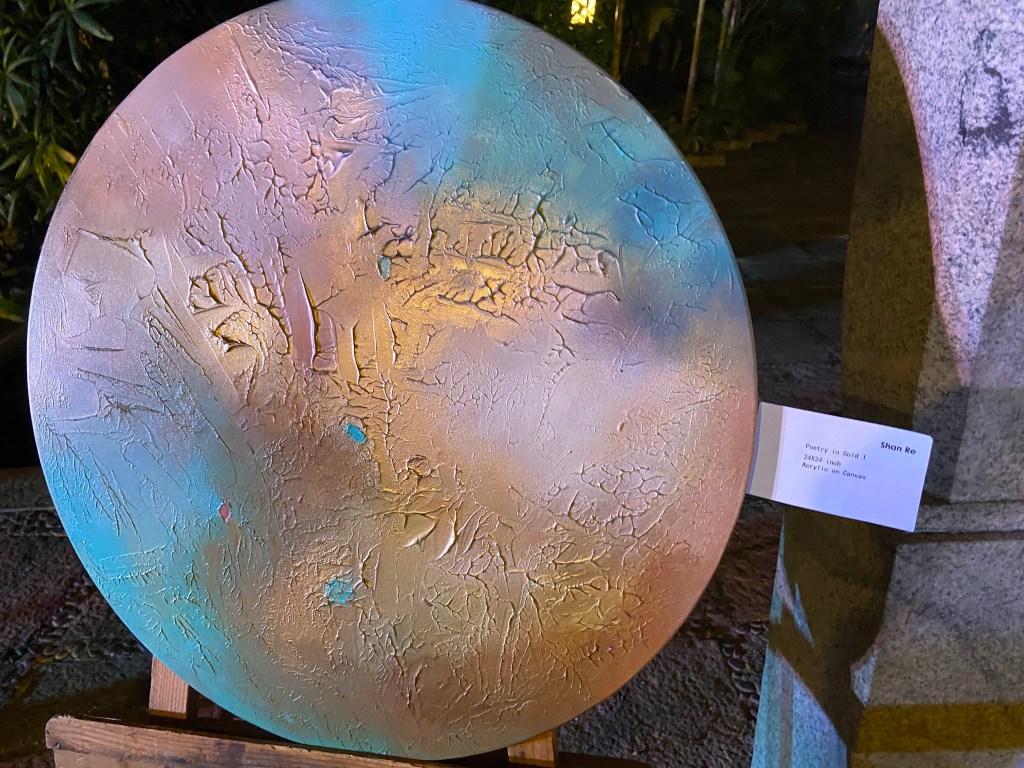
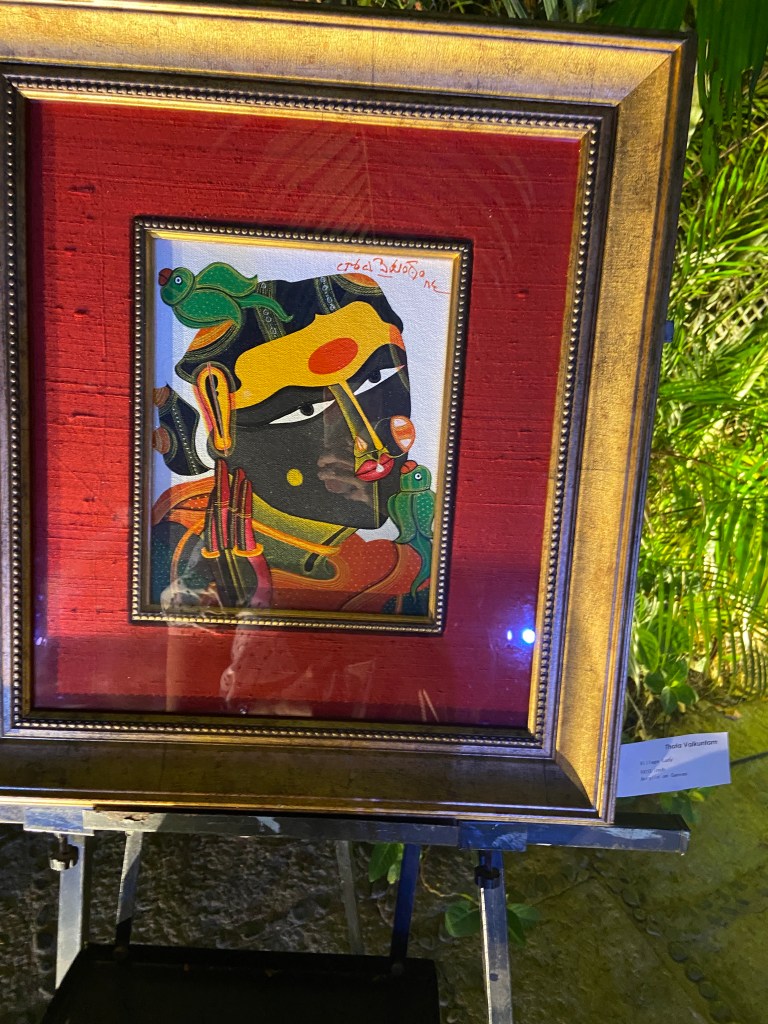
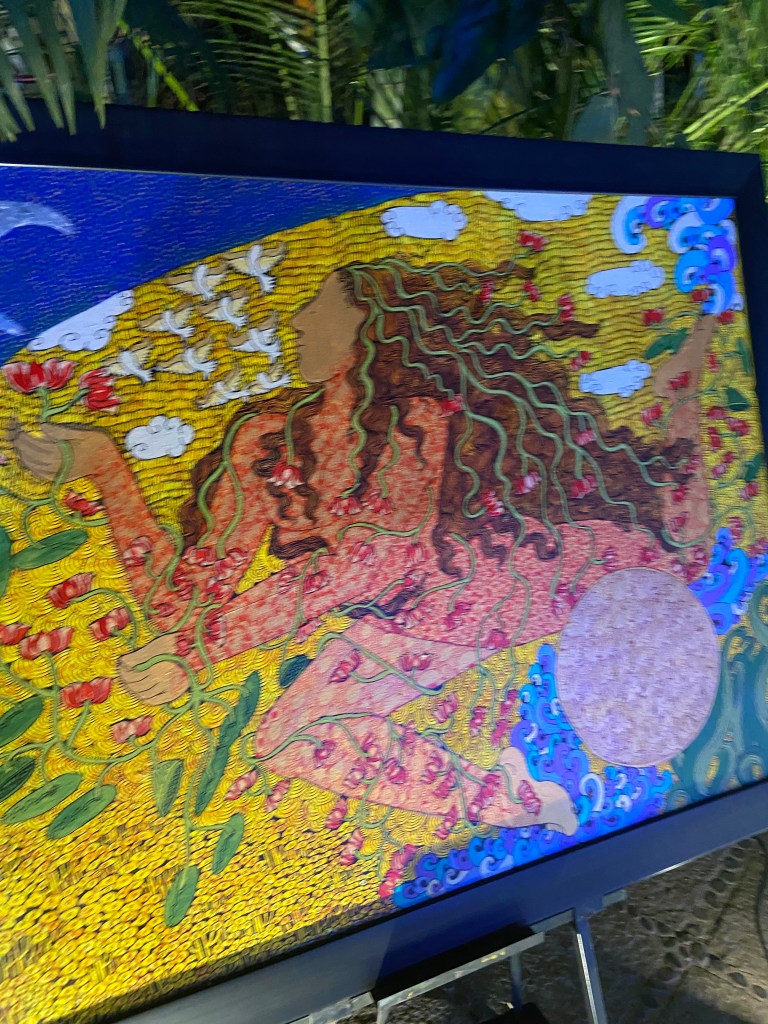
Curated by the Reves art gallery, in Bangalore, set in a delightful setting by the pool at Taj Westend, with a book in my hand, the evening was a picture of literally all of my favourite things. Here are a few of the works that caught my attention. Vaikuntam is evergreen ofcourse, but two pieces by Shan Re looked fabulous and one by a Seema Kholi. While buying art is an art, for sure, soaking in art too is an art, less exhausting though ofcourse.
Vaikuntam’sSeema Kholi’s
With turkeys and other fowl for company, Kamal Pant inaugurated the well curated exhibition and the IPS officer clearly defined the role of the artist as a indispensable part of a society. To create anything, to imagine the nonexistent requires courage and creativity by that definition definitely requires courage. And the way art provides a perspective encouraging one to pause and reflect if not experience a certain bliss, for the doer and the seeer is undoubtable.
So here’s cheers to art, may we see it, may we make it, may we live with it, in it, may we experience it and thus may our lives be a work of art!
Tucked away in the leafy bylanes of Basvanagudi, Svasa Homes plays home to this delightful abode, an apartment sprinkled with a aesthetic and a vibe that transports one to the best of India. It is incredible really, like the country it takes deep inspiration from. Peppered with Chettinad columns and adorned with beautiful paintings from Rajasthan, carpets for Kashmir, this home boasts of an even delectable sight, a view of Bangalore’s leafy and cultural Basvanagudi from the 15th floor.
The entrance foyer is arresting and commanding with a set of arm chairs and a huge painting that sets the tone of the house. Covered in a patina of shiny grey paint, the walls enclose a flooring of wood conveying a warm and cultural aura in the home. The Pooja area is a glorified niche kept minimal and in balance with a Tanjore painting and a lamp. The kitchen door is an antique carved door that is an art piece in itself. The kitchen is alarmingly modern but balances itself with Atangudi tiles on the floor and a caramelised hue all over it’s fixed cabinetry and the counter top.
The bedrooms are aesthetically pleasing with beds and furniture in wood, impeccably sourced from the various parts of the country. The walls again use art and craft paying a cultural ode to the country’s vast extents. Keeping the wardrobes modern and utilitarian is a genius stroke as the sliding doors keep within them all the functional necessities in a home while blending into the walls quite effortlessly. The masterbed with an independent study unit speaks volumes of the finesse in crafted bespoke furniture.
The dining are has a gravitas of it own in a home that exemplifies gravitas. With a stunning chandelier casting light over an even more exquisite carpet, while a mega-Tanjore painting looks down at the dining table itself. The bar unit is hidden well in an heritage armoire that opens up into an elaborately well-stocked bar. In this home that resembles a temple of South-India it is only apt to have a bird’s eye view of a zillion coconut trees of the Ramakrishna Math Ashram in Bangalore.
Curated with taste of the highest order, paying keen attention to showcasing the best of India, being a visual delight, keeping to the basics, glorifying the arts and crafts of India, allowing room to breathe with classic minimalism, bringing a new definition to luxury ethnic, setting the standards of home really high, this super gorgeous home is definitely a marker of all things beautiful, all things aspirational and all things drool worthy. It makes one proud of India, it makes one proud of being Indian and presents the best of the country minus the chaos. It is so beautiful and with all the art so cultural that it becomes effortlessly soulful. It is a temple of sorts to India, to the nature of beauty and is a harbinger of inner peace.
I could not but exclaim at this point that Truth is Beauty, and a beautiful home could just inspire a beautiful life.
2010 was a big year for me, a huge move across the Indian Ocean, the starting at a world-famous architecture firm that does smart projects across the globe with a work ethic like no other, but more importantly the granting of my architecture license by the Council of Architecture. It has been twelve years hence and as I renew my license this year, I feel tremendously hopeful of what the future has in store for me. The last twelve years, 144 full moons and a lot of learning in this vast and diverse field that constitutes the making of things, small and big, sometimes a handle and at other times a building. The best is yet to come, and I simply am super enthused about it.
Meanwhile here are brief samples of work that came my way in the last twelve years. There a many of course that haven’t made it in this video, but they are all dear to me, being a part of my journey, they and have played a huge role in what I am today and what I seek to be in the future. This year is truly special with all the work pouring in, diverse, challenging work that’s has me stepping up to newer and brighter avenues. It’s been long in the coming and the path has been winding so far, I sincerely hope that this path straightens up in the next twelve years.
Raring to go, beaming with a curious sense of design, clear in the head, hopeful in the heart, I continue my journey in the field of architecture, sometimes witnessing, sometimes drawing inspiration, sometimes happily inspiring, at other times keenly learning. Thank you all dear readers for reading, incidentally, this blog completes 11 years this year, I started it a year after attaining my professional license. Soon we will have an option of listening in, with a podcast and an aural reading of the blog articles starting now. So read on, listen in and have me design your home, workplace or precinct!
The iconic Secunderabad Club was established on the 26th day of April in 1878 and that makes it today about 144 years old. What a figure for a building! That number itself catapults it to the echelons of history, making it a part of the rich heritage of Hyderabad and in turn of the country. Though the present building or the anchor of buildings, began with a generous donation of Sir Salarjung Bahadur II, it stood the test of time, till now, surviving, playing host to various turns of events, morphing itself from a humble hunting lodge to a prestigious club with world-class facilities. From being called first the Secunderabad Public Rooms, to the Secunderabad Garrison Club, the Secunderabad Gymkhana Club, the United Services Club, before finally being named the Secunderabad Club it has donned several hats in its hundred year old history. Built then of massive wood-work, the club’s form boasted of cutting-edge construction techniques of those times, when massive building spans and heights were maintained through stone pillars and wooden trusses, supported my iron and steel before being finished off with stone slabs for the floor. Set in about 22 acres of lush greenery, the club also comprises of several structures in the compound serving as additional facilities added over time. The main hunting lodge remained ever since as the main colonnade topped by a ball room, fringed by a heritage billiards room, administrative offices and chambers for the club’s elected President.
History has it that this Club was formed by the British Army Garrisons that were stationed in Secunderabad under an agreement with the 3rd Nizam – Sikandar Jah. The Club was then known as Garrison Club. Over a period of 15 to 20 years the British presence in Hyderabad increased and the British brought in their civilian officers to look after the Nizam’s Railways, as well as the judicial system to administer the cantonment area. The Nizam also requisitioned the British Officers to help him set up the electrical, waterworks and various revenue reforms in the state. During the late 19th century, the name of Garrison Club was changed to United Services Club representing the membership from all parts of the services. The Club was no longer an army club and it served all the services represented by the British. As time went by, the officers later changed the name to Secunderabad Club since it was situated in Secunderabad. This name change coincided with the presentation by Salar Jung I who was the Prime Minister of Hyderabad State to the resident at that point of time of his hunting lodge. The club came to the current location on March 1903 growing into several structures across its extent.
It is an icon for several reasons, because of its excruciatingly exquisite history, because of its distinguished people, because of it’s progressive attitude, because of it’s exceptional facilities, because of it’s insightful insignia and mostly also because of the superlative stories it’s walls tell. Layered with the past and laced with the vagaries of the modern, the building that was once a simple hunting lodge festooned by man’s conquest in the wild, one that stored the past on its walls but has always been poised stoically in the present, at the same time raring to go forth into the future has been popular generation after generation, decade after decade and that my dear readers, is no mean feat. To remain timeless and faultless, embracing the need of every member, charming with the old wooden panelling or chiding with the pendulum of the clock, providing enough room for the celebration of every festival, be it the chaos of Holi or the joy of Christmas, or simply for allowing a drink or two under the gaze of a star-lit sky, it has shown what classic in architecture really is. I could regale you with stories of how my ninety-one year old grandfather and my four year old son relate to the club’s aura in their own capacity not to mention my sixty-something parents or my brother and me at half their age. I for one have fond memories of participating and winning (no wonder I said fond) several drawing and painting competitions that every child is subjected to, once winning by the choice of the very famous illustrator R K Laxman! There are some buildings that make one’s heart swell with pride, some buildings that make one’s heart feel safe and sound, some buildings are that encourage intelligent conversation, some buildings that in-still a sense of propriety, some buildings that make one feel royal, some buildings that install in one a sense of leisure, possibly deep relaxation, still other buildings that infuse a heart of joy, but this one, it does it all. Am sure there isn’t one soul who has seen this building in real and not felt the same, member or not. From setting me on a path of growth as a little impressionable girl and later as a young buoyant architect, this magnificent building always made me feel great, we never do forget how something makes us feel, do we? And today, out of the blue, the visuals of the iconic main building, one that survived, two World Wars, one Cold War and one non-violent struggle for independence, retrofitting over the years to fit the British sensibilities and then the Indians of free India, to see this masterpiece of a building on fire is shocking.
I feel shaken even now writing this, recollecting for myself what the building meant to me as a child. It obviously inspired awe, but also was a home away from home, it always felt like a safe haven, where we spent hours whiling away time or learning something new, always besotted with familiar faces, the colonnade, from where came incessant chatter or at times guffaws of laughter, where my father introduced me for the first time to the various types of alcohol by name, I never drank of course and have continued to be a happy teetotaller, where an odd old gentleman or two would fall asleep on generous plantation chairs, (I could never imagine such gay abandon in a seemingly busy place!) where we could in a mobile-less world, que up to call our parents on the landline to pick us up, later lapping up food as the colonnade served the club’s varied cuisine that is extremely singular to its space, why it was also the place where I gave my first magazine interview and being published! Though little did I know then of the travails of fame. Retrospection is always a side effect of nostalgia. 🙂 The main ball room, well that played canvas to my forays into acting, played host to several summer camps, and the terrace that adjoins it played backdrop to our childhood charades. The administrative chambers is where we’d go when we irresponsibly lost our club cards, the grand staircase is what took us there. At his point I must admit that I was always spooked by the animal heads, or rather the taxidermy mounts on the walls. It always is spooky no matter which part of the world and I wonder what makes one embalm such creatures (!), but then I would never hunt, so the conquests of the game is past me. The building on fire, gutted to the core, is another level of spooky altogether, or must I say how unimaginable it really is. My social media walls are full of stories paying tribute to the burnt out building, leaving so many broken hearts that it feels like a person has died, but then it only is a building, housing no one at the time of fire, costing no lives. As an architect I am certain that it can be rebuilt, even incorporating what the older one missed, read recent amenities. I always wondered how the club has a petrol station and no elevator, seems wondrous isn’t it. It comes at a cost though, I am told the damages to the club are worth over thirty-crores, but when we are looking into the future there is really no time to lament the past.
And this I say with utter confidence as while interning in 2008, I had the chance to work on a part of the building, thankfully untouched by the fire last night, under the able guidance of architect Yeshwant Ramamurthy of Studio One, approved by the then Works Committee Chairman of the club Mr Vijay Sree Ram, where we worked on the design of the Dining Hall and restored the facade of the dining room, stone block by stock block, and with that experience of restoration I am glad with the certainty that this is an accident that can be set right. Helmed by a very proficient President and a suitable committee, there really is no member who has not got a vested interest in the Club. Like a doting child, every member means well, and every brick in the wall says the same thing, a story of Agathism, it will all turn out well in the end. A short-circuit is what set the building abuzz, bit by bit, but eventually decimating every part of the superstructure, it is a very unfortunate event, an accident that would better off be not, but it is and whether we build it up exactly as it was or something different, build it we will. And that is the spirit of the Secunderabad Club, or call it by any another name, with all the name changes of the past, it doesn’t matter what we call it, it doesn’t matter what it looks like, those who have witnessed this piece of history will remember it fondly for eons to come, the next generation will see glimpses of it in the sketches that notable artists have made in the past, but the building itself? Well, like a Phoenix it shall rise, from the ashes, in that I implicitly trust.
And it burns on in our hearts, making us forever grateful for the memories. After all for all that we cannot see, we can feel.
Last weekend I had the pleasure of putting my hands and mind to a new style of acrylic art, minus the paint brushes and with an addition of a pouring medium. Fluid art has caught on a new flight along with alcohol ink art and resin art, all these three forms of art do away with the traditional notions of fine art that has always employed the use of a paint brush and been made on the premise of a pre-conceived solid idea of what should be finally accrued, challenging the traditional notions, these forms of fine art insist on the artist having a certain sense of detachment. It is but for all a necessity, for a fluid art artist. Of course there is a choice in terms of colour, the scale but the final art is allowed to emerge from the canvas as such.
The freedom from the paintbrush makes this form of art accessible to a greater populace, but that trend would certainly be reversed as some people are perfectionists and hence prefer a greater control over their art work. This art is the epitome of letting go, but yes, letting go soon, for the acrylic and the pouring medium will definitely dry up all too soon. That’s one oil painting that makes Oils all too superior. There is always that element of change possible over a stipulated time with oil paints, with acrylic change was never perfectly possible, but the pouring medium gives oscillation a chance for a very short duration. The act to going with the flow is essentially a great life skill to have and fluid act may we’ll help one practice that. On a more philosophical note, non-action with this medium produces an equally splendid/beautiful result as could an extremely deliberated final product. There is power, insight and strength in non-action (as opposed to inaction), going with the flow, a sense of detachment and acceptance. It is wonderful to know that whatever will be will be and it will be okay, just like whatever is is. Now that’s a bit too philosophical but in these times these are life lessons and fluid is then the new solid.
P.s. getting the paint off your fingers may well be an art form in itself!
I have for the longest time in my life been against alcohol anything, well until COVID came along and then had me all-embracing the humble iso-propyl alcohol. In high school chemistry I particularly aced organic chemistry and should have found my inkling then, but two decades later I have isopropyl alcohol on my desk again. This time not on the pages of my text book but on the pages called ‘yupo paper’ and it is setting my imagination on fire. The flow is uncontrollable it is largely subtly guided over a little directed air. While alcohol ink art is largely arbitrary and abstract there are ways to again guide the ink into a coherent picture. A landscape or a portrait perhaps, sometimes just a pretty flower all zoomed in. The layers provided by the transparent-ish paint with ample dabs of isopropyl alcohol give rise to a visual splendour. It is indeed a wonderful medium to work on elevations of buildings or particularly walls in interior spaces. Putting colours together is the first and the most important step in the whole process, and then the intelligent application of quantity versus everything else. While purple and pink are a great combination with a dash of gold, other wondrous colours combined to perfection include sunset orange, black and crimson red, an earthy brown with effluent turquoise tinged with an ochre yellow can remind one of an oasis in the desert, lovely marigold yellow teamed with zesty scarlet and speckled copper reminds one of celebrations galore.
As a more suggestive art, it hinges its tidings on impressionist art with a whole lot of surrealism imbibed in it. Beguiling and thrilling.
I am an architect, a building enthusiast, a connoisseur of fine spaces and at times fine books, and with this I have certainly struck gold by all accounts. Dan Cruickshank is a British Journalist and much like me an architectural aficionado, but with this particularly incredibly researched book he strikes a chord on many accounts. Even after finishing a five year degree in architecture and topping it with another year of Masters in the subject I had a lot to learn while reading this book, and the learning here as always was as organic as ever. The hundred buildings that Cruickshank chooses to document are extremely relevant, the descriptions of par excellence and the book had me look up many of the buildings for a lack of pictures. The few pictures that are included give a brief idea of what is being said, for the pictures in architecture make up about a million words.
Now apart from the very well known architecture in the world, there are the lesser known ones and even with the well-known architectural wonders there are facts that we don’t know about all of them. A few buildings that were documented and impressed upon me their brilliance are the Thorvaldsen Museum, it’s colours of the Mediterranean, look so splendid and much like the Dulwich Picture Gallery say volumes about the utilisation of colour, that too colour of character on the walls, with white or off-white on the ceiling, that adds so much depth and beauty to a space. The piece on The Fallingwater building in the United States is almost an ode to its most impulsive and brazen architect, who’s fame hung on the rocks just as precariously as this famous building. Frank Lloyd Wright’s arrogance and pride may just have served him very well architecturally as it did to cope with his unique set of situations in life. However brazen and bold, the Fallingwater and Wright have become icons of adoration. With The Hanging Temple in China Cruickshank gives an insight into a very different kind of religion, Taoism, one that does have slight inclinations towards the greater abstract philosophy of Hinduism and its patriot Buddhism with a tad bit of non-doing and simply being added to the mix of an ideology based on Simplicity, honesty and compassion, just like the Hanging temple that is rooted in the mountain base. The Taj Mahal in India, built by the Mughal Emperor Shah Jahan is a visual treat but lesser known facts about it are the sounds that it’s architecture generates making use of the wind by letting the wind in through its many jaalis and swirling it into its onion-shaped dome, swirling and sobbing as the day goes, eternally epitomising Shah Jahan’s grief.
And then there is the Sagrafa Famila, one that unsettled me immensely from the outside but provided to me a warm embrace in the sun-kissed and sun-lit interiors. Inside I felt like I was in heaven and the murals on the facade? Well those were clearly hell, I couldn’t make sense of it, finding so much more peace in Park Guell, but when Cruickshank writes about this wondrous structure by Gaudi, he analyses it for me and that analysis finally provided me some peace. The spontaneous, unplanned and irrational aspect of Sagrada Familia though is perfectly laudable. He also says that this ode to God and place of worship celebrates architecture as an organic art and buildings as children of the imagination. Conceived to be a place of atonement and spiritual healing, it has turned out to be an act of penitence. Of the Sydney Opera House he writes that the building in a sense reinvents Modernism, evolving it from a box-like primary functionalism to something more humane, emotive, sinuous and artistically rich, it is no doubt a great symbol of beauty and a compelling symbol for not only a city but a whole country and continent.
And then there is information that one would not have known even visiting these marvellous pieces of architecture. For example, of the Great Wall of China, it took 10 years and 30000 men to build this wall, that has the bodies of thousands – dead of exhaustion, or sacrifices – mixed into the brick clay and mortar. As much as mortified I am by this information, the arguably longest graveyard in the world is still known by many Chinese people as the ‘Wall of Tears’. But it’s power is undeniable, following ridges, climbing and tumbling, it snakes through the landscape like a great work of nature rather than of man. The miraculous Forbidden City he writes, maintains and retains its tranquility, poise and harmony as if it really were a little piece of heaven on earth. The Church of Transfiguration in Kizhi, Russia is particularly spell-binding as is the Catherine Palace. Russia is an enigma, certainly the home to the most beautiful city in the world, St Petersburg, but it also is home to architecture that is excessively unique. If architecture is a mark of civilisation, then the Russian civilisation is exquisite. Colour is often employed as a crucial means to bring a sense of Mediterranean exuberance and gaiety to a place or space.
A wonderful read for the knowledgeable, and the architects of course! And a mini-trip around the world, from the confines of one’s home in a quarantined world.
The 17th Venice Biennale’s Architectural division asks that very question and countries across the globe with a pavilion playing ode to each of their countries tries to answer that very question within the climes of architecture. The question remains a pertinent one considering the pandemic situation across the globe and every country tries to answer that very question very appropriately. The German pavilion for one has no material except for QR scan codes pasted on the walls making the point of digitation and physical absence abundantly clear. There is nothing that leaves the indelible mark of the pandemic absent from out lives and from the biennale. As we spend more time locked down in our homes, architecture has emerged an important aspect, a key discipline in the global corona virus response.
The curator perhaps meant how will we like together, with each other, in such close proximity, within the confines of our humble homes, that have doubled up, lets say more rightly tripled and also quadrupled up into work places, entertainment spaces, leisure spaces and fitness spaces, serving multiple roles, living through minus the public space, the breathing spaces in the cities, within close quarters at times quarantined. To me the question sounds more like how will we live together with the virus? Just like we live through umpteen viruses that we are accustomed to or even immune to? Vaccination is the answer, for sure, a shot of immunity, that will keep us away from the clutches of mortality or through the domains of architecture do we like all the past civilisations aim for immortality through architecture, through our environs, more specifically our built environs.
As homes begin to be remodelled will it suffice to say that it certainly is time for workspaces to be remodelled as well to allow for living with the virus, without causing us harm. There is more to understand of COVID-19 as the world continues to battle wave after wave. All the vaccinations developed in the world are disease-modifying and serve no purpose in disease-breaking or battling nature, something that provides more cues than ever of the fact that we will have to live with this, together and beat it in a very different way. Even when the government asks us to be masked within the confines of our homes, we are positioned to be aware of the nature of the virus where we are all by ourselves, and have to be self-sufficient just like our homes or workplaces. If its in the air, then well, filters are the need of the hour, if its in the water then again filters are the need of the hour, but even with filtering in the world that we perceive, the inner environment needs to certainly be ready to win over the virus without battling with it.
Then what would make sense? Living in pods aka the astronaut costumes that are donned in space? Or in one acre homes like what Jane Jacobs advocated at one point of time, where we grow our own vegetables and live totally oblivious to our surroundings? Or do we work on our immune systems to disengage the virus should it attend to us? Like the yogis disappear into the mountains away from the humdrum of daily lives? Build our world within worlds and as we distance ourselves from each other physically, get closer than ever in the confines of our digital spaces? And in these digital times, vacation meaning getting off social media for a while, that could probably be the only vacation we take during these times! Living together, takes on whole new meanings, living together could also mean fusing back into a community if we have been on our own depending on the nature of need, of our loved ones, of our requirements and everything else.
However we may choose to live together, it has to be with a degree of tolerance, more than any other tolerance, with immune tolerance to the virus. Till then, we need to maintain what every healthcare personal advices us to. My favorites from the pavilions this year were the Japanese pavilion, paying heed to materiality in construction, building with materials that are nimble, quick-footed and light, easily changeable, making it abundantly clear that when the time strikes living together may mean change, the German pavilion that starkly pays heed to the growing digital importance in the world where physical closeness is shunned and the British pavilion with fine metal work in gorgeous colors and fine craftsmanship put together in arty shapes and modules than gives an insight into how solitude in nature is not loneliness for nature is a great company and a pretty thing too!
P.s. For more information on the Venice Biennale that runs all the way till November this year check out the following link.
Now, here comes an Oscar-nominated and winning in one category, that of the best supporting actress, which deserves a watch for sure.
Minari is so sweet, so subtle and so quaint. The Koreans have taken the digital world by storm and in effect the world at large, but this movie that highlights the ties of life, the need for ambition, for hard work and for insight so clearly touches upon so many aspects of life. The relationship between the grandmother and the grandson is touching to watch while the house is so frail looking yet stronger as much as needed, the father and his belief in having a better life is heart-wrenching as much as the fire that proverbially destroys it all. But fluttering in the wind, an embodiment of change, twinkling amongst the sunlight, the Minari comes like a ray of hope. Recently I’ve been reading about the concept of Wu Wei, or that of effortless action, a little more lengthily explained, the nature of setting life’s sails to the winds of chi, working with life to get on, get by, to look for what works and aligning oneself to it. That’s exactly what the Grandma does, planting Minari seeds in an apt location such that it needs no manual or in other words forced tending to, no irrigation, no supervision but gently is tended to by nature. By finding a suitable location for dispersing the seeds, Grandma manages to save the say with her action of non-doing. While of course the ideal remains to use chi to the best of one’s ability and for all things, even a brush of using chi or life’s energy to one’s advantage may we’ll be enough.
The visuals of the movie as extremely delightful, the acting great, but the little boy steals the day with his boyish charms and quick-wit. While judging the Grandma for not knowing how to cook or bake cookies and teaching the kids what seems to be Mah-jong, the boy makes his own rapport with the free-spirited woman. She won the Oscar for her acting which I must say was very well deserved. When she bows down to the Minari, returning the gesture that she says the Minari are doing, she makes you smile at her utter alignment with the winds of life. Brushing aside all criticism from the children she even dismisses and smiles when the boy displays his wit when being punished. Far away from her native land, her mannerisms highlight the differences in culture and in being, but gently show us how connected life really is. The Minari leaf known and grown in Korean culture can actually be grown anywhere with similar climatic conditions of course. The fire makes one ache for the family but when life triumphs one truly realises that making much ado about nothing is not a great thing. A lesson in non-doing, a lesson in Wu Wei, a lesson in slow-living, a lesson in not giving up, Minari has a dozen or so tales to tell, if only one is listening.
In fashion there are fads, in architecture there are trends, in life there is both, fashion and architecture and ofcourse fads and trends. While one cannot really pay much attention to fads or trends, one cannot ignore fashion or architecture. It’s been a while since Van de Rohe proclaimed that, “Less is More”, an adage that has found it’s application in a bunch of things across the world, in unlikely disciplines, say literature or waste management, meditation or even in conversations, for the wise often said, “least said, soonest mended”. Now thats a one for the road or even another post. But this is the age for Minimalism, not Brutal Minimalism lest we are mentally afflicted with the cause of nothingness, but instead Clinical Minimalism. In an age of COVID, lesser surfaces means lesser space for the virus to land on and lesser chances for it to thrive. But minimalism has got to be kept clinical, and my clinical I mean that we are all patients, prospective or retrospective, and all attention needs to be made to make sure we are well observed very efficient and very detached, being all at once practical and clear. And clinical also in the sense of being with a scientific bent of mind. There is little that we can do, and that little has to be done with clinical precision. As I tuck away unnecessary material possessions, a friend chopped of her hair, for the ease of maintenance during these times, am reducing the number of surfaces thereby clutter and embracing this age of clinical minimalism.
There is little that we humans need to live, oxygen being the number one on the list, but of course there are others, to maintain our sanity and to keep ourselves predominantly human. In our quest to be safe and stay protected may we not lose the one thing that makes us human, our empathy for fellow human beings. It is a pity when one exhibits such clinical precision in cutting one off, sets up boundaries, only to keep oneself safe, demonstrating no sense of humanity, or even a sense of empathy for fellow human beings. Pristine castles are built with absolutely no warmth and are perfectly cold and detached havens for such beings, who perhaps will not be affected by COVID, let alone any other virus, but such people then are building castles devoid of warmth, devoid of any feelings. They are the clinical materialists, the opportunists who manage to live, and be largely unaffected by the lives of the others. Let us then clinically purge such people, embracing minimalism in the truest sense of the word. In a fear of turning Positive, may we not forget how to indeed be positive, optimistic rather than opportunists.
There are homes, that are losing members, cities that are losing citizens and countries that are losing people. As architecture, stands tall, it can shelter us from the elements and perhaps from the virus, if only we let in ample ventilation and make use of cleaning products to wipe out this vicious virus. It may just have shown us the viciousness that thrives in the world, but then we have our forts, built on land to tide us through this storm that has come unannounced. Our homes, are our havens. They have always been, but even more now. And in these homes its time we embrace a clinical attitude to minimalism, and as we take away things that we deem inessential, may we not purge human values, that make us human. Caring for the world at large but caring for those who we can protect by the resources that we have. For what use is material possessions that are in place instead of a beating heart, and when COVID is gone, may it show us how to thrive in spite of all odds, showing us how fruit full less can really be, especially when it is coupled with science and make with deliberate observations. As the construction industry grinds to a halt, let our imagination still soar, dream and manifest a life that thrives beyond all odds.
For the average 90s kid, Kashmir, meant unrest, a slew of news revolving around the militants and the military, peppered by geography lessons of the Himalayas, the Pir Panjal range, the cultural aspects of the beautiful people, succulent apple orchards, salubrious summers, picturesque winters comprising of pherans and kangdis, political unrest followed by a hard-won Kargil war at the end of the decade. And I happen to be one of those average 90’s kid, growing up far away from Kashmir, who’s tales came to be either from school text books or newspaper headlines in the 90s. Kashmir – Paradise on Earth seemed to me to be simply a tourist jargon cause nothing that was told to be or shown to me about this Indian erstwhile Princely state seemed paradise-ish to me. The only connection that stood out to me, was it’s similarity with the erstwhile Princely state of Hyderabad that I was born in’s reluctance to be a part of the Indian Republic. The special status that was awarded to Jammu and Kashmir state was not awarded to Hyderabad, the Nizam crumbled under the invasion led by Sardar Patel while Ranjit Singh, the Maharaja of the Kashmir state signed a treaty. A treaty which gave the state special status right upto 2019, which then changed it’s status to a Union Territory of this Country. What also changed from my learning days at school to the time that I actually set foot in the erstwhile special state is the mark of it’s territory. The head of India which I would draw proudly in my Geography test maps is now severely cut off, with a third of it called Gilgit Baluchistan, and another hurtfully titled parcel of China-occupied-Kashmir. Completely lost in the tidings of my own life, some historical tidings went amiss from my radar, and catching it while my plane began taxiing on the runway ready for take-off left me on a 2 hour flight to Delhi with an avalanche of questions on my head.
After my transit, again in the hands of Wikipedia, I was aghast at everything that has happened throughout history specifically things that pertain to the Kashmir valley and India’s northern borders. Not only was I shocked that my five years of architecture study in Delhi did not take me to Kashmir, I was surprised how the most beautiful city, aptly titled, Srinagar, was just over an hour’s flight away from Delhi. The snow-covered views of the Pir Panjal first come into view as the plane begins to enter into the Kashmir valley and in winter, during the Chillai Kalan period it is a wondrous sight to behold. Just like landing in Leh over the Zanskar Range, this view of the Pir Panjal is spell-binding. As we landed on a trusted Indigo aircraft into the defence airport of Srinagar, one cant help but feel a flutter in the heart, the snow is spectacular, covering fields, pine trees, slanted rooftops of houses, stationary cars, roads, even garbage dumps and all earth alike, leaving no discrimination in sight! The COVID test to be taken upon landing too, well traveling in 2021 has some cons, cons that will upset the nasal passage and cause a sneeze or two, does not discriminate and once all set only can one set foot in this state. As a flurry of taxi-drivers begin haggling we found our trusted hotel driver and happily checked into our hotel set on a hill in the middle of the city. The best views awaited us and it was extremely wonderful to be in this magical city that has more army that residents, residents who look as peaceful and seem as friendly as ever. After getting over the sheer sights on the everyday including a quaint wooden bridge called the Zero Point bridge and a meal at the House of Habibi, the young-blooded people all over the world are not very different I surmised(!), we embarked upon our first touristy appointment in the city to the very popular and synonymous to the city, the Dal Lake. This expansive lake, host to many Bollywood songs and stories is incredible with houseboats and a frozen upper layer. The season one visits the Kashmir Valley is crucial as the colors of the season could be vividly different, our Gondola rower, told us a hindi catchphrase, “Mumbai ka fashion aur Kashmir ka Mausam, badalte rehta hain”, at the risk of losing its gist in translation, here goes, “The fashion of Mumbai and the weather of Kashmir can never be trusted as they keep changing!”. Visiting in the 40-day period of Chillai Kalan, we were in for a white winter-wonderland, a totally white Kashmir and it seemed very chilling, but very beautiful. Holding on to the Kangdi we sat in the gondola, pestered heavily by hawkers rowing next to us in their own boats and asking us buy their wares, that ranged from woodwork, to kahwa, to walnut cookies, to pherans and more. We did indulge them, taking the very popular pictures wearing the pheran and happily posing with the Kashmiri jewelry, flowers, lapping up warm Kahmiri Kahwa, and buying out a pheran. It felt like we were boosting the tourism economy of the country. So much so when the grumpy husband was asked what he wanted by the hawkers, he replied, “Shanti chahiye”, meaning peace! But then when they stopped bothering us to buy, we actually enjoyed the sounds of the lake, the breaking of the five centimetre frozen top, the sounds of water falling onto the lake and all the beauty that it entails. Though the lake is fraught by extensively commercials, the surrounds of the Himalayas, the quietness of the lake, the mirror that it is of the city that it is a part of is amazing. An experience of a lifetime, is a boat-ride in the Dal lake in Srinagar, its so surreal that nothing else compares, or so I thought till we went to our next destination, the Shankaracharya temple in Srinagar. The ride up to the temple itself was a prelude of what lay ahead, by more stellar than ever is the view from the top, from the main sanctum of the temple. The view exceeds all expectations, it is so breathtakingly beautiful that after my darshan when I stepped out I was taken aback and sucked in my breath cause the view literally took away my breath, the mighty Jhelum, the snow-capped mountains and the snow-capped buildings set about a visual orchestra that is very stunning to say the least. A pity, for that moment could only be captured in the canvas of our memories, as cameras or phones are not allowed in the temple precincts, but it is true when someone once told me that the best memories can never be captured in a photo, most often while we are living the best moments, it never occurs to us to document them! But then, that view is remarkable and one that will be cherished as one of the moments of my life, that took my breath away, in this month, on that day, with that weather, it could not have been more magical or mystical at all. For after that tryst with a divine location on this planet, I was so touched by the beauty of creation, that I had to spend several moments in introspection. Our next stop in Srinagar was the Chashma Shahi garden, a Mughal garden, that boasts of beautiful gardens inundated by ingenious water channels. With the flowers absent, we were treated instead to warm water in the middle of winter hosted by the warmth of the earth. From Chashma Shahi we headed to the Taj Vivanta for its warm hospitality and it’s spectacular views, joined by our new Kashmiri friend, the views were indeed brilliant but not a patch on what we saw atop the Shankaracharya hill, but beautiful enough to magnanimously allow for the carrying of a camera and a deluge of pictures. Again stopping by at a wannabe New Yorker cafe, 14th Avenue, we buried our day in desserts ranging from Oreo Cheesecake to Chocolate Eclair and a Walnut pie, globalisation is literally flattening the earth, culture of the new youngsters including us, is limited to what we like best, in that cafe, we could have been in any city in the world, Paris, New York or London even. And every single person there was upset with the lack of 4G services in the valley but were more than happy to latch on to the free WiFi. A stark contrast we felt when we then later headed to the local market of Laal Chowk in the city. The architectural fabric of Laal Chowk though made in wood strongly resembled the alleys of Jaisalmer, Purani Delhi or even the old city of Hyderabad, with shops on the ground floor and upper floors used for residential purposes. Perhaps though we extol the differences in culture across the world, the essence was always daintily similar.
Not in continum, but in Srinagar we also went to the Hazratbal shrine, the Jama Masjid, the Laal Chowk again for Ahdoos and the Gulshan Book stores, saw a traditional Kashmiri house and walked across half the city, or perhaps a fraction cause Srinagar against our old belief in actual is a rather large city, spanning about 300 square kilometres and homing a population of about 1 million people. The metropolitan area of Srinagar spans an area of about 800 square kilometres. The Hazratbal Shrine, offered no entry to the main quarters for women, so while I walked around enjoying views but not the cold, on the shore of the Dal Lake, the temperature in the locales of the Hazratbal shrine was rather extremely frigid and for the only time on the whole trip I was close to tears because of the cold. The Husband however was given a tour of the shrine and the mortal remains of the Prophet in terms of a strand of hair. Sufficiently warm and impressed by the shrine, he had the energy to take beautiful pictures, while I just wanted out, I mean in to a warm location where the cold could be firmly escaped! The story of the Hazratbal shrine entwines the Mughal Emperor Aurangzeb, a Kashmiri Businessman and a noble man from Hyderabad. The shrine however is very grand and beautiful with the white stone dome rising over the shore of the pristine lake. The beauty is real and I witnessed fervent devotees praying to their Lord with extremely happy and devoted faces. Prayers seem to be closely answered in this particular shrine! Our next stop Jamia Masjid was no less delightful, not exactly following the Islamic architectural styles, this Masjid is built with the Kashmiri style of architecture that comprises of steeper trusses and a sloped roof rather than the circular domes. The square layout of the mosque, with alleyways for prayer is full of sharp corners and exquisite wood work that offers a prayer space for about 33,333 people. Incidentally this is the first mosque that I had ever entered in real time, having watched the architecture of the Jama Masjid in New Delhi virtually. The mosque is fringed by shops on all its four sides, that sell daily household items, clothes, sweaters, the community feel during daily or weekly prayers offer social interactions and may well be the fabric of the community. After imbibing the cultural aspects of Srinagar, we moved on to immerse ourselves in more intellectual pursuits as we stopped by Gulshan Bookstores, a very old and respected book store in the country, who twin with stores like Bahri & Sons in Delhi, Blossoms in Bangalore or Higginbothams in Chennai, the only other feather in the cap of the Gulshan bookstores is their entrepreneurial visions in publishing. When I stepped in to look for some Kashmir-based reads, the store had a gallon or so of books in choice. Unable to choose, we spent over two hours reading parts of books, and finally choosing one for the road, the rest had to be on the Kindle, such is the power of lightness! More about the book recommendations in my following posts, for now the incredible variety at Gulshan bookstores was amazing. The owner of the bookstore asked if his store should be shared on my Instagram page and then I began to only understand the powerful influence of social media, it is very powerful, and can mean a lot to everyone in the world, when used rightly. If a picture speaks a thousand words, then well, Instagram has quite nailed it. It is certainly making less readers out of us, but is keeping us forever glued to the screen and filling our heads with all that we ought to or not ought to know. I picked the Saga of Sativar to read, a book written by Chandrakant and translated from Hindi. Mostly I chose that to understand how Srinagar once functioned, extremely secularly and how the paths of the Hindus, the muslims and all other communities enmeshed with each other, becoming incongruous as ever. The other books I have gotten on the Kindle include a racy read called Kashmir-nama, Return to Jammu, Paradise at War and The Tree with a Thousand Apples. More on them, in a bit! Hungry with all that mental stimulation we strode across the road to the best place for Wazwan food, Ahdoos, much like Hyderabad’s very own Paradise, on the ground floor of the family-owned, award-winning, old restaurant is the Ahdoos Patiserrie, who’s walnut cake was to die for, walnuts are a staple in Kashmir like all the other dry-fruits and for the first-time ever it took away the prima-donna space that chocolate had in our lives, just as the Kashmiri Kahwa dethroned hot-chocolate in our heads. The meal at Ahdoos was very satisfying, and for a vegetarian in Kashmir, wanting to live on Wazwan food, one would have to live on Kashmiri Pulau fraught with raisins, paneer in a tomato gravy, Butt haqq made of collard greens cooked with a hint of garlic and Nadru Yakhni, a lotus stem gravy cooked to perfection, apart from the breads of Girda and the like. Needless to say though we were spoilt for choice with Vaisho-dhabas, serving excellent north indian food, I tended to gravitate to the Wazwan cuisine and ate all the paneer that I must have eaten in my life so far in just one week of being in Kashmir! Srinagar also shows us the real numbers in our Indian army, though Cantonment was a neighbour for me all my life, in Kashmir, the army is everywhere, and thankfully so, for if they weren’t we may have needed passports to go to Kashmir! While walking about the market place of laal Chowk we saw several graffitti markers that said loudly and clearly, “India go back”! The people of Kashmir still seem to be divided upon the political situation in the state. The Badami Bagh cantonment that we tried to pass seemed never ending, while the army headquarters on a hill, whose name I could not learn, served as the north pole star ever where we went in Srinagar, the hill with its line of lights guided us back to our hotel that stood on a slightly smaller hill opposite the United Nations headquarters. All the building in the UN with their sloped roofs were marked to establish their identity, perhaps during an air-raid to warn of their neutrality. That felt scary, for sure. As did the multitude of army men with their guns parading the streets or setting up points at every junction. The locals though seemed unfazed as they went about their business, merrily and happily.
Our next destinations were out of the city and need I mention out of the world!
Our journey to Pahalgam was as beautiful as the destination as we covered fields of snow and snow-sprinkled chinar trees but mostly we stopped on the highway to let a large number of army trucks pass, a trend we later observed in Gulmarg too. Army-watchdogs checked the area before the contingent passed but army soldiers religiously manned the highway continuously. Pahalgam, usually referred to as the ‘Valley of Shepherds’ offers sceneries that are stunning and out of the world. And to see this scenery in winter is a lot of hard work, possible only accessed by horseback. While there are many spots that one can see, the whole ride comprising of about seven scenic spots include the Damo valley, the Kashmir valley, the Lidder River, Baisaran or mini Switzerland, the Pahalgam Valley, the Shepherd’s village, stopping by for the warm Kahwa or the even warmer maggi noodles, a very popular food that is melting all cultural norms and uniting the various ranges of the Himalayas or very much the entire country! The over four-hour horse ride, is strenuous but the views are so captivating that the minutes morph into one another and one completely loses track of time. In Kashmir, in these remote valleys, we stopped by to eat and drink the said Kahwa and Maggi, while the locals helped us take fabulous pictures, they all seemed to know the right angles and the right lighting, and mistook me for being a German or an Italian, while I felt flattered, I was amazed at their geographical and cultural knowledge, courtesy the tourists who come to visit them over time. Witnessing so much plush white snow my heart set aflutter, singing happy melodious tunes while all the cares and worries of the world sublimed into non-existence. The cold air forces one to breathe slowly and that itself is a great relaxant, relaxing is the best condition to live one’s life in, nothing much may be accomplished but then what if it all aint. Seeing so much white snow, feels indelibly peaceful and while being at peace one is definitely happy, the snow accomplishes much in that sense bestowing happiness aplenty. Our horses, Raja and Sheru, trudged on the precarious path, slipping, falling with us on them at times but they never did disappoint and we were not hurt. My Grandfather who had gone to Kashmir about 50 years ago, reminiscenced with me all the paths he took then and nothing seemed to have changed in the last 50 years! Pahalgam is also the starting point of the Amarnath yatra, so the whole town serves as the starting point for the yatris with accommodation and paths marked clearly as to where the yatris can set up base before embarking on the Amarnath Yatra. The Heevan retreat hotel on the bank of the Lidder though is certainly the highlight of the town, the flowing water frozen on the sides, provides a stunning view, while the sounds of water provides a symphony of alacrity. The hotel itself is old, charismatic, made of wood with heating and kahwa, a sure comfort for sore limbs and reddened faces! On popular recommendations though we stopped for lunch at Dana Paani, having waited for a cool forty-five minutes outside, to get a table, this Dhaba, again a Vaishno Dhaba, served us fantastic food that was piping hot and desirously fresh making the day at the wait totally worth it. The day out in Pahalgam left us yearning for more and though we had planned only a day trip we could have done better to stay over in this beautiful hill-town, seeing both sunrise and sunset. The drive back to Srinagar, again picturesque is home to several walnut farms and the farms we did visit. Dry-fruits, a pride of Kashmir are found a plenty and stopping by at Noor Mohammad’s dry fruits one can pick the choicest walnuts, mamra almonds, cranberries, blueberries, figs, dried apples and a host of other palatable dry fruits. Saffron, of course, is the highlight in these shops and are sold, fresh and pure with no adulteration. With the oncoming of commercial viability, people often sell their wares across the country, delivered by the umpteen delivery platforms that have only gained in strength over lockdowns and other factors of convenience. The trip to Pahalgam in the middle of winter offered an opportunity to witness the Himalayas covered in snow and a vista of white that is inspiring and salubrious. As the sun burnt our noses and turned them black we were enthralled with the beauty of the drive.
Gulmarg, on the other hand and on the other side directionally from Srinagar, is quite different from Pahalgam due to its geographical location. The valley of flowers, that it’s name literally translates to is not so much pastoral like the latter, but is bountiful in its produce of flowers and fruits. Tulips that are grown aplenty by the state horticultural department dot the city of Srinagar, but in Gulmarg the flowers are in full bloom in spring and summer. In winter though Gulmarg is extremely popular for the array of winter sports, in being the skiing capital of the country, Gulmarg offers splendid slopes across different ranges of the Pir Panjal mountain. The baby slopes, the intermediate slopes are ideal for learning how to ski. The baby slopes and intermediate slopes are in the summer a part of Gulmarg’s extensive golf course. There is nothing in the world like Gulmarg, expecially in winter, while we were welcomed by the sun on Day 1, Day 2 and 3 were magical with snow falling lightly and magically over two days of our stay there. Gulmarg has brilliant properties, the Khyber being the most popular and large, with a spa by L’Occitainne, a heated swimming pool and surrounded by pine trees all around its precincts, the Highlands Hotel right next to the intermediate slopes though is beautiful in it’s old-world charm, is quite scattered in its form across the slope, the Needos Hotel located a little far away is extremely quaint and to reach the doors of this hotel we had to literally wade through about six feet of snow. The Shaw Inn though a perfect ski-lodge is boutique with excellent food and even more courteous footmen manning the estate. A town primarily for tourists, Gulmarg offers a plethora of options for the adventurous spirited. With warm conversations and infections ski-suggestions by our fellow tourists we were inspired to make acquaintance with a fellow freelancing architect who has been in the industry for about twenty odd years, freelancing across continents and steering clear of any desk chained job. Having finished a house in Udaipur he headed to Gulmarg to cool off his heels with some time on the mountain. There is I gathered so much science to ski-ing, there is firstly the weather, then there are the anthropometric projections, then the fitness aspect and finally a mix of bravery before being allowed to harness the power of gravity required to sped down the slope. Food like ammunition comes in the form of omlettes with one’s choice of maida poison – bread or maggi and Kahwa in water or in milk. The country needless to say guzzles on maggi in the snowy environs, but chocolate too is not far behind. This is the humble lunch that is offered in the middle of the learners ski slopes. But with an agenda on learning to ski, food is the last thing on our minds. Several ski schools are also around to teach people how to ski and one can spend two, three or four weeks learning this brilliant sport, which I cannot believe I have never had the chance to learn. Is it like skating? Is it like swimming I am often asked about skiiing, it is like both of them but a lot more thrilling I say, cause then one adds gravity to the mix and then it becomes a very adrenalin-boosting exercise. While having been terrifically inclined to learn the act of ski-ing I did bide my time and waited for an opportunity for over ten years of my life, ten years since I first saw skiers skiing down the slopes of the Alps in 2011. During that vacation, I did partake in many other snow sports including snow-boarding and tubing, ski-ing happened to me ten years later in 2011 and am sure glad that it did. Spending the first day on the baby slope, the second on the intermediate slopes and the third on the Phase 1 mountain of Gulmarg, I for one felt extremely accomplished by the end of the mountain in Gulmarg, but encountered a knee strain as I skid, oops ski-ed down the Phase 1 slope on Day 3. The day began with a ride up the gondola where the morning was very cold and foggy and we could hardly see to a distance of eleven metres from the top of Phase 1. As the day progressed the sun moved out of the clouds and by the time I commenced my descent down the ski slope a lot was visible in the distance. Ski-ing down the ski slope was the best feeling ever and as I did my turns masterfully, I did have a couple of falls, but nothing that was too painful. Upon reaching the end of the phase 1 slope, and literally doing a little victory dance in my head, I managed to somehow slip on a more flat section of the hill and in a twist of fate or of luck, managed to hurtfully strain my knee. The sharp pain lasted for about a few minutes, but then the hesitation crept up and after my knee buckled a time I had to bid adieu to Phase 1 for a bit. Completing a few other momentous ski-time in the flatter ski-section it was time to say good-bye to Gulmarg after an extravagant Wazwan lunch at Needous. Now exactly two weeks since the day of my fall in Gulmarg, I feel completely recovered from the knee strain, in between also straining my back lifting my three year old son, will I do all of it again? And my head answers with a resounding yes!!! Just like the scuba-diving accident in Maldives, this ski-accident was also completely unnecessary. I would attribute it to a bad case of buri nazar, or the evil eye, and am convinced that for my next vacation and probably for life, I’d like to get into what they call the ski-shape. My mother-in-law said its not about being thin, its about being agile, my grandfather said one muscle injured and all the others suffer, for while one rests the others feel the brunt of inactivity. To live life well, one must have an optimally healthy body, now that piece of wisdom comes from a very wise book that I have been reading over the last couple of weeks – the Autobiography of a Yogi. The importance of breath is extolled in this book as is the need for having a healthy body, mind and spirit in order to navigate the sometimes cool and the sometimes agitated waters of life. My fitness goals after this specific ski trip have begun to take form and the belief that everything broken can be fixed, will be fixed, its all a matter of time. This came to me from the mind of a Kashmiri local in Gulmarg, a amateurish-pro of the ski-ing slopes, who has seen a lot happen on these mountains. What you pay attention to in your life, grows, now that comes in the very first few lines of the current book I am reading called Dhando. While I go figure on what to do with my body, mind and spirit, life will always take a turn for me, one that lasted BK and now thats happening AK. You guessed it right, Before Kashmir and After Kashmir, and while I am certainly hesitant to share my travels on the interlude of social media, read Instagram, it was fun to share, but not a lot of good things happened out of it, and have been asked to stop tempting the effects of Buri Nazar, I can imagine my Husband rolling his eyes as I type this. But that apart, getting off social media, sugar and oily food is the next challenge, dodging the bullets of the evil eyes and possibly getting into ski-shape. As dry-fuits have begun trumping my love for chocolate and the kashmiri Kahwa has firmly dethroned hot chocolate, there is hope in this challenge. While superstitions are all as reliable as hay, it could not hurt to hope that with the removal of this nazar, worse things will not come to pass. Getting hurt, falling, picking oneself up and marching stridently ahead is well the best way to live, in life or on the ski slope. The wise man’s words ring in my ear, ‘kya nahi jud jata?’, “sab kuch jud jata hain”, he said. Eventually everything comes together. Perhaps that’s what the Gita says too!
Kangdi, Apples, exquisite Embroidery, Beautiful people, militancy, protests were what Kashmir meant to me. Militancy because well, I was a 90’s child when news ranged between military, militants and finally a well-won Kargil war. Today, Kashmir to me is a feeling of liberation, a feeling of novelty for when we try new things we are refreshed, its a feeling of learning what it is to live through all odds and to come out victorious, its a feeling of learning how to live with yourself, a feeling of how to live with others, to be tolerant of everything, its a feeling of peace-ing out, it is no wonder that white is the colour of peace, it feels very peaceful to see an expanse of white, its a feeling of being content when all at once of wanting more. Just like how scuba-diving is off my list, but after a mishap at the end of the dive, it left me wanting for more and not being convinced on crossing it off my list just yet, being on Phase 1 made me think that ski-ing would be off my bucket list, but with a knee strain just after my first exploit of Phase 1 leaving take two and take three undone, my heart (and spirit) do not allow me to cross off ski-ing from my bucket-list just yet, the mishaps do have their way of making one feel more determined to scale that mountain and to dive into that deep blue sea, until the heart feels like it has conquered it all. Now living in my AK life, the best seems like it’s yet to come.
“If there is heaven on earth, it is here, it is here, it is here!”, said Firdaus, and he could not have been more right. What can I say, “Bas Jannat Dekh Liya”, well I have seen heaven. The feels of the place could be felt extremely well on myself, the body glowed as the mind was filled with peace. Great skin, great hair and a fabulous fuselage, this location made a whole world of a difference to me. Beautiful places make us look and feel good, beautiful architecture too notwithstanding. Kashmir could well have been the most beautiful place I have witnessed, though I strongly suspect the huge blanket of snow had a lot to do with it, the blanket of snow covered up the innumerable plastic packets of ghutkas, maggi and all else that tourists love to consume in colder climes, those loves that leave behind the magical feels and introduces a garbage-ical sight that had long ago repelled my visual senses in Manali, the ban of plastic bags, and a long more social consciousness if not for the snow, makes Gulmarg, and in effect the Kashmir Valley, a mini-Switzerland, albeit the Rosti and the Chocolate though!
I would definitely put Kashmir, particularly Kashmir in winter a firm fitting on your bucket list. White Kashmir is not just a time or a place or a feeling, it is a phenomena.
P.S Do write in to me to hear more tales, or if you are planning a trip a complete high and low down on what it takes to take on Kashmir. Would be happy to help!