• Bonne Annee or so they say

    in le amore paris as they sway

    all en-robed in happy foray

    for the new year’s on the way

    just a change in date quips the cynic

    and starts being a nasty  forensic

    be optimistic instructs the cryptic

    cause the future is but magnetic

    as it attracts one to instantly elope

    its also a strong harbinger of hope

    a thing that brings one the findings

    in sullen life many a silver linings

    when we do wish upon a star

    there is likely to be no war

    when the start is all well begun

    there is no reason to cry or run

    so hence we all wish for luck

    and all the means to not be stuck

    the past is always a key to the future

    the present is nothing but an allure

    when we do spread the + ions

    it echoes through many an eons

    so heres an echo of all the higher

    for then there may be a louder

    a more enthralling year than ever

    of happiness and joie de vivre

    for us all in this beautiful world

    that will leave us inspired

    much beyond any written word.

    Bonne année once again

    its a new year for you to claim!

    Van_Gogh_-_Starry_Night_sm


    starry night by vincent van gogh.

  • Well, Merry Christmas folks!

    Wishing you all a lot of fun filled family moments and may the festive cheer give you more reasons to smile this year.

    The last of the series shows a perspective signifying that true change happens and is propelled only from within, whatever that change may be.

    The Cop and the Anthem

    By O’Henry


    images (7)

    In his bench in Madison Square Soapy moved uneasily. When wild geese honk high of nights, and when women without sealskin coats grow kind to their husbands, and when Soapy moves uneasily on his bench in the park, you may know that winter is near at hand.

    A dead leaf fell in Soapy’s lap. That was Jack Frost’s card. Jack is kind to the regular denizens of Madison Square, and gives fair warning of his annual call. At the corners of four streets he hands his pasteboard to the North Wind, footman of the mansion of All Outdoors, so that the inhabitants thereof may make ready.

    Soapy’s mind became cognizant of the fact that the time had come for him to resolve himself into a singular Committee of Ways and Means to provide against the coming rigour. And therefore he moved uneasily on his bench.

    The hibernatorial ambitions of Soapy were not of the highest. In them there were no considerations of Mediterranean cruises, of soporific Southern skies drifting in the Vesuvian Bay. Three months on the Island was what his soul craved. Three months of assured board and bed and congenial company, safe from Boreas and bluecoats, seemed to Soapy the essence of things desirable.

    For years the hospitable Blackwell’s had been his winter quarters. Just as his more fortunate fellow New Yorkers had bought their tickets to Palm Beach and the Riviera each winter, so Soapy had made his humble arrangements for his annual hegira to the Island. And now the time was come. On the previous night three Sabbath newspapers, distributed beneath his coat, about his ankles and over his lap, had failed to repulse the cold as he slept on his bench near the spurting fountain in the ancient square. So the Island loomed big and timely in Soapy’s mind. He scorned the provisions made in the name of charity for the city’s dependents. In Soapy’s opinion the Law was more benign than Philanthropy. There was an endless round of institutions, municipal and eleemosynary, on which he might set out and receive lodging and food accordant with the simple life. But to one of Soapy’s proud spirit the gifts of charity are encumbered. If not in coin you must pay in humiliation of spirit for every benefit received at the hands of philanthropy. As Caesar had his Brutus, every bed of charity must have its toll of a bath, every loaf of bread its compensation of a private and personal inquisition. Wherefore it is better to be a guest of the law, which though conducted by rules, does not meddle unduly with a gentleman’s private affairs.

    Soapy, having decided to go to the Island, at once set about accomplishing his desire. There were many easy ways of doing this. The pleasantest was to dine luxuriously at some expensive restaurant; and then, after declaring insolvency, be handed over quietly and without uproar to a policeman. An accommodating magistrate would do the rest.

    Soapy left his bench and strolled out of the square and across the level sea of asphalt, where Broadway and Fifth Avenue flow together. Up Broadway he turned, and halted at a glittering cafe, where are gathered together nightly the choicest products of the grape, the silkworm and the protoplasm.

    Soapy had confidence in himself from the lowest button of his vest upward. He was shaven, and his coat was decent and his neat black, ready-tied four-in-hand had been presented to him by a lady missionary on Thanksgiving Day. If he could reach a table in the restaurant unsuspected success would be his. The portion of him that would show above the table would raise no doubt in the waiter’s mind. A roasted mallard duck, thought Soapy, would be about the thing–with a bottle of Chablis, and then Camembert, a demi-tasse and a cigar. One dollar for the cigar would be enough. The total would not be so high as to call forth any supreme manifestation of revenge from the cafe management; and yet the meat would leave him filled and happy for the journey to his winter refuge.

    But as Soapy set foot inside the restaurant door the head waiter’s eye fell upon his frayed trousers and decadent shoes. Strong and ready hands turned him about and conveyed him in silence and haste to the sidewalk and averted the ignoble fate of the menaced mallard.

    Soapy turned off Broadway. It seemed that his route to the coveted island was not to be an epicurean one. Some other way of entering limbo must be thought of.

    At a corner of Sixth Avenue electric lights and cunningly displayed wares behind plate-glass made a shop window conspicuous. Soapy took a cobblestone and dashed it through the glass. People came running around the corner, a policeman in the lead. Soapy stood still, with his hands in his pockets, and smiled at the sight of brass buttons.

    “Where’s the man that done that?” inquired the officer excitedly.

    “Don’t you figure out that I might have had something to do with it?” said Soapy, not without sarcasm, but friendly, as one greets good fortune.

    The policeman’s mind refused to accept Soapy even as a clue. Men who smash windows do not remain to parley with the law’s minions. They take to their heels. The policeman saw a man half way down the block running to catch a car. With drawn club he joined in the pursuit. Soapy, with disgust in his heart, loafed along, twice unsuccessful.

    On the opposite side of the street was a restaurant of no great pretensions. It catered to large appetites and modest purses. Its crockery and atmosphere were thick; its soup and napery thin. Into this place Soapy took his accusive shoes and telltale trousers without challenge. At a table he sat and consumed beefsteak, flapjacks, doughnuts and pie. And then to the waiter be betrayed the fact that the minutest coin and himself were strangers.

    “Now, get busy and call a cop,” said Soapy. “And don’t keep a gentleman waiting.”

    “No cop for youse,” said the waiter, with a voice like butter cakes and an eye like the cherry in a Manhattan cocktail. “Hey, Con!”

    Neatly upon his left ear on the callous pavement two waiters pitched Soapy. He arose, joint by joint, as a carpenter’s rule opens, and beat the dust from his clothes. Arrest seemed but a rosy dream. The Island seemed very far away. A policeman who stood before a drug store two doors away laughed and walked down the street.

    Five blocks Soapy travelled before his courage permitted him to woo capture again. This time the opportunity presented what he fatuously termed to himself a “cinch.” A young woman of a modest and pleasing guise was standing before a show window gazing with sprightly interest at its display of shaving mugs and inkstands, and two yards from the window a large policeman of severe demeanour leaned against a water plug.

    It was Soapy’s design to assume the role of the despicable and execrated “masher.” The refined and elegant appearance of his victim and the contiguity of the conscientious cop encouraged him to believe that he would soon feel the pleasant official clutch upon his arm that would insure his winter quarters on the right little, tight little isle.

    Soapy straightened the lady missionary’s readymade tie, dragged his shrinking cuffs into the open, set his hat at a killing cant and sidled toward the young woman. He made eyes at her, was taken with sudden coughs and “hems,” smiled, smirked and went brazenly through the impudent and contemptible litany of the “masher.” With half an eye Soapy saw that the policeman was watching him fixedly. The young woman moved away a few steps, and again bestowed her absorbed attention upon the shaving mugs. Soapy followed, boldly stepping to her side, raised his hat and said:

    “Ah there, Bedelia! Don’t you want to come and play in my yard?”

    The policeman was still looking. The persecuted young woman had but to beckon a finger and Soapy would be practically en route for his insular haven. Already he imagined he could feel the cozy warmth of the station-house. The young woman faced him and, stretching out a hand, caught Soapy’s coat sleeve.

    Sure, Mike,” she said joyfully, “if you’ll blow me to a pail of suds. I’d have spoke to you sooner, but the cop was watching.”

    With the young woman playing the clinging ivy to his oak Soapy walked past the policeman overcome with gloom. He seemed doomed to liberty.

    At the next corner he shook off his companion and ran. He halted in the district where by night are found the lightest streets, hearts, vows and librettos.

    Women in furs and men in greatcoats moved gaily in the wintry air. A sudden fear seized Soapy that some dreadful enchantment had rendered him immune to arrest. The thought brought a little of panic upon it, and when he came upon another policeman lounging grandly in front of a transplendent theatre he caught at the immediate straw of “disorderly conduct.”

    On the sidewalk Soapy began to yell drunken gibberish at the top of his harsh voice. He danced, howled, raved and otherwise disturbed the welkin.

    The policeman twirled his club, turned his back to Soapy and remarked to a citizen.

    “‘Tis one of them Yale lads celebratin’ the goose egg they give to the Hartford College. Noisy; but no harm. We’ve instructions to lave them be.”

    Disconsolate, Soapy ceased his unavailing racket. Would never a policeman lay hands on him? In his fancy the Island seemed an unattainable Arcadia. He buttoned his thin coat against the chilling wind.

    In a cigar store he saw a well-dressed man lighting a cigar at a swinging light. His silk umbrella he had set by the door on entering. Soapy stepped inside, secured the umbrella and sauntered off with it slowly. The man at the cigar light followed hastily.

    “My umbrella,” he said, sternly.

    “Oh, is it?” sneered Soapy, adding insult to petit larceny. “Well, why don’t you call a policeman? I took it. Your umbrella! Why don’t you call a cop? There stands one on the corner.”

    The umbrella owner slowed his steps. Soapy did likewise, with a presentiment that luck would again run against him. The policeman looked at the two curiously.

    “Of course,” said the umbrella man–“that is–well, you know how these mistakes occur–I–if it’s your umbrella I hope you’ll excuse me–I picked it up this morning in a restaurant–If you recognise it as yours, why–I hope you’ll–”

    “Of course it’s mine,” said Soapy, viciously.

    The ex-umbrella man retreated. The policeman hurried to assist a tall blonde in an opera cloak across the street in front of a street car that was approaching two blocks away.

    Soapy walked eastward through a street damaged by improvements. He hurled the umbrella wrathfully into an excavation. He muttered against the men who wear helmets and carry clubs. Because he wanted to fall into their clutches, they seemed to regard him as a king who could do no wrong.

    At length Soapy reached one of the avenues to the east where the glitter and turmoil was but faint. He set his face down this toward Madison Square, for the homing instinct survives even when the home is a park bench.

    But on an unusually quiet corner Soapy came to a standstill. Here was an old church, quaint and rambling and gabled. Through one violet-stained window a soft light glowed, where, no doubt, the organist loitered over the keys, making sure of his mastery of the coming Sabbath anthem. For there drifted out to Soapy’s ears sweet music that caught and held him transfixed against the convolutions of the iron fence.

    The moon was above, lustrous and serene; vehicles and pedestrians were few; sparrows twittered sleepily in the eaves–for a little while the scene might have been a country churchyard. And the anthem that the organist played cemented Soapy to the iron fence, for he had known it well in the days when his life contained such things as mothers and roses and ambitions and friends and immaculate thoughts and collars.

    The conjunction of Soapy’s receptive state of mind and the influences about the old church wrought a sudden and wonderful change in his soul. He viewed with swift horror the pit into which he had tumbled, the degraded days, unworthy desires, dead hopes, wrecked faculties and base motives that made up his existence.

    And also in a moment his heart responded thrillingly to this novel mood. An instantaneous and strong impulse moved him to battle with his desperate fate. He would pull himself out of the mire; he would make a man of himself again; he would conquer the evil that had taken possession of him. There was time; he was comparatively young yet; he would resurrect his old eager ambitions and pursue them without faltering. Those solemn but sweet organ notes had set up a revolution in him. To-morrow he would go into the roaring downtown district and find work. A fur importer had once offered him a place as driver. He would find him to-morrow and ask for the position. He would be somebody in the world. He would–

    Soapy felt a hand laid on his arm. He looked quickly around into the broad face of a policeman.

    “What are you doin’ here?” asked the officer.

    “Nothin’,” said Soapy.

    “Then come along,” said the policeman.

    “Three months on the Island,” said the Magistrate in the Police Court the next morning.

    images (6)


  • For this story I have no words, like really.

    The Sniper

    by  Liam O’Flaherty

    images (5)

    The long June twilight faded into night. Dublin lay enveloped in darkness but for the dim light of the moon that shone through fleecy clouds, casting a pale light as of approaching dawn over the streets and the dark waters of the Liffey. Around the beleaguered Four Courts the heavy guns roared. Here and there through the city, machine guns and rifles broke the silence of the night, spasmodically, like dogs barking on lone farms. Republicans and Free Staters were waging civil war.

    On a rooftop near O’Connell Bridge, a Republican sniper lay watching. Beside him lay his rifle and over his shoulders was slung a pair of field glasses. His face was the face of a student, thin and ascetic, but his eyes had the cold gleam of the fanatic. They were deep and thoughtful, the eyes of a man who is used to looking at death.

    He was eating a sandwich hungrily. He had eaten nothing since morning. He had been too excited to eat. He finished the sandwich, and, taking a flask of whiskey from his pocket, he took a short drought. Then he returned the flask to his pocket. He paused for a moment, considering whether he should risk a smoke. It was dangerous. The flash might be seen in the darkness, and there were enemies watching. He decided to take the risk.

    Placing a cigarette between his lips, he struck a match, inhaled the smoke hurriedly and put out the light. Almost immediately, a bullet flattened itself against the parapet of the roof. The sniper took another whiff and put out the cigarette. Then he swore softly and crawled away to the left.

    Cautiously he raised himself and peered over the parapet. There was a flash and a bullet whizzed over his head. He dropped immediately. He had seen the flash. It came from the opposite side of the street.

    He rolled over the roof to a chimney stack in the rear, and slowly drew himself up behind it, until his eyes were level with the top of the parapet. There was nothing to be seen–just the dim outline of the opposite housetop against the blue sky. His enemy was under cover.

    Just then an armored car came across the bridge and advanced slowly up the street. It stopped on the opposite side of the street, fifty yards ahead. The sniper could hear the dull panting of the motor. His heart beat faster. It was an enemy car. He wanted to fire, but he knew it was useless. His bullets would never pierce the steel that covered the gray monster.

    Then round the corner of a side street came an old woman, her head covered by a tattered shawl. She began to talk to the man in the turret of the car. She was pointing to the roof where the sniper lay. An informer.

    The turret opened. A man’s head and shoulders appeared, looking toward the sniper. The sniper raised his rifle and fired. The head fell heavily on the turret wall. The woman darted toward the side street. The sniper fired again. The woman whirled round and fell with a shriek into the gutter.

    Suddenly from the opposite roof a shot rang out and the sniper dropped his rifle with a curse. The rifle clattered to the roof. The sniper thought the noise would wake the dead. He stooped to pick the rifle up. He couldn’t lift it. His forearm was dead. “I’m hit,” he muttered.

    Dropping flat onto the roof, he crawled back to the parapet. With his left hand he felt the injured right forearm. The blood was oozing through the sleeve of his coat. There was no pain–just a deadened sensation, as if the arm had been cut off.

    Quickly he drew his knife from his pocket, opened it on the breastwork of the parapet, and ripped open the sleeve. There was a small hole where the bullet had entered. On the other side there was no hole. The bullet had lodged in the bone. It must have fractured it. He bent the arm below the wound. the arm bent back easily. He ground his teeth to overcome the pain.

    Then taking out his field dressing, he ripped open the packet with his knife. He broke the neck of the iodine bottle and let the bitter fluid drip into the wound. A paroxysm of pain swept through him. He placed the cotton wadding over the wound and wrapped the dressing over it. He tied the ends with his teeth.

    Then he lay still against the parapet, and, closing his eyes, he made an effort of will to overcome the pain.

    In the street beneath all was still. The armored car had retired speedily over the bridge, with the machine gunner’s head hanging lifeless over the turret. The woman’s corpse lay still in the gutter.

    The sniper lay still for a long time nursing his wounded arm and planning escape. Morning must not find him wounded on the roof. The enemy on the opposite roof coverd his escape. He must kill that enemy and he could not use his rifle. He had only a revolver to do it. Then he thought of a plan.

    Taking off his cap, he placed it over the muzzle of his rifle. Then he pushed the rifle slowly upward over the parapet, until the cap was visible from the opposite side of the street. Almost immediately there was a report, and a bullet pierced the center of the cap. The sniper slanted the rifle forward. The cap clipped down into the street. Then catching the rifle in the middle, the sniper dropped his left hand over the roof and let it hang, lifelessly. After a few moments he let the rifle drop to the street. Then he sank to the roof, dragging his hand with him.

    Crawling quickly to his feet, he peered up at the corner of the roof. His ruse had succeeded. The other sniper, seeing the cap and rifle fall, thought that he had killed his man. He was now standing before a row of chimney pots, looking across, with his head clearly silhouetted against the western sky.

    The Republican sniper smiled and lifted his revolver above the edge of the parapet. The distance was about fifty yards–a hard shot in the dim light, and his right arm was paining him like a thousand devils. He took a steady aim. His hand trembled with eagerness. Pressing his lips together, he took a deep breath through his nostrils and fired. He was almost deafened with the report and his arm shook with the recoil.

    Then when the smoke cleared, he peered across and uttered a cry of joy. His enemy had been hit. He was reeling over the parapet in his death agony. He struggled to keep his feet, but he was slowly falling forward as if in a dream. The rifle fell from his grasp, hit the parapet, fell over, bounded off the pole of a barber’s shop beneath and then clattered on the pavement.

    Then the dying man on the roof crumpled up and fell forward. The body turned over and over in space and hit the ground with a dull thud. Then it lay still.

    The sniper looked at his enemy falling and he shuddered. The lust of battle died in him. He became bitten by remorse. The sweat stood out in beads on his forehead. Weakened by his wound and the long summer day of fasting and watching on the roof, he revolted from the sight of the shattered mass of his dead enemy. His teeth chattered, he began to gibber to himself, cursing the war, cursing himself, cursing everybody.

    He looked at the smoking revolver in his hand, and with an oath he hurled it to the roof at his feet. The revolver went off with a concussion and the bullet whizzed past the sniper’s head. He was frightened back to his senses by the shock. His nerves steadied. The cloud of fear scattered from his mind and he laughed.

    Taking the whiskey flask from his pocket, he emptied it a drought. He felt reckless under the influence of the spirit. He decided to leave the roof now and look for his company commander, to report. Everywhere around was quiet. There was not much danger in going through the streets. He picked up his revolver and put it in his pocket. Then he crawled down through the skylight to the house underneath.

    When the sniper reached the laneway on the street level, he felt a sudden curiosity as to the identity of the enemy sniper whom he had killed. He decided that he was a good shot, whoever he was. He wondered did he know him. Perhaps he had been in his own company before the split in the army. He decided to risk going over to have a look at him. He peered around the corner into O’Connell Street. In the upper part of the street there was heavy firing, but around here all was quiet.

    The sniper darted across the street. A machine gun tore up the ground around him with a hail of bullets, but he escaped. He threw himself face downward beside the corpse. The machine gun stopped.

    Then the sniper turned over the dead body and looked into his brother’s face.

    Liam_O'Flaherty

  • Another beautiful story, speaking of endings and probably new beginnings and of Art that is divine, it really is, the soul quencher in otherwise drab days of routine.

    The last leaf

    By O’Henry

    download (1)

    In a little district west of Washington Square the streets have run crazy and broken themselves into small strips called “places.” These “places” make strange angles and curves. One Street crosses itself a time or two. An artist once discovered a valuable possibility in this street. Suppose a collector with a bill for paints, paper and canvas should, in traversing this route, suddenly meet himself coming back, without a cent having been paid on account!

    So, to quaint old Greenwich Village the art people soon came prowling, hunting for north windows and eighteenth-century gables and Dutch attics and low rents. Then they imported some pewter mugs and a chafing dish or two from Sixth Avenue, and became a “colony.”

    At the top of a squatty, three-story brick Sue and Johnsy had their studio. “Johnsy” was familiar for Joanna. One was from Maine; the other from California. They had met at the table d’hôte of an Eighth Street “Delmonico’s,” and found their tastes in art, chicory salad and bishop sleeves so congenial that the joint studio resulted.

    That was in May. In November a cold, unseen stranger, whom the doctors called Pneumonia, stalked about the colony, touching one here and there with his icy fingers. Over on the east side this ravager strode boldly, smiting his victims by scores, but his feet trod slowly through the maze of the narrow and moss-grown “places.”

    Mr. Pneumonia was not what you would call a chivalric old gentleman. A mite of a little woman with blood thinned by California zephyrs was hardly fair game for the red-fisted, short-breathed old duffer. But Johnsy he smote; and she lay, scarcely moving, on her painted iron bedstead, looking through the small Dutch window-panes at the blank side of the next brick house.

    One morning the busy doctor invited Sue into the hallway with a shaggy, gray eyebrow.

    “She has one chance in – let us say, ten,” he said, as he shook down the mercury in his clinical thermometer. ” And that chance is for her to want to live. This way people have of lining-u on the side of the undertaker makes the entire pharmacopoeia look silly. Your little lady has made up her mind that she’s not going to get well. Has she anything on her mind?”

    “She – she wanted to paint the Bay of Naples some day.” said Sue.

    “Paint? – bosh! Has she anything on her mind worth thinking twice – a man for instance?”

    “A man?” said Sue, with a jew’s-harp twang in her voice. “Is a man worth – but, no, doctor; there is nothing of the kind.”

    “Well, it is the weakness, then,” said the doctor. “I will do all that science, so far as it may filter through my efforts, can accomplish. But whenever my patient begins to count the carriages in her funeral procession I subtract 50 per cent from the curative power of medicines. If you will get her to ask one question about the new winter styles in cloak sleeves I will promise you a one-in-five chance for her, instead of one in ten.”

    After the doctor had gone Sue went into the workroom and cried a Japanese napkin to a pulp. Then she swaggered into Johnsy’s room with her drawing board, whistling ragtime.

    Johnsy lay, scarcely making a ripple under the bedclothes, with her face toward the window. Sue stopped whistling, thinking she was asleep.

    She arranged her board and began a pen-and-ink drawing to illustrate a magazine story. Young artists must pave their way to Art by drawing pictures for magazine stories that young authors write to pave their way to Literature.

    As Sue was sketching a pair of elegant horseshow riding trousers and a monocle of the figure of the hero, an Idaho cowboy, she heard a low sound, several times repeated. She went quickly to the bedside.

    Johnsy’s eyes were open wide. She was looking out the window and counting – counting backward.

    “Twelve,” she said, and little later “eleven”; and then “ten,” and “nine”; and then “eight” and “seven”, almost together.

    Sue look solicitously out of the window. What was there to count? There was only a bare, dreary yard to be seen, and the blank side of the brick house twenty feet away. An old, old ivy vine, gnarled and decayed at the roots, climbed half way up the brick wall. The cold breath of autumn had stricken its leaves from the vine until its skeleton branches clung, almost bare, to the crumbling bricks.

    “What is it, dear?” asked Sue.

    “Six,” said Johnsy, in almost a whisper. “They’re falling faster now. Three days ago there were almost a hundred. It made my head ache to count them. But now it’s easy. There goes another one. There are only five left now.”

    “Five what, dear? Tell your Sudie.”

    “Leaves. On the ivy vine. When the last one falls I must go, too. I’ve known that for three days. Didn’t the doctor tell you?”

    “Oh, I never heard of such nonsense,” complained Sue, with magnificent scorn. “What have old ivy leaves to do with your getting well? And you used to love that vine so, you naughty girl. Don’t be a goosey. Why, the doctor told me this morning that your chances for getting well real soon were – let’s see exactly what he said – he said the chances were ten to one! Why, that’s almost as good a chance as we have in New York when we ride on the street cars or walk past a new building. Try to take some broth now, and let Sudie go back to her drawing, so she can sell the editor man with it, and buy port wine for her sick child, and pork chops for her greedy self.”

    “You needn’t get any more wine,” said Johnsy, keeping her eyes fixed out the window. “There goes another. No, I don’t want any broth. That leaves just four. I want to see the last one fall before it gets dark. Then I’ll go, too.”

    “Johnsy, dear,” said Sue, bending over her, “will you promise me to keep your eyes closed, and not look out the window until I am done working? I must hand those drawings in by to-morrow. I need the light, or I would draw the shade down.”

    “Couldn’t you draw in the other room?” asked Johnsy, coldly.

    “I’d rather be here by you,” said Sue. “Beside, I don’t want you to keep looking at those silly ivy leaves.”

    “Tell me as soon as you have finished,” said Johnsy, closing her eyes, and lying white and still as fallen statue, “because I want to see the last one fall. I’m tired of waiting. I’m tired of thinking. I want to turn loose my hold on everything, and go sailing down, down, just like one of those poor, tired leaves.”

    “Try to sleep,” said Sue. “I must call Behrman up to be my model for the old hermit miner. I’ll not be gone a minute. Don’t try to move ’til I come back.”

    Old Behrman was a painter who lived on the ground floor beneath them. He was past sixty and had a Michael Angelo’s Moses beard curling down from the head of a satyr along with the body of an imp. Behrman was a failure in art. Forty years he had wielded the brush without getting near enough to touch the hem of his Mistress’s robe. He had been always about to paint a masterpiece, but had never yet begun it. For several years he had painted nothing except now and then a daub in the line of commerce or advertising. He earned a little by serving as a model to those young artists in the colony who could not pay the price of a professional. He drank gin to excess, and still talked of his coming masterpiece. For the rest he was a fierce little old man, who scoffed terribly at softness in any one, and who regarded himself as especial mastiff-in-waiting to protect the two young artists in the studio above.

    Sue found Behrman smelling strongly of juniper berries in his dimly lighted den below. In one corner was a blank canvas on an easel that had been waiting there for twenty-five years to receive the first line of the masterpiece. She told him of Johnsy’s fancy, and how she feared she would, indeed, light and fragile as a leaf herself, float away, when her slight hold upon the world grew weaker.

    Old Behrman, with his red eyes plainly streaming, shouted his contempt and derision for such idiotic imaginings.

    “Vass!” he cried. “Is dere people in de world mit der foolishness to die because leafs dey drop off from a confounded vine? I haf not heard of such a thing. No, I will not bose as a model for your fool hermit-dunderhead. Vy do you allow dot silly pusiness to come in der brain of her? Ach, dot poor leetle Miss Yohnsy.”

    “She is very ill and weak,” said Sue, “and the fever has left her mind morbid and full of strange fancies. Very well, Mr. Behrman, if you do not care to pose for me, you needn’t. But I think you are a horrid old – old flibbertigibbet.”

    “You are just like a woman!” yelled Behrman. “Who said I will not bose? Go on. I come mit you. For half an hour I haf peen trying to say dot I am ready to bose. Gott! dis is not any blace in which one so goot as Miss Yohnsy shall lie sick. Some day I vill baint a masterpiece, and ve shall all go away. Gott! yes.”

    Johnsy was sleeping when they went upstairs. Sue pulled the shade down to the window-sill, and motioned Behrman into the other room. In there they peered out the window fearfully at the ivy vine. Then they looked at each other for a moment without speaking. A persistent, cold rain was falling, mingled with snow. Behrman, in his old blue shirt, took his seat as the hermit miner on an upturned kettle for a rock.

    When Sue awoke from an hour’s sleep the next morning she found Johnsy with dull, wide-open eyes staring at the drawn green shade.

    “Pull it up; I want to see,” she ordered, in a whisper.

    Wearily Sue obeyed.

    But, lo! after the beating rain and fierce gusts of wind that had endured through the livelong night, there yet stood out against the brick wall one ivy leaf. It was the last one on the vine. Still dark green near its stem, with its serrated edges tinted with the yellow of dissolution and decay, it hung bravely from the branch some twenty feet above the ground.

    “It is the last one,” said Johnsy. “I thought it would surely fall during the night. I heard the wind. It will fall to-day, and I shall die at the same time.”

    “Dear, dear!” said Sue, leaning her worn face down to the pillow, “think of me, if you won’t think of yourself. What would I do?”

    But Johnsy did not answer. The lonesomest thing in all the world is a soul when it is making ready to go on its mysterious, far journey. The fancy seemed to possess her more strongly as one by one the ties that bound her to friendship and to earth were loosed.

    The day wore away, and even through the twilight they could see the lone ivy leaf clinging to its stem against the wall. And then, with the coming of the night the north wind was again loosed, while the rain still beat against the windows and pattered down from the low Dutch eaves.

    When it was light enough Johnsy, the merciless, commanded that the shade be raised.

    The ivy leaf was still there.

    Johnsy lay for a long time looking at it. And then she called to Sue, who was stirring her chicken broth over the gas stove.

    “I’ve been a bad girl, Sudie,” said Johnsy. “Something has made that last leaf stay there to show me how wicked I was. It is a sin to want to die. You may bring a me a little broth now, and some milk with a little port in it, and – no; bring me a hand-mirror first, and then pack some pillows about me, and I will sit up and watch you cook.”

    And hour later she said:

    “Sudie, some day I hope to paint the Bay of Naples.”

    The doctor came in the afternoon, and Sue had an excuse to go into the hallway as he left.

    “Even chances,” said the doctor, taking Sue’s thin, shaking hand in his. “With good nursing you’ll win.” And now I must see another case I have downstairs. Behrman, his name is – some kind of an artist, I believe. Pneumonia, too. He is an old, weak man, and the attack is acute. There is no hope for him; but he goes to the hospital to-day to be made more comfortable.”

    The next day the doctor said to Sue: “She’s out of danger. You won. Nutrition and care now – that’s all.”

    And that afternoon Sue came to the bed where Johnsy lay, contentedly knitting a very blue and very useless woollen shoulder scarf, and put one arm around her, pillows and all.

    “I have something to tell you, white mouse,” she said. “Mr. Behrman died of pneumonia to-day in the hospital. He was ill only two days. The janitor found him the morning of the first day in his room downstairs helpless with pain. His shoes and clothing were wet through and icy cold. They couldn’t imagine where he had been on such a dreadful night. And then they found a lantern, still lighted, and a ladder that had been dragged from its place, and some scattered brushes, and a palette with green and yellow colors mixed on it, and – look out the window, dear, at the last ivy leaf on the wall. Didn’t you wonder why it never fluttered or moved when the wind blew? Ah, darling, it’s Behrman’s masterpiece – he painted it there the night that the last leaf fell.”

    download (2)

  • Some stories are so charming, their very essence is dictated their illustrious writers. The Kabuliwallah is one such, that is the result of Tagore’s great way with words.

    The Kabuliwallah

    By Rabindranath Tagore

    kabuliwala1

    My five years’ old daughter Mini cannot live without chattering. I really believe that in all her life she has not wasted a minute in silence. Her mother is often vexed at this, and would stop her prattle, but I would not. To see Mini quiet is unnatural, and I cannot bear it long. And so my own talk with her is always lively.

    One morning, for instance, when I was in the midst of the seventeenth chapter of my new novel, my little Mini stole into the room, and putting her hand into mine, said: “Father! Ramdayal the doorkeeper calls a crow a krow! He doesn’t know anything, does he?”

    Before I could explain to her the differences of language in this world, she was embarked on the full tide of another subject. “What do you think, Father? Bhola says there is an elephant in the clouds, blowing water out of his trunk, and that is why it rains!”

    And then, darting off anew, while I sat still making ready some reply to this last saying, “Father! what relation is Mother to you?”

    “My dear little sister in the law!” I murmured involuntarily to myself, but with a grave face contrived to answer: “Go and play with Bhola, Mini! I am busy!”

    The window of my room overlooks the road. The child had seated herself at my feet near my table, and was playing softly, drumming on her knees. I was hard at work on my seventeenth chapter, where Protrap Singh, the hero, had just caught Kanchanlata, the heroine, in his arms, and was about to escape with her by the third story window of the castle, when all of a sudden Mini left her play, and ran to the window, crying, “A Kabuliwallah! a Kabuliwallah!” Sure enough in the street below was a Kabuliwallah, passing slowly along. He wore the loose soiled clothing of his people, with a tall turban; there was a bag on his back, and he carried boxes of grapes in his hand.

    I cannot tell what were my daughter’s feelings at the sight of this man, but she began to call him loudly. “Ah!” I thought, “he will come in, and my seventeenth chapter will never be finished!” At which exact moment the Kabuliwallah turned, and looked up at the child. When she saw this, overcome by terror, she fled to her mother’s protection, and disappeared. She had a blind belief that inside the bag, which the big man carried, there were perhaps two or three other children like herself. The pedlar meanwhile entered my doorway, and greeted me with a smiling face.

    So precarious was the position of my hero and my heroine, that my first impulse was to stop and buy something, since the man had been called. I made some small purchases, and a conversation began about Abdurrahman, the Russians, the English, and the Frontier Policy.

    As he was about to leave, he asked: “And where is the little girl, sir?”

    And I, thinking that Mini must get rid of her false fear, had her brought out.

    She stood by my chair, and looked at the Kabuliwallah and his bag. He offered her nuts and raisins, but she would not be tempted, and only clung the closer to me, with all her doubts increased.

    This was their first meeting.

    One morning, however, not many days later, as I was leaving the house, I was startled to find Mini, seated on a bench near the door, laughing and talking, with the great Kabuliwallah at her feet. In all her life, it appeared; my small daughter had never found so patient a listener, save her father. And already the corner of her little sari was stuffed with almonds and raisins, the gift of her visitor, “Why did you give her those?” I said, and taking out an eight-anna bit, I handed it to him. The man accepted the money without demur, and slipped it into his pocket.

    Alas, on my return an hour later, I found the unfortunate coin had made twice its own worth of trouble! For the Kabuliwallah had given it to Mini, and her mother catching sight of the bright round object, had pounced on the child with: “Where did you get that eight-anna bit? ”

    “The Kabuliwallah gave it me,” said Mini cheerfully.

    “The Kabuliwallah gave it you!” cried her mother much shocked. “Oh, Mini! how could you take it from him?”

    I, entering at the moment, saved her from impending disaster, and proceeded to make my own inquiries.

    It was not the first or second time, I found, that the two had met. The Kabuliwallah had overcome the child’s first terror by a judicious bribery of nuts and almonds, and the two were now great friends.

    They had many quaint jokes, which afforded them much amusement. Seated in front of him, looking down on his gigantic frame in all her tiny dignity, Mini would ripple her face with laughter, and begin: “O Kabuliwallah, Kabuliwallah, what have you got in your bag?”

    And he would reply, in the nasal accents of the mountaineer: “An elephant!” Not much cause for merriment, perhaps; but how they both enjoyed the witticism! And for me, this child’s talk with a grown-up man had always in it something strangely fascinating.

    Then the Kabuliwallah, not to be behindhand, would take his turn: “Well, little one, and when are you going to the father-in-law’s house?”

    Now most small Bengali maidens have heard long ago about the father-in-law’s house; but we, being a little new-fangled, had kept these things from our child, and Mini at this question must have been a trifle bewildered. But she would not show it, and with ready tact replied: “Are you going there?”

    Amongst men of the Kabuliwallah’s class, however, it is well known that the words father-in-law’s house have a double meaning. It is a euphemism for jail, the place where we are well cared for, at no expense to ourselves. In this sense would the sturdy pedlar take my daughter’s question. “Ah,” he would say, shaking his fist at an invisible policeman, “I will thrash my father-in-law!” Hearing this, and picturing the poor discomfited relative, Mini would go off into peals of laughter, in which her formidable friend would join.

    These were autumn mornings, the very time of year when kings of old went forth to conquest; and I, never stirring from my little corner in Calcutta, would let my mind wander over the whole world. At the very name of another country, my heart would go out to it, and at the sight of a foreigner in the streets, I would fall to weaving a network of dreams, –the mountains, the glens, and the forests of his distant home, with his cottage in its setting, and the free and independent life of far-away wilds.

    Perhaps the scenes of travel conjure themselves up before me, and pass and repass in my imagination all the more vividly, because I lead such a vegetable existence, that a call to travel would fall upon me like a thunderbolt.

    In the presence of this Kabuliwallah, I was immediately transported to the foot of arid mountain peaks, with narrow little defiles twisting in and out amongst their towering heights. I could see the string of camels bearing the merchandise, and the company of turbaned merchants, carrying some of their queer old firearms, and some of their spears, journeying downward towards the plains. I could see–but at some such point Mini’s mother would intervene, imploring me to “beware of that man.”

    Mini’s mother is unfortunately a very timid lady. Whenever she hears a noise in the street, or sees people coming towards the house, she always jumps to the conclusion that they are either thieves, or drunkards, or snakes, or tigers, or malaria or cockroaches, or caterpillars, or an English sailor. Even after all these years of experience, she is not able to overcome her terror. So she was full of doubts about the Kabuliwallah, and used to beg me to keep a watchful eye on him.

    I tried to laugh her fear gently away, but then she would turn round on me seriously, and ask me solemn questions.

    Were children never kidnapped?

    Was it, then, not true that there was slavery in Kabul?

    Was it so very absurd that this big man should be able to carry off a tiny child?

    I urged that, though not impossible, it was highly improbable. But this was not enough, and her dread persisted. As it was indefinite, however, it did not seem right to forbid the man the house, and the intimacy went on unchecked.

    Once a year in the middle of January Rahmun, the Kabuliwallah, was in the habit of returning to his country, and as the time approached he would be very busy, going from house to house collecting his debts. This year, however, he could always find time to come and see Mini. It would have seemed to an outsider that there was some conspiracy between the two, for when he could not come in the morning, he would appear in the evening.

    Even to me it was a little startling now and then, in the corner of a dark room, suddenly to surprise this tall, loose-garmented, much bebagged man; but when Mini would run in smiling, with her, “O! Kabuliwallah! Kabuliwallah!” and the two friends, so far apart in age, would subside into their old laughter and their old jokes, I felt reassured.

    One morning, a few days before he had made up his mind to go, I was correcting my proof sheets in my study. It was chilly weather. Through the window the rays of the sun touched my feet, and the slight warmth was very welcome. It was almost eight o’clock, and the early pedestrians were returning home, with their heads covered. All at once, I heard an uproar in the street, and, looking out, saw Rahmun being led away bound between two policemen, and behind them a crowd of curious boys. There were blood-stains on the clothes of the Kabuliwallah, and one of the policemen carried a knife.

    Hurrying out, I stopped them, and enquired what it all meant. Partly from one, partly from another, I gathered that a certain neighbour had owed the pedlar something for a Rampuri shawl, but had falsely denied having bought it, and that in the course of the quarrel, Rahmun had struck him. Now in the heat of his excitement, the prisoner began calling his enemy all sorts of names, when suddenly in a verandah of my house appeared my little Mini, with her usual exclamation: “O Kabuliwallah! Kabuliwallah!” Rahmun’s face lighted up as he turned to her. He had no bag under his arm today, so she could not discuss the elephant with him. She at once therefore proceeded to the next question: “Are you going to the father-in-law’s house?” Rahmun laughed and said: “Just where I am going, little one!” Then seeing that the reply did not amuse the child, he held up his fettered hands. ” Ali,” he said, ” I would have thrashed that old father-in-law, but my hands are bound!”

    On a charge of murderous assault, Rahmun was sentenced to some years’ imprisonment.

    Time passed away, and he was not remembered. The accustomed work in the accustomed place was ours, and the thought of the once-free mountaineer spending his years in prison seldom or never occurred to us. Even my light-hearted Mini, I am ashamed to say, forgot her old friend. New companions filled her life. As she grew older, she spent more of her time with girls. So much time indeed did she spend with them that she came no more, as she used to do, to her father’s room. I was scarcely on speaking terms with her.

    Years had passed away. It was once more autumn and we had made arrangements for our Mini’s marriage. It was to take place during the Puja Holidays. With Durga returning to Kailas, the light of our home also was to depart to her husband’s house, and leave her father’s in the shadow.

    The morning was bright. After the rains, there was a sense of ablution in the air, and the sun-rays looked like pure gold. So bright were they that they gave a beautiful radiance even to the sordid brick walls of our Calcutta lanes. Since early dawn to-day the wedding-pipes had been sounding, and at each beat my own heart throbbed. The wail of the tune, Bhairavi, seemed to intensify my pain at the approaching separation. My Mini was to be married to-night.

    From early morning noise and bustle had pervaded the house. In the courtyard the canopy had to be slung on its bamboo poles; the chandeliers with their tinkling sound must be hung in each room and verandah. There was no end of hurry and excitement. I was sitting in my study, looking through the accounts, when some one entered, saluting respectfully, and stood before me. It was Rahmun the Kabuliwallah. At first I did not recognise him. He had no bag, nor the long hair, nor the same vigour that he used to have. But he smiled, and I knew him again.

    “When did you come, Rahmun?” I asked him.

    “Last evening,” he said, “I was released from jail.”

    The words struck harsh upon my ears. I had never before talked with one who had wounded his fellow, and my heart shrank within itself, when I realised this, for I felt that the day would have been better-omened had he not turned up.

    “There are ceremonies going on,” I said, “and I am busy. Could you perhaps come another day?”

    At once he turned to go; but as he reached the door he hesitated, and said: “May I not see the little one, sir, for a moment?” It was his belief that Mini was still the same. He had pictured her running to him as she used, calling “O Kabuliwallah! Kabuliwallah!” He had imagined too that they would laugh and talk together, just as of old. In fact, in memory of former days he had brought, carefully wrapped up in paper, a few almonds and raisins and grapes, obtained somehow from a countryman, for his own little fund was dispersed.

    I said again: “There is a ceremony in the house, and you will not be able to see any one to-day.”

    The man’s face fell. He looked wistfully at me for a moment, said “Good morning,” and went out. I felt a little sorry, and would have called him back, but I found he was returning of his own accord. He came close up to me holding out his offerings and said: “I brought these few things, sir, for the little one. Will you give them to her?”

    I took them and was going to pay him, but he caught my hand and said: “You are very kind, sir! Keep me in your recollection. Do not offer me money!–You have a little girl, I too have one like her in my own home. I think of her, and bring fruits to your child, not to make a profit for myself.”

    Saying this, he put his hand inside his big loose robe, and brought out a small and dirty piece of paper. With great care he unfolded this, and smoothed it out with both hands on my table. It bore the impression of a little band. Not a photograph. Not a drawing. The impression of an ink-smeared hand laid flat on the paper. This touch of his own little daughter had been always on his heart, as he had come year after year to Calcutta, to sell his wares in the streets.

    Tears came to my eyes. I forgot that he was a poor Kabuli fruit-seller, while I was–but no, what was I more than he? He also was a father. That impression of the hand of his little Parbati in her distant mountain home reminded me of my own little Mini.

    I sent for Mini immediately from the inner apartment. Many difficulties were raised, but I would not listen. Clad in the red silk of her wedding-day, with the sandal paste on her forehead, and adorned as a young bride, Mini came, and stood bashfully before me.

    The Kabuliwallah looked a little staggered at the apparition. He could not revive their old friendship. At last he smiled and said: “Little one, are you going to your father-in-law’s house?”

    But Mini now understood the meaning of the word “father-in-law,” and she could not reply to him as of old. She flushed up at the question, and stood before him with her bride-like face turned down.

    I remembered the day when the Kabuliwallah and my Mini had first met, and I felt sad. When she had gone, Rahmun heaved a deep sigh, and sat down on the floor. The idea had suddenly come to him that his daughter too must have grown in this long time, and that he would have to make friends with her anew. Assuredly he would not find her, as he used to know her. And besides, what might not have happened to her in these eight years?

    The marriage-pipes sounded, and the mild autumn sun streamed round us. But Rahmun sat in the little Calcutta lane, and saw before him the barren mountains of Afghanistan.

    I took out a bank-note, and gave it to him, saying: “Go back to your own daughter, Rahmun, in your own country, and may the happiness of your meeting bring good fortune to my child!”

    Having made this present, I had to curtail some of the festivities. I could not have the electric lights I had intended, nor the military band, and the ladies of the house were despondent at it. But to me the wedding feast was all the brighter for the thought that in a distant land a long-lost father met again with his only child.

    155px-Tagore3


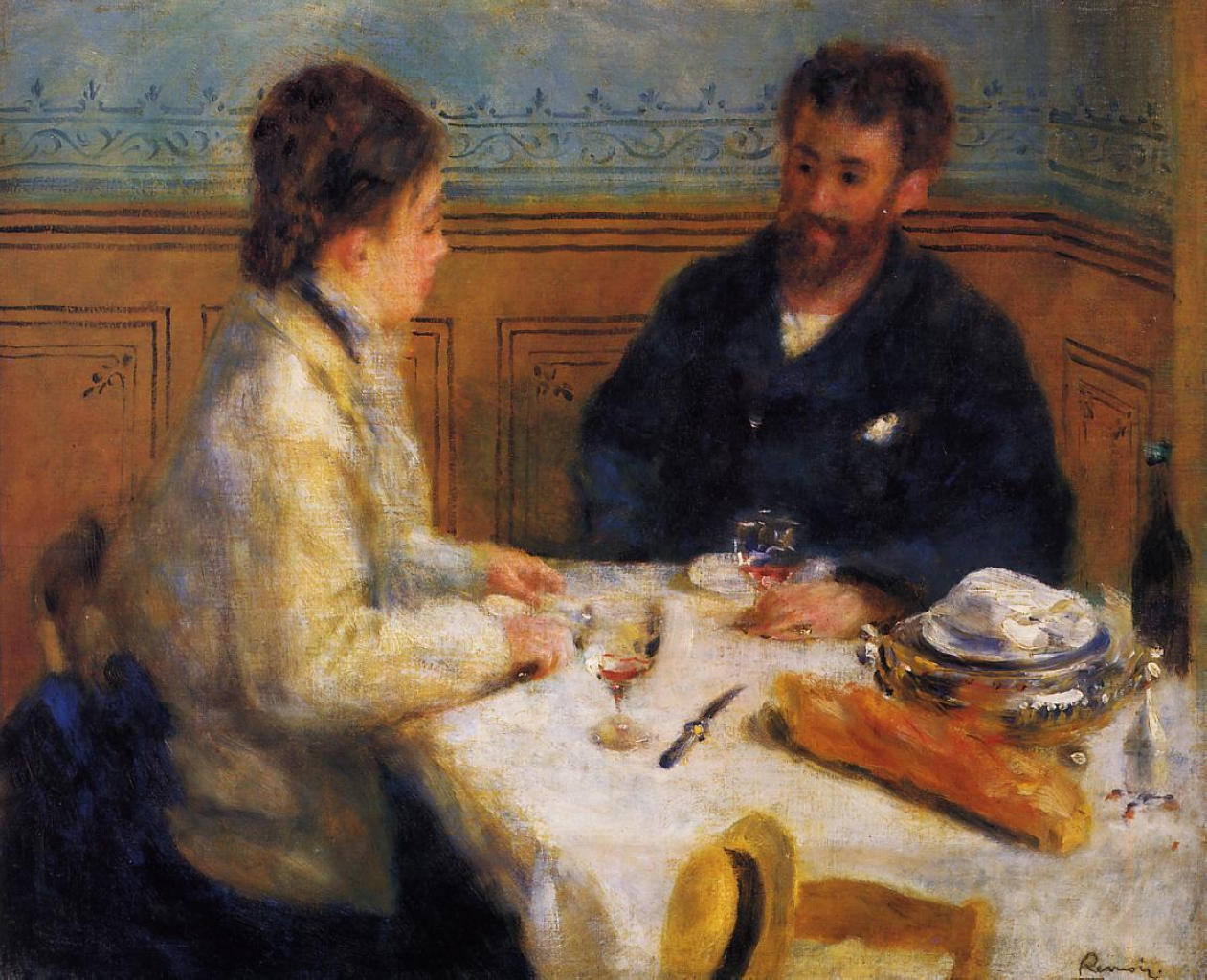
  • After the heart-wrench, here is something to lighten up the mood coupled with the amazing British humor. Though Maugham suffers his predicament is funny and the Mademoiselle is hilarious!

    The Luncheon

    By William Somerset Maugham

    Pierre Auguste Renoir (1841-1919)-The-Luncheon-1879


    I caught sight of her at the play and in answer to her beckoning I went over during the interval and sat down beside her. It was long since I had last seen her and if someone had not mentioned her name, I hardly think I would have recognized her.   She addressed me brightly.

    “Well, its many years since we first met.   How time does fly!   We’re none of us getting any younger.   Do you remember the first time I saw you?   You asked me to luncheon.” Did I remember?

    It was twenty years ago and I was living in Paris. I had a tiny apartment in the Latin Quarter overlooking a cemetery and I was earning barely enough money to keep body and soul together. She had read a book of mine and had written to me about it. I answered, thanking her, and presently I received from her another letter saying she was passing through Paris and would like to have a chat with me; but her time was limited and the only free moment she had was on the following Thursday; she was spending the morning at the Luxembourg and would I give her a little luncheon at Foyot’s afterwards? Foyot’s is a restaurant at which the French senators eat and it was so far beyond my means that I had never even thought of going there. But I was flattered and I was too young to have learned to say no to a woman. (Few men, I may add, learn this until theyare too old to make it of any consequence to a woman what they say.) I had eighty francs (gold francs) to last me the rest of the month and a modest luncheon should not cost more than fifteen. If I cut out coffee for the next two weeks I could manage well enough.

    I answered that I would meet my friend—by correspon­dence—at Foyot’s on Thursday at half-past twelve.   She was not so young as I expected and in appearance imposing rather than attractive. She was in fact a woman of forty (a charming age, but not one that excites a sudden and devastating passion at first sight), and she gave me the impression of having more teeth, white and large and even, than were necessary for any practical purpose. She was ‘ talkative, but since she seemed inclined to talk about me I was prepared to be an attentive listener.

    I was startled when the bill of fare was brought, for, the prices were a great deal higher than I had anticipated.   But she reassured me. “I never eat anything for luncheon”, she said.

    “Oh, don’t say that!” I answered generously.

    “I never eat more than one thing. I think people eat far too much nowadays. A little fish, perhaps. I wonder if they have any salmon.”

    Well, it was early in the year for salmon and it was not on the bill of fare, but I asked the waiter if there was, any.   Yes, a beautiful salmon had just come in, it was the first they had had. I ordered it for my guest.The waiter asked her if she would have something while it was being cooked. “No”, she answered, “I never eat more than one thing, unless you had a little caviare. I never mind caviare.”

    My heart sank a little. I knew I could not afford caviare, but I could not very well tell her that. I told the waiter by all means to bring caviare. For myself I chose the cheapest dish on the menu and that was a mutton chop.

    “I think you’re unwise to eat meat,” she said.   “I don’t know how you can expect to work after eating heavy things like chops.   I don’t believe in overloading my stomach.”

    Then came the question of drink.

    “I never drink anything for luncheon,” she said.

    “Neither do I,” I answered promptly.

    “Except white wine,” she proceeded as though I had not spoken. “These French white wines are so light. They’re wonderful for the digestion.”

    “What would you like?” I asked, hospitable still, but not exactly effusive. She gave me a bright and amicable flash of her white teeth.

    “My doctor won’t let me drink anything but cham­pagne.”

    I fancy I turned a trifle pale. I ordered half a bottle. I mentioned casually that my doctor had absolutely forbid­den me to drink champagne.

    “What are you going to drink, then?”

    “Water.”

    She ate the caviare and she ate the salmon. She talked gaily of art and literature and music. But I wondered what the bill would come to.   When my mutton chop arrived she took me quite seriously to task.

    “I see that you’re in the habit of eating a heavy luncheon. I’m sure it’s a mistake. Why don’t you follow my example and just eat one thing? I’m sure you’d feel ever so much better for it.”

    “I am only going to eat one thing,” I said as the waiter came again with the bill of fare.

    She waved him aside with an airy gesture.

    “No, no, I never eat anything for luncheon. Just a bite, I never want more than that, and I eat that more as an excuse for conversation than anything else. I couldn’t possibly eat anything more—unless they had some of those giant asparagus. I should be sorry to leave Paris without having some of them.”

    My heart sank. I had seen them in the shops and I knew that they were horribly expensive. My mouth had often watered at the sight of them.

    “Madame wants to know if you have any of those giant asparagus,” I asked the waiter.

    I tried with all my might to will him to say no. A happy smile spread over his broad, priest-like face, and he assured me that they had some so large, so splendid, so tender, that  it was a marvel.

    “I’m not in the least hungry,” my guest sighed, “but if you insist I don’t mind having some asparagus.” I ordered them.

    “Aren’t you going to have any?” “No, I never eat asparagus.”

    “I know there are people who don’t like them. The fact is, you ruin your palate by all the meat you eat.”

    We waited for the asparagus to be cooked. Panic seized me. It was not a question now how much money I should have left over for the rest of the month, but whether I had enough to pay the bill. It would be mortifying to find myself ten francs short and be obliged to borrow from my guest. I could not bring myself to do that. I knew exactly how much I had and if the bill came to more I made up my mind that I would put my hand in my pocket and with a dramatic cry start up and say it had been picked.   Of course it would be awkward if she had not money enough either to pay the bill. Then the only thing would be to leave my watch and say I would come back and pay later.

    The asparagus appeared. They were enormous, succu­lent and appetising. The smell of the melted butter tickled my nostrils as the nostrils of Jehovah were tickled by the burned offerings of the virtuous Semites. I watched the abandoned woman thrust them down her throat in large voluptuous mouthful and in my polite way I discoursed on the condition of the drama in the Balkans. At last shefinished.

    “Coffee?” I said.

    “Yes, just an ice-cream and coffee,” she answered.

    I was past caring now, so I ordered coffee for myself and an ice-cream and coffee for her.

    “You know, there’s one thing I thoroughly believe in”, she said, as she ate the ice-cream. “One should always get up from a meal feeling one could eat a little more.”

    “Are you still hungry?” I asked faintly.

    “Oh, no, I’m not hungry, you see, I don’t eat luncheon. I have a cup of coffee in the morning and then dinner, but I never eat more than one thing for luncheon. I was speaking for you.”

    “Oh, I see”

    Then a terrible thing happened. While we were waiting for the coffee, the head waiter, with an ingratiating smile on his false face, came up to us bearing a large basket full of huge peaches. They had the blush of an innocent girl; they had the rich tone of an Italian landscape. But surely peaches were not in season then? Lord knew what they cost. I knew too—a little later, for my guest, going on with her conversation, absentmindedly took one.

    “You see, you’ve filled your stomach with a lot of meat”—my one miserable little chop—”and you can’t eat 30 any more. But I’ve just had a snack and I shall enjoy a peach.”

    The bill came and when I paid it I found that I had only enough for a quite inadequate tip. Her eyes rested for an instant on the three francs I left for the waiter and I knew that she thought me mean. But when I walked out of therestaurant I had the whole month before me and not a penny in my pocket.

    “Follow my example,” she said as we shook hands, “and never eat more than one thing for luncheon.”

    “I’ll do better than that,” I retorted, “I’ll eat nothing for dinner to-night.”

    “Humorist!” she cried gaily, jumping into a cab. “You’re quite a humorist!”

    But I have had my revenge at last. I do not believe that I am a vindictive man, but when the immortal gods take a hand in the matter it is pardonable to observe the result with complacency. Today she weighs twenty-one stone.

    download


  • Life is not always fair. It simply is not. There is tragedy, there is comedy and finally there is making peace, cause frankly sometimes thats all that one can do. Make peace. Find peace. Like Ivan Dmitritch Aksyokof. Its one of those pieces of fiction that will need a box of tissues to go with.


    God sees truth, but waits

    By Count Leo Tolstoy

    images (4)

    IN the town of Vladímir lived a young merchant named Iván Dmítritch Aksyónof. He had two shops and a house of his own.

    Aksyónof was a handsome, fair-haired, curly-headed fellow, full of fun, and very fond of singing. When quite a young man he had been given to drink, and was riotous when he had had too much, but after he married he gave up drinking, except now and then.

    One summer Aksyónof was going to the Nízhny Fair, and as he bade good-bye to his family his wife said to him, ‘Iván Dmítritch, do not start to-day; I have had a bad dream about you.’

    Aksyónof laughed, and said, ‘You are afraid that when I get to the fair I shall go on the spree.’

    His wife replied: ‘I do not know what I am afraid of; all I know is that I had a bad dream. I dreamt you returned from the town, and when you took off your cap I saw that your hair was quite grey.’

    Aksyónof laughed. ‘That’s a lucky sign,’ said he. ‘See if I don’t sell out all my goods, and bring you some presents from the fair.’

    So he said good-bye to his family, and drove away.

    When he had travelled half-way, he met a merchant whom he knew, and they put up at the same inn for the night. They had some tea together, and then went to bed in adjoining rooms.

    It was not Aksyónof’s habit to sleep late, and, wishing to travel while it was still cool, he aroused his driver before dawn, and told him to put in the horses. Then he made his way across to the landlord of the inn (who lived in a cottage at the back), paid his bill, and continued his journey.

    When he had gone about twenty-five miles, he stopped for the horses to be fed. Aksyónof rested awhile in the passage of the inn, then he stepped out into the porch and, ordering a samovár[1] to be heated got out his guitar and began to play.

    Suddenly a tróyka[2] drove up with tinkling bells, and an official alighted, followed by two soldiers. He came to Aksyónof and began to question him, asking him who he was and whence he came. Aksyónof answered him fully, and said, ‘Won’t you have some tea with me?’ But the official went on cross-questioning him and asking him, ‘Where did you spend last night? Were you alone, or with a fellow-merchant? Did you see the other merchant this morning? Why did you leave the inn before dawn?’

    Aksyónof wondered why he was asked all these questions, but he described all that had happened, and then added, ‘Why do you cross-question me as if I were a thief or a robber? I am travelling on business of my own, and there is no need to question me.’

    Then the official, calling the soldiers, said, ‘I am the police-officer of this district, and I question you because the merchant with whom you spent last night has been found with his throat cut. We must search your things.’

    They entered the house. The soldiers and the police-officer unstrapped Aksyónof’s luggage and searched it. Suddenly the officer drew a knife out of a bag, crying, ‘Whose knife is this?’

    Aksyónof looked, and seeing a blood-stained knife taken from his bag, he was frightened.

    ‘How is it there is blood on this knife?’

    Aksyónof tried to answer, but could hardly utter a word, and only stammered: ‘I — I don’t know — not mine.’

    Then the police-officer said, ‘This morning the merchant was found in bed with his throat cut. You are the only person who could have done it. The house was locked from inside, and no one else was there. Here is this bloodstained knife in your bag, and your face and manner betray you! Tell me how you killed him, and how much money you stole?’

    Aksyónof swore he had not done it; that he had not seen the merchant after they had had tea together; that he had no money except eight thousand roubles[3] of his own, and that the knife was not his. But his voice was broken, his face pale, and he trembled with fear as though he were guilty.

    The police-officer ordered the soldiers to bind Aksyónof and to put him in the cart. As they tied his feet together and flung him into the cart, Aksyónof crossed himself and wept. His money and goods were taken from him, and he was sent to the nearest town and imprisoned there. Enquiries as to his character were made in Vladímir. The merchants and other inhabitants of that town said that in former days he used to drink and waste his time, but that he was a good man. Then the trial came on: he was charged with murdering a merchant from Ryazán, and robbing him of twenty thousand roubles.

    His wife was in despair, and did not know what to believe. Her children were all quite small; one was a baby at her breast. Taking them all with her, she went to the town where her husband was in gaol. At first she was not allowed to see him; but, after much begging, she obtained permission from the officials, and was taken to him. When she saw her husband in prison-dress and in chains, shut up with thieves and criminals, she fell down, and did not come to her senses for a long time. Then she drew her children to her, and sat down near him. She told him of things at home, and asked about what had happened to him. He told her all, and she asked, ‘What can we do now?’

    ‘We must petition the Tsar not to let an innocent man perish.’

    His wife told him that she had sent a petition to the Tsar, but that it had not been accepted.

    Aksyónof did not reply, but only looked downcast.

    Then his wife said, ‘It was not for nothing I dreamt your hair had turned grey. You remember? You should not have started that day.’ And passing her fingers through his hair, she said: ‘Ványa dearest, tell your wife the truth; was it not you who did it?’

    ‘So you, too, suspect me!’ said Aksyónof, and hiding his face in his hands, he began to weep. Then a soldier came to say that the wife and children must go away; and Aksyónof said good-bye to his family for the last time.

    When they were gone, Aksyónof recalled what had been said, and when he remembered that his wife also had suspected him, he said to himself, ‘It seems that only God can know the truth, it is to Him alone we must appeal, and from Him alone expect mercy.’

    And Aksyónof wrote no more petitions; gave up all hope, and only prayed to God.

    Aksyónof was condemned to be flogged and sent to the mines. So he was flogged with a knout, and when the wounds made by the knout were healed, he was driven to Siberia with other convicts.

    For twenty-six years Aksyónof lived as a convict in Siberia. His hair turned white as snow and his beard grew long, thin, and grey. All his mirth went; he stooped; he walked slowly, spoke little, and never laughed, but he often prayed.

    In prison Aksyónof learnt to make boots, and earned a little money, with which he bought The Lives of the Saints. He read this book when there was light enough in the prison; and on Sundays in the prison-church he read the lessons and sang in the choir; for his voice was still good.

    The prison authorities liked Aksyónof for his meekness, and his fellow-prisoners respected him: they called him ‘Grandfather,’ and ‘The Saint.’ When they wanted to petition the prison authorities about anything, they always made Aksyónof their spokesman, and when there were quarrels among the prisoners they came to him to put things right, and to judge the matter.

    No news reached Aksyónof from his home, and he did not even know if his wife and children were still alive.

    One day a fresh gang of convicts came to the prison. In the evening the old prisoners collected round the new ones and asked them what towns or villages they came from, and what they were sentenced for. Among the rest Aksyónof sat down near the new-comers, and listened with downcast air to what was said.

    One of the new convicts, a tall, strong man of sixty, with a closely-cropped grey beard, was telling the others what he had been arrested for.

    ‘Well, friends,’ he said, ‘I only took a horse that was tied to a sledge, and I was arrested and accused of stealing. I said I had only taken it to get home quicker, and had then let it go; besides, the driver was a personal friend of mine. So I said, “It’s all right.” “No,” said they, “you stole it.” But how or where I stole it they could not say. I once really did something wrong, and ought by rights to have come here long ago, but that time I was not found out. Now I have been sent here for nothing at all. . . . Eh, but it’s lies I’m telling you; I’ve been to Siberia before, but I did not stay long.’

    ‘Where are you from?’ asked some one.

    ‘From Vladímir. My family are of that town. My name is Makár, and they also call me Semyónitch.’

    Aksyónof raised his head and said: ‘Tell me, Semyónitch, do you know anything of the merchants Aksyónof, of Vladímir? Are they still alive?’

    ‘Know them? Of course I do. The Aksyónofs are rich, though their father is in Siberia: a sinner like ourselves, it seems! As for you, Gran’dad, how did you come here?’

    Aksyónof did not like to speak of his misfortune. He only sighed, and said, ‘For my sins I have been in prison these twenty-six years.’

    ‘What sins?’ asked Makár Semyónitch.

    But Aksyónof only said, ‘Well, well — I must have deserved it!’ He would have said no more, but his companions told the new-comer how Aksyónof came to be in Siberia: how some one had killed a merchant and had put a knife among Aksyónof’s things, and Aksyónof had been unjustly condemned.

    When Makár Semyónitch heard this, he looked at Aksyónof, slapped his own knee, and exclaimed, ‘Well this is wonderful! Really wonderful! But how old you’ve grown, Gran’dad!’

    The others asked him why he was so surprised, and where he had seen Aksyónof before; but Makár Semyónitch did not reply. He only said: ‘It’s wonderful that we should meet here, lads!’

    These words made Aksyónof wonder whether this man knew who had killed the merchant; so he said ‘Perhaps, Semyónitch, you have heard of that affair or maybe you’ve seen me before?’

    ‘How could I help hearing? The world’s full of rumours. But it’s long ago, and I’ve forgotten what I heard.’

    ‘Perhaps you heard who killed the merchant?’ asked Aksyónof.

    Makár Semyónitch laughed, and replied, ‘It must have been him in whose bag the knife was found! If some one else hid the knife there, “He’s not a thief till he’s caught,” as the saying is. How could any one put a knife into your bag while it was under your head? It would surely have woke you up?’

    When Aksyónof heard these words, he felt sure this was the man who had killed the merchant. He rose and went away. All that night Aksyónof lay awake.

    He felt terribly unhappy, and all sorts of images rose in his mind. There was the image of his wife as she was when he parted from her to go to the fair. He saw her as if she were present; her face and her eyes rose before him; he heard her speak and laugh. Then he saw his children, quite little, as they were at that time: one with a little cloak on, another at his mother’s breast. And then he remembered himself as he used to be — young and merry. He remembered how he sat playing the guitar in the porch of the inn where he was arrested, and how free from care he had been. He saw, in his mind, the place where he was flogged, the executioner, and the people standing around; the chains, the convicts, all the twenty-six years of his prison life, and his premature old age. The thought of it all made him so wretched that he was ready to kill himself.

    ‘And it’s all that villain’s doing!’ thought Aksyónof. And his anger was so great against Makár Semyónitch that he longed for vengeance, even if he himself should perish for it. He kept repeating prayers all night, but could get no peace. During the day he did not go near Makár Semyónitch, nor even look at him.

    A fortnight passed in this way. Aksyónof could not sleep at nights, and was so miserable that he did not know what to do.

    One night as he was walking about the prison he noticed some earth that came rolling out from under one of the shelves on which the prisoners slept. He stopped to see what it was. Suddenly Makár Semyónitch crept out from under the shelf, and looked up at Aksyónof with frightened face. Aksyónof tried to pass without looking at him, but Makár seized his hand and told him that he had dug a hole under the wall, getting rid of the earth by putting it into his high-boots, and emptying it out every day on the road when the prisoners were driven to their work.

    ‘Just you keep quiet, old man, and you shall get out too. If you blab they’ll flog the life out of me, but I will kill you first.’

    Aksyónof trembled with anger as he looked at his enemy. He drew his hand away, saying, ‘I have no wish to escape, and you have no need to kill me; you killed me long ago! As to telling of you — I may do so or not, as God shall direct.’ Next day, when the convicts were led out to work, the convoy soldiers noticed that one or other of the prisoners emptied some earth out of his boots. The prison was searched, and the tunnel found. The Governor came and questioned all the prisoners to find out who had dug the hole. They all denied any knowledge of it. Those who knew, would not betray Makár Semyónitch, knowing he would be flogged almost to death. At last the Governor turned to Aksyónof, whom he knew to be a just man, and said:

    ‘You are a truthful old man; tell me, before God, who dug the hole?’

    Makár Semyónitch stood as if he were quite unconcerned, looking at the Governor and not so much as glancing at Aksyónof. Aksyónof’s lips and hands trembled, and for a long time he could not utter a word. He thought, ‘Why should I screen him who ruined my life? Let him pay for what I have suffered. But if I tell, they will probably flog the life out of him and maybe I suspect him wrongly. And, after all, what good would it be to me?’

    ‘Well, old man,’ repeated the Governor, ‘tell us the truth: who has been digging under the wall?’

    Aksyónof glanced at Makár Semyónitch, and said ‘I cannot say, your honour. It is not God’s will that I should tell! Do what you like with me; I am in your hands.’

    However much the Governor tried, Aksyónof would say no more, and so the matter had to be left.

    That night, when Aksyónof was lying on his bed and just beginning to doze, some one came quietly and sat down on his bed. He peered through the darkness and recognized Makár.

    ‘What more do you want of me?’ asked Aksyónof. ‘Why have you come here?’

    Makár Semyónitch was silent. So Aksyónof sat up and said, ‘What do you want? Go away, or I will call the guard!’

    Makár Semyónitch bent close over Aksyónof, and whispered, ‘Iván Dmítritch, forgive me!’

    ‘What for?’ asked Aksyónof.

    ‘It was I who killed the merchant and hid the knife among your things. I meant to kill you too, but I heard a noise outside; so I hid the knife in your bag and escaped out of the window.’

    Aksyónof was silent, and did not know what to say. Makár Semyónitch slid off the bed-shelf and knelt upon the ground. ‘Iván Dmítritch,’ said he, ‘forgive me! For the love of God, forgive me! I will confess that it was I who killed the merchant, and you will be released and can go to your home.’

    ‘It is easy for you to talk,’ said Aksyónof, ‘but I have suffered for you these twenty-six years. Where could I go to now? . . . My wife is dead, and my children have forgotten me. I have nowhere to go. . . .’

    Makár Semyónitch did not rise, but beat his head on the floor. ‘Iván Dmítritch, forgive me!’ he cried. ‘When they flogged me with the knout it was not so hard to bear as it is to see you now . . . yet you had pity on me, and did not tell. For Christ’s sake forgive me, wretch that I am!’ And he began to sob.

    When Aksyónof heard him sobbing he, too, began to weep.

    ‘God will forgive you!’ said he. ‘Maybe I am a hundred times worse than you.’ And at these words his heart grew light, and the longing for home left him. He no longer had any desire to leave the prison, but only hoped for his last hour to come.

    In spite of what Aksyónof had said, Maker Semyónitch confessed his guilt. But when the order for his release came, Aksyónof was already dead.

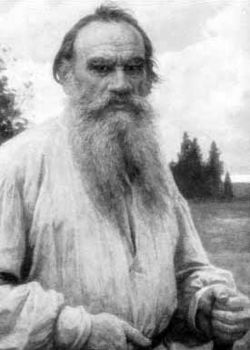
    tolstoy2

  • Honesty is the best policy. I mean what even if some wise men believe that its the straightest of trees that are felled first. This one piece of fiction by the dear French writer Maupassant reinstates that very belief.

    The Diamond Necklace

    By Guy de maupassant

    images (2)

    The girl was one of those pretty and charming young creatures who sometimes are born, as if by a slip of fate, into a family of clerks. She had no dowry, no expectations, no way of being known, understood, loved, married by any rich and distinguished man; so she let herself be married to a little clerk of the Ministry of Public Instruction.

    She dressed plainly because she could not dress well, but she was unhappy as if she had really fallen from a higher station; since with women there is neither caste nor rank, for beauty, grace and charm take the place of family and birth. Natural ingenuity, instinct for what is elegant, a supple mind are their sole hierarchy, and often make of women of the people the equals of the very greatest ladies.

    Mathilde suffered ceaselessly, feeling herself born to enjoy all delicacies and all luxuries. She was distressed at the poverty of her dwelling, at the bareness of the walls, at the shabby chairs, the ugliness of the curtains. All those things, of which another woman of her rank would never even have been conscious, tortured her and made her angry. The sight of the little Breton peasant who did her humble housework aroused in her despairing regrets and bewildering dreams. She thought of silent antechambers hung with Oriental tapestry, illumined by tall bronze candelabra, and of two great footmen in knee breeches who sleep in the big armchairs, made drowsy by the oppressive heat of the stove. She thought of long reception halls hung with ancient silk, of the dainty cabinets containing priceless curiosities and of the little coquettish perfumed reception rooms made for chatting at five o’clock with intimate friends, with men famous and sought after, whom all women envy and whose attention they all desire.

    When she sat down to dinner, before the round table covered with a tablecloth in use three days, opposite her husband, who uncovered the soup tureen and declared with a delighted air, “Ah, the good soup! I don’t know anything better than that,” she thought of dainty dinners, of shining silverware, of tapestry that peopled the walls with ancient personages and with strange birds flying in the midst of a fairy forest; and she thought of delicious dishes served on marvellous plates and of the whispered gallantries to which you listen with a sphinxlike smile while you are eating the pink meat of a trout or the wings of a quail.

    She had no gowns, no jewels, nothing. And she loved nothing but that. She felt made for that. She would have liked so much to please, to be envied, to be charming, to be sought after.

    She had a friend, a former schoolmate at the convent, who was rich, and whom she did not like to go to see any more because she felt so sad when she came home.

    But one evening her husband reached home with a triumphant air and holding a large envelope in his hand.

    “There,” said he, “there is something for you.”

    She tore the paper quickly and drew out a printed card which bore these words:

       The Minister of Public Instruction and Madame Georges Ramponneau
       request the honor of M. and Madame Loisel's company at the palace of
       the Ministry on Monday evening, January 18th.

    Instead of being delighted, as her husband had hoped, she threw the invitation on the table crossly, muttering:

    “What do you wish me to do with that?”

    “Why, my dear, I thought you would be glad. You never go out, and this is such a fine opportunity. I had great trouble to get it. Every one wants to go; it is very select, and they are not giving many invitations to clerks. The whole official world will be there.”

    She looked at him with an irritated glance and said impatiently:

    “And what do you wish me to put on my back?”

    He had not thought of that. He stammered:

    “Why, the gown you go to the theatre in. It looks very well to me.”

    He stopped, distracted, seeing that his wife was weeping. Two great tears ran slowly from the corners of her eyes toward the corners of her mouth.

    “What’s the matter? What’s the matter?” he answered.

    By a violent effort she conquered her grief and replied in a calm voice, while she wiped her wet cheeks:

    “Nothing. Only I have no gown, and, therefore, I can’t go to this ball. Give your card to some colleague whose wife is better equipped than I am.”

    He was in despair. He resumed:

    “Come, let us see, Mathilde. How much would it cost, a suitable gown, which you could use on other occasions—something very simple?”

    She reflected several seconds, making her calculations and wondering also what sum she could ask without drawing on herself an immediate refusal and a frightened exclamation from the economical clerk.

    Finally she replied hesitating:

    “I don’t know exactly, but I think I could manage it with four hundred francs.”

    He grew a little pale, because he was laying aside just that amount to buy a gun and treat himself to a little shooting next summer on the plain of Nanterre, with several friends who went to shoot larks there of a Sunday.

    But he said:

    “Very well. I will give you four hundred francs. And try to have a pretty gown.”

    The day of the ball drew near and Madame Loisel seemed sad, uneasy, anxious. Her frock was ready, however. Her husband said to her one evening:

    “What is the matter? Come, you have seemed very queer these last three days.”

    And she answered:

    “It annoys me not to have a single piece of jewelry, not a single ornament, nothing to put on. I shall look poverty-stricken. I would almost rather not go at all.”

    “You might wear natural flowers,” said her husband. “They’re very stylish at this time of year. For ten francs you can get two or three magnificent roses.”

    She was not convinced.

    “No; there’s nothing more humiliating than to look poor among other women who are rich.”

    “How stupid you are!” her husband cried. “Go look up your friend, Madame Forestier, and ask her to lend you some jewels. You’re intimate enough with her to do that.”

    She uttered a cry of joy:

    “True! I never thought of it.”

    The next day she went to her friend and told her of her distress.

    Madame Forestier went to a wardrobe with a mirror, took out a large jewel box, brought it back, opened it and said to Madame Loisel:

    “Choose, my dear.”

    She saw first some bracelets, then a pearl necklace, then a Venetian gold cross set with precious stones, of admirable workmanship. She tried on the ornaments before the mirror, hesitated and could not make up her mind to part with them, to give them back. She kept asking:

    “Haven’t you any more?”

    “Why, yes. Look further; I don’t know what you like.”

    Suddenly she discovered, in a black satin box, a superb diamond necklace, and her heart throbbed with an immoderate desire. Her hands trembled as she took it. She fastened it round her throat, outside her high-necked waist, and was lost in ecstasy at her reflection in the mirror.

    Then she asked, hesitating, filled with anxious doubt:

    “Will you lend me this, only this?”

    “Why, yes, certainly.”

    She threw her arms round her friend’s neck, kissed her passionately, then fled with her treasure.

    The night of the ball arrived. Madame Loisel was a great success. She was prettier than any other woman present, elegant, graceful, smiling and wild with joy. All the men looked at her, asked her name, sought to be introduced. All the attaches of the Cabinet wished to waltz with her. She was remarked by the minister himself.

    She danced with rapture, with passion, intoxicated by pleasure, forgetting all in the triumph of her beauty, in the glory of her success, in a sort of cloud of happiness comprised of all this homage, admiration, these awakened desires and of that sense of triumph which is so sweet to woman’s heart.

    She left the ball about four o’clock in the morning. Her husband had been sleeping since midnight in a little deserted anteroom with three other gentlemen whose wives were enjoying the ball.

    He threw over her shoulders the wraps he had brought, the modest wraps of common life, the poverty of which contrasted with the elegance of the ball dress. She felt this and wished to escape so as not to be remarked by the other women, who were enveloping themselves in costly furs.

    Loisel held her back, saying: “Wait a bit. You will catch cold outside. I will call a cab.”

    But she did not listen to him and rapidly descended the stairs. When they reached the street they could not find a carriage and began to look for one, shouting after the cabmen passing at a distance.

    They went toward the Seine in despair, shivering with cold. At last they found on the quay one of those ancient night cabs which, as though they were ashamed to show their shabbiness during the day, are never seen round Paris until after dark.

    It took them to their dwelling in the Rue des Martyrs, and sadly they mounted the stairs to their flat. All was ended for her. As to him, he reflected that he must be at the ministry at ten o’clock that morning.

    She removed her wraps before the glass so as to see herself once more in all her glory. But suddenly she uttered a cry. She no longer had the necklace around her neck!

    “What is the matter with you?” demanded her husband, already half undressed.

    She turned distractedly toward him.

    “I have—I have—I’ve lost Madame Forestier’s necklace,” she cried.

    He stood up, bewildered.

    “What!—how? Impossible!”

    They looked among the folds of her skirt, of her cloak, in her pockets, everywhere, but did not find it.

    “You’re sure you had it on when you left the ball?” he asked.

    “Yes, I felt it in the vestibule of the minister’s house.”

    “But if you had lost it in the street we should have heard it fall. It must be in the cab.”

    “Yes, probably. Did you take his number?”

    “No. And you—didn’t you notice it?”

    “No.”

    They looked, thunderstruck, at each other. At last Loisel put on his clothes.

    “I shall go back on foot,” said he, “over the whole route, to see whether I can find it.”

    He went out. She sat waiting on a chair in her ball dress, without strength to go to bed, overwhelmed, without any fire, without a thought.

    Her husband returned about seven o’clock. He had found nothing.

    He went to police headquarters, to the newspaper offices to offer a reward; he went to the cab companies—everywhere, in fact, whither he was urged by the least spark of hope.

    She waited all day, in the same condition of mad fear before this terrible calamity.

    Loisel returned at night with a hollow, pale face. He had discovered nothing.

    “You must write to your friend,” said he, “that you have broken the clasp of her necklace and that you are having it mended. That will give us time to turn round.”

    She wrote at his dictation.

    At the end of a week they had lost all hope. Loisel, who had aged five years, declared:

    “We must consider how to replace that ornament.”

    The next day they took the box that had contained it and went to the jeweler whose name was found within. He consulted his books.

    “It was not I, madame, who sold that necklace; I must simply have furnished the case.”

    Then they went from jeweler to jeweler, searching for a necklace like the other, trying to recall it, both sick with chagrin and grief.

    They found, in a shop at the Palais Royal, a string of diamonds that seemed to them exactly like the one they had lost. It was worth forty thousand francs. They could have it for thirty-six.

    So they begged the jeweler not to sell it for three days yet. And they made a bargain that he should buy it back for thirty-four thousand francs, in case they should find the lost necklace before the end of February.

    Loisel possessed eighteen thousand francs which his father had left him. He would borrow the rest.

    He did borrow, asking a thousand francs of one, five hundred of another, five louis here, three louis there. He gave notes, took up ruinous obligations, dealt with usurers and all the race of lenders. He compromised all the rest of his life, risked signing a note without even knowing whether he could meet it; and, frightened by the trouble yet to come, by the black misery that was about to fall upon him, by the prospect of all the physical privations and moral tortures that he was to suffer, he went to get the new necklace, laying upon the jeweler’s counter thirty-six thousand francs.

    When Madame Loisel took back the necklace Madame Forestier said to her with a chilly manner:

    “You should have returned it sooner; I might have needed it.”

    She did not open the case, as her friend had so much feared. If she had detected the substitution, what would she have thought, what would she have said? Would she not have taken Madame Loisel for a thief?

    Thereafter Madame Loisel knew the horrible existence of the needy. She bore her part, however, with sudden heroism. That dreadful debt must be paid. She would pay it. They dismissed their servant; they changed their lodgings; they rented a garret under the roof.

    She came to know what heavy housework meant and the odious cares of the kitchen. She washed the dishes, using her dainty fingers and rosy nails on greasy pots and pans. She washed the soiled linen, the shirts and the dishcloths, which she dried upon a line; she carried the slops down to the street every morning and carried up the water, stopping for breath at every landing. And dressed like a woman of the people, she went to the fruiterer, the grocer, the butcher, a basket on her arm, bargaining, meeting with impertinence, defending her miserable money, sou by sou.

    Every month they had to meet some notes, renew others, obtain more time.

    Her husband worked evenings, making up a tradesman’s accounts, and late at night he often copied manuscript for five sous a page.

    This life lasted ten years.

    At the end of ten years they had paid everything, everything, with the rates of usury and the accumulations of the compound interest.

    Madame Loisel looked old now. She had become the woman of impoverished households—strong and hard and rough. With frowsy hair, skirts askew and red hands, she talked loud while washing the floor with great swishes of water. But sometimes, when her husband was at the office, she sat down near the window and she thought of that gay evening of long ago, of that ball where she had been so beautiful and so admired.

    What would have happened if she had not lost that necklace? Who knows? who knows? How strange and changeful is life! How small a thing is needed to make or ruin us!

    But one Sunday, having gone to take a walk in the Champs Elysees to refresh herself after the labors of the week, she suddenly perceived a woman who was leading a child. It was Madame Forestier, still young, still beautiful, still charming.

    Madame Loisel felt moved. Should she speak to her? Yes, certainly. And now that she had paid, she would tell her all about it. Why not?

    She went up.

    “Good-day, Jeanne.”

    The other, astonished to be familiarly addressed by this plain good-wife, did not recognize her at all and stammered:

    “But—madame!—I do not know—You must have mistaken.”

    “No. I am Mathilde Loisel.”

    Her friend uttered a cry.

    “Oh, my poor Mathilde! How you are changed!”

    “Yes, I have had a pretty hard life, since I last saw you, and great poverty—and that because of you!”

    “Of me! How so?”

    “Do you remember that diamond necklace you lent me to wear at the ministerial ball?”

    “Yes. Well?”

    “Well, I lost it.”

    “What do you mean? You brought it back.”

    “I brought you back another exactly like it. And it has taken us ten years to pay for it. You can understand that it was not easy for us, for us who had nothing. At last it is ended, and I am very glad.”

    Madame Forestier had stopped.

    “You say that you bought a necklace of diamonds to replace mine?”

    “Yes. You never noticed it, then! They were very similar.”

    And she smiled with a joy that was at once proud and ingenuous.

    Madame Forestier, deeply moved, took her hands.

    “Oh, my poor Mathilde! Why, my necklace was paste! It was worth at most only five hundred francs!”

    images (3)

  • From the Indian writers, this one is a memory. K N Daruwalla writes about love in this earthy Love story set in the great rann of kutch. The story has been an inspiration for the Bollywood movie of Refugee. The movie is miss-able, but the story is laudable.

    Love across the salt desert

    By Keki N. Daruwalla

    images (1)

    The Rann of Kutch is a vast, lonely desert, almost impossible to cross. Yet, some people do cross it for reasons of their own. Najab Hussain also crossed the vast desert for a very special reason. What was it?
    1. THE DROUGHT in Kutch had lasted for three successive years. Even when clouds were sighted they passed by, ignoring the stricken country. The monsoons had, so to speak, forgotten to land. The Rann lay like a paralysed monster, its back covered with scab and scar-tissue and dried blister-skin. The earth had cracked and it looked as if chunks of it had been baked in a kiln and then embedded in the soil-crust. The cattle became thin and emaciated. The oxen died. The camel alone survived comfortably, feeding on the bawal, camelthorn. Then one day the clouds rolled in like wineskins and the lightning crackled and the wineskins burst. Though two years have passed since the drought ended, everyone remembers that it first rained on the day when Fatimah entered the village. This is how she came.
    * * * * *
    What would he not do for her, the daughter of the spice-seller; she who smelt of cloves and cinnamon, whose laughter had the timbre of ankle-bells, whose eyebrows were like black wisps of the night and whose hair was the night itself? For her he would cross the salt desert! He had stayed the day at Kala Doongar, a black hill capped with basalt, the highest in Kutch. He had set his camel, Allahrakha, free to crop on the bawal trees. At dusk he paid homage to the footprints of the Panchmai Pir on the hilltop. He left some food there and started beating on his thali, according to the custom here. In a few minutes jackals materialised and gobbled up the food. This was auspicious. If they had not turned up he would have cancelled the journey. A lamp was lighted in the Pir’s honour every night on the hilltop and the flame could be seen on all the way from Khavda. Over a hundred years earlier the Panchmai Pir had trudged these salt wastes serving the people accompanied, as legend had it, by a jackal. Reclusive by habit he used to retire to thorn jungles, where apart from his vulpine companions none else dared to disturb his nocturnal trysts. The custom of feeding the jackals had lingered since then. Najab bowed before the flame and set out. He left behind the camelthorn shrubs and the area once famous for its savannahs of stunted grass, but now sere and brown as the desert. He had left behind all human habitation, Kuran being the last village.

    For the next three days he would not be seeing any bhungas, those one-room mud-houses, circular at the base, but tapering into conical thatch-roofs at the top. Now only the sand-scapes stretched out before him, mile upon mile. Water splashed in the chagals. With the name of the Pir on his lips Najab Hussain set forth. Najab’s diffidence was notorious among his friends. He was known to have blushed at the mere mention of a girl. A strangely introverted lad with dreamy eyes, no one had ever associated him with any act of bravado. His father, Aftab, would say, “All that my ancestors and I have acquired during a hundred years, this lad will squander away, not because he is a spendthrift but because he will be too shy to charge money for what he sells!” He had crossed the Rann on four occasions earlier, though he had turned twenty only a month ago. But each time he had either accompanied his father or that wily old smuggler, Zaman, the veteran of a hundred illegal trips to Sind. Each time they had taken tendu leaf worth about five hundred, and sold it across the border for twelve hundred. But between the pay-off to officials and to the intermediaries who arranged the sale of the biri leaf, to the man who took the camel out to graze and to the friend or relative who harboured them, there was precious little left. It was just enough to buy some used terylene garments or cloves and then it was time to make the long trek across the desert. It was during one of these trips that they had stayed with Kaley Shah, the clove-seller. “He is a distant relative of your mother,” his father told Najab. Kaley Shah was tall, and well-fleshed and his thick-jowled face had a purple tinge about it as if somewhere along the way it had got stuck with a discoloured patch. He always wore a tahmat of black and white checks. Within a day Najab discovered that the fellow was an absolute rogue who drove such a cussed bargain that for the first time in his hearing his father started mouthing obscenities. But his daughter Fatimah was a hoor with eyes so bright that they would have lit up the darkness of the underworld. She was taken by this quiet, pleasant young man so ready with his smiles.

    But she could hardly elicit a word out of him. Fatimah had been under pressure to get engaged to someone in the village known for his slurred speech and grotesque stammer. “Just my luck to run into mutes,” she thought. But then, as she caught him staring at her, she laughed back. And in the evening when Fatimah repeated the performance and her face flooded with excitement as if she dared him to take the next step, he had flung his arms around her in a reckless, dizzy moment. Yes, he would come again, he told her, and saw her start with disbelief for he seemed to have answered her inarticulated question: Would he come again? This time he would come alone with no father to cramp his style. And as he left he looked behind to find her gaze following him, her eyes like a pair of storm lanterns in the dark. Ever since his return Khavda, Najab had been straining to get away. What was there about the Rann that he did not know? He could cross the Rann in the daylight, leave alone starlight, a thing none of his elders had dared to do! And one morning Aftab was woken up by a shout from Zaman. What does that old rogue want, he muttered, rubbing his sleepy eyes. Zaman asked about Najab’s whereabouts. 2. “The boy has been sulking of late but he should be around. Anyway, what business is it of yours?” The old man did not hide his irritation. “Who are you trying to fool, Aftab Mian?” asked the smuggler. “Don’t you know that Allahrakha is also missing?” In these border villages the pattern of life was such that if a man was absent long with his camel, it was taken for granted that he had made a foray across the desert into Pakistan. Aftab went into the mud enclosure where his camel was kept and found it empty. His heart sank.

    He ran into the house to see if the bundles of tendu leaf he had bought by him had been taken by the boy. “Oh, the fool! That son of a fool!” exclaimed Aftab, almost shaking with fury. “He has forgotten to take the leaf with him!” “Who are you trying to fool with all this drama?” called out Zaman who was still standing at the door. “This son of yours is not as innocent as the world believes. He is a pig and the son of a pig.” There was no limit to his chagrin. Zaman was a ‘chief’, the man who kept the Rangers across happy. Any one crossing the Rann without his support was running the gauntlet with the law. And here this fledgling had blundered in without as much as a word to him, or a salaam, or a hundred rupee note! “May Allah bring him safely out of this!” said the old rogue piously. He means just the opposite, thought Aftab. Nothing would please him more than to see Najab turned into carrion with vultures hovering around. “Don’t worry, Zaman, Allah will see him through!” he said testily and banged the door in the smuggler’s face. As Zaman walked off, Aftab went in to break the news of their son’s escapade to his wife. She would faint, he thought. He found her crouching with her back against the mud wall. She did not even blink in surprise, once. She just sat there cowering as if he had just slapped her and was about to do so again. Allah! She knew it! She knew it all the time!

    She was waist-deep in this conspiracy along with her son and never breathed a word about it. His eye fell on her bare arm. “Where is the gold bangle my father gave you, woman.” “You need not worry. Najab will return with cloves.” The long-striding Allahrakha kept a brisk pace. A strong south wind drove the tang of the Kori creek back into Najab’s nostrils. He followed the stars, the Milky Way flaked with mica, the Great Bear shambling towards the north. Before dawn he had reached his destination, for a sandy elevation palisaded with the bones of dead animals told him he had arrived at Sarbela, over twenty miles from Kala Doongar. He was already beyond the interna- tional boundary. Here he rested. During daylight, movement was impossible. The Indus Rangers would be looking from their bamboo watch-towers. And in the heat everything became a mirage. A depression in the sand looked like a splash of water, a freak, stunted cactus gave the appearance of a grove, and a camel looked like a huge prehistoric animal on the move. Any movement was sure to be noticed through binoculars.

    When the sun came up Najab took his first drink of water from his cha- gal. At noon he had his first meal – dry, stale bread with onion. By now thoughts about Fatimah took a vice-like grip over him. An entire night lay between them, he thought. And the distance was less than ten miles. The thought of it made him writhe even as the sun started beating its anvil on the desert. A whiff of the tangy south wind caught his nostrils again. But this time it brought with it a thin, dappled veil of cloud, patches of which lay overlapping like fish scales. Within an hour this corrugated cloud had cov- ered a substantial portion of the sky, looking for all the world like a stretch of wind-rippled sand. Yes, this was the time! He got up and shook the sand from his turban. Even as he harnessed his camel he thought that Allahrakha was looking at him quizzically as if asking what the hell he was up to. At one level of consciousness he knew that this was madness. He knew of over- worked camels dying of fatigue, of the patrolling parties of the B.S.F. and the Indus Rangers and the mirage-chequered, trackless wastes of the desert. But he succumbed to a rush of blood and the face of Fatimah beckoned him like a mirage. Najab crossed the International Boundary Pillar Number 1066.

    He knew the track he had to take, bisecting the two posts of the Indus Rangers at Jaga- trai and Vingoor. But he strayed ever so slightly, and from their watch-tower they saw through their binoculars this sleek camel, wrapped and distorted by the heat-shimmer into a lumbering leviathan. An Indian slipping into their territory with tendu leaf right under their noses, and that too without paying any hush money! They were not going to stand for it. Najab was in a trance now, events flashing past him like figures on a screen. The mile-long chase, the firing from behind, the spent bullets flopping in the sand and then the rising wind which churned the dust into his eyes and then rose between the hunter and the hunted. When the dust settled half an hour later he was alone in the Rann. The next few hours passed in a daze. He was mortally scared that Al- lahrakha may die of fatigue. To ease him of his burden he now started walking beside him. Within an hour the salt had scraped the callus from his feet and scarred them with agonising cracks. Under a hot tin sky, the Rann was blazing now, throwing up white needles which hurt the eyes. And as the Rann palpitated, it haunted him with its mirages, pools of shadow, scooped half-moons of water. Hours of wandering as if in a trance, attempting to lick the receding edges of the mirage.

    Then light thinning away, and an hour or two later, dusk, and a thin plume of smoke rising from a dung-fire. Allah be praised! He was now within range. He waited for the night to descend and then struck out hobbling on his toes, for his desert odyssey had cost him his heels. Within an hour he was at the clove-seller’s door. Fatimah rose from her bed like a panic-stricken doe as he called out her name softly through the window bars. It took some anxious moments for it to sink in that it was Najab. Her lustrous eyes lit up the dark of the room as she opened the door. 3. Two hours before dawn, Kaley Shah was woken up by the beat constable banging on the door. “A smuggler has come across the Rann, Kaley Shah. You wouldn’t know anything about him, would you?” “Kasam tumhari, not a sparrow has entered the house, or the village. Even the dogs have not been barking tonight.” Then he added with a know- ing wink, “Why should a smuggler come to me?” But the law was not amused. “Kaley Shah,” he said sardonically, “your belly is stuffed full with silver. It would outweigh even the dirt in your heart!” The constable’s words rattled like a sack of empty cans in his head and prevented him from sleeping. “You have a guest,” said Fatimah as she brought him his tumbler of hot, steaming milk next morning. “It is Najab. He stayed the night in the cattle shed.” For a moment he was terrified. A smuggler in the house, the police prowling all around and he did not even know of it! His meeting with Najab had been brief. The wretched fellow had brought no tendu leaf.

    “First you come unannounced, dragging the police behind you, and then I find you have come with nothing. Trading with you is going to be a dead loss, son, with the cops on your back and your hands empty.” Najab thought that Kaley Shah’s waist-cloth, with its black and white checks looked like a chess board. He would have to make his moves carefully. He showed the gold bracelet. “I have come for cloves, Chacha jan. And I shall pay in gold.” The next two days Kaley Shah was busy buying cloves and arranging to get Allahrakha grazed a few miles away, by a cowherd. Otherwise the presence of a strange camel would have let loose a babble of tongues. Najab slept in the cattle-shed in the evening and slipped into Fatimah’s room late at night. “They want me to marry Mahfuz Ali,” she told him. “He is related to us from my mother’s family. The way he stammers! You should hear him! Urchins start mimicking him the moment they set eyes on him. It is just a step removed from being hounded like a madman and pelted with stones.” “Has it never occurred to you to take a ride on Allahrakha across the Rann?” She had kept silent and silence was assent. It was as simple as that.

    The first lurch of the camel next evening and they were off. He had waited with his camel at the outskirts of the village and she had slipped out after her father had started snoring. The moment was too big for them and they did not speak. It was only in passing that she thought of the village she was leaving for good. As for quitting one and entering another, she never gave it a thought. Where did one have the time for Pakistan and Hindustan when one was eloping with one’s love and crossing the desert which divided, both physically and symbolically, the two countries? For her it meant just a shift in dialect, a smear of Kutchi added and a little of Sindhi sandpapered away. And the camel lurched and bumped onwards and Najab drove him hard. By the time they reached Sarbela she was exhausted and fell asleep. She woke up in the afternoon to find the sky overcast. It turned ominous in the evening with depth upon depth of dark-edged nimbus gathering at the summons of a storm-god. Another night they journeyed facing the wind which hurled the sand in their faces. As they neared Khavda, the thunder started rolling and reverberating across the skies. Three times during the night Aftab opened the door, thinking his son had come. But it was only the wind knocking against the door. This time the banging was persistent. When he unlatched the door he found Allahrakha shying away from a streak of lightening. Huge, isolated drops of rain were falling, kicking up the dust. Aftab steeled himself. He would not allow any relief, any expression of joy to show on his face. “Son, have you brought anything?” he asked, an edge of iron deliberately introduced in his voice. “Yes,” replied Najab, as he ushered Fatimah in. The rain stormed down and swept away three years of drought.

  • Anton Chekhov is undoubtedly my most favorite writer, the Russian doctor wrote short stories in his spare time and this short story is undoubtedly my favorite.

    The Bet by Anton Chekhov


    images

    It was a dark autumn night. The old banker was walking up and down his study and remembering how, fifteen years before, he had given a party one autumn evening. There had been many clever men there, and there had been interesting conversations. Among other things they had talked of capital punishment. The majority of the guests, among whom were many journalists and intellectual men, disapproved of the death penalty. They considered that form of punishment out of date, immoral, and unsuitable for Christian States. In the opinion of some of them the death penalty ought to be replaced everywhere by imprisonment for life. “I don’t agree with you,” said their host the banker. “I have not tried either the death penalty or imprisonment for life, but if one may judge a priori, the death penalty is more moral and more humane than imprisonment for life. Capital punishment kills a man at once, but lifelong imprisonment kills him slowly. Which executioner is the more humane, he who kills you in a few minutes or he who drags the life out of you in the course of many years?”

    “Both are equally immoral,” observed one of the guests, “for they both have the same object – to take away life. The State is not God. It has not the right to take away what it cannot restore when it wants to.”

    Among the guests was a young lawyer, a young man of five-and-twenty. When he was asked his opinion, he said:

    “The death sentence and the life sentence are equally immoral, but if I had to choose between the death penalty and imprisonment for life, I would certainly choose the second. To live anyhow is better than not at all.”

    A lively discussion arose. The banker, who was younger and more nervous in those days, was suddenly carried away by excitement; he struck the table with his fist and shouted at the young man:

    “It’s not true! I’ll bet you two million you wouldn’t stay in solitary confinement for five years.”

    “If you mean that in earnest,” said the young man, “I’ll take the bet, but I would stay not five but fifteen years.”

    *******************************************************************************

         “Fifteen? Done!” cried the banker. “Gentlemen, I stake two million!”

    “Agreed! You stake your millions and I stake my freedom!” said the young man.

    And this wild, senseless bet was carried out! The banker, spoilt and frivolous, with millions beyond his reckoning, was delighted at the bet. At supper he made fun of the young man, and said:

    “Think better of it, young man, while there is still time. To me two million is a trifle, but you are losing three or four of the best years of your life. I say three or four, because you won’t stay longer. Don’t forget either, you unhappy man, that voluntary confinement is a great deal harder to bear than compulsory. The thought that you have the right to step out in liberty at any moment will poison your whole existence in prison. I am sorry for you.”

    And now the banker, walking to and fro, remembered all this, and asked himself: “What was the object of that bet? What is the good of that man’s losing fifteen years of his life and my throwing away two million? Can it prove that the death penalty is better or worse than imprisonment for life? No, no. It was all nonsensical and meaningless. On my part it was the caprice of a pampered man, and on his part simple greed for money …”

    Then he remembered what followed that evening. It was decided that the young man should spend the years of his captivity under the strictest supervision in one of the lodges in the banker’s garden. It was agreed that for fifteen years he should not be free to cross the threshold of the lodge, to see human beings, to hear the human voice, or to receive letters and newspapers. He was allowed to have a musical instrument and books, and was allowed to write letters, to drink wine, and to smoke. By the terms of the agreement, the only relations he could have with the outer world were by a little window made purposely for that object. He might have anything he wanted – books, music, wine, and so on – in any quantity he desired by writing an order, but could only receive them through the window. The agreement provided for every detail and every trifle that would make his imprisonment strictly solitary, and bound the young man to stay there exactly fifteen years, beginning from twelve o’clock of November 14, 1870, and ending at twelve o’clock of November 14, 1885. The slightest attempt on his part to break the conditions, if only two minutes before the end, released the banker from the obligation to pay him the two million.

    ******************************************************************************

         For the first year of his confinement, as far as one could judge from his brief notes, the prisoner suffered severely from loneliness and depression. The sounds of the piano could be heard continually day and night from his lodge. He refused wine and tobacco. Wine, he wrote, excites the desires, and desires are the worst foes of the prisoner; and besides, nothing could be more dreary than drinking good wine and seeing no one. And tobacco spoilt the air of his room. In the first year the books he sent for were principally of a light character; novels with a complicated love plot, sensational and fantastic stories, and so on.

    In the second year the piano was silent in the lodge, and the prisoner asked only for the classics. In the fifth year music was audible again, and the prisoner asked for wine. Those who watched him through the window said that all that year he spent doing nothing but eating and drinking and lying on his bed, frequently yawning and angrily talking to himself. He did not read books. Sometimes at night he would sit down to write; he would spend hours writing, and in the morning tear up all that he had written. More than once he could be heard crying.

    In the second half of the sixth year the prisoner began zealously studying languages, philosophy, and history. He threw himself eagerly into these studies – so much so that the banker had enough to do to get him the books he ordered. In the course of four years some six hundred volumes were procured at his request. It was during this period that the banker received the following letter from his prisoner:

    “My dear Jailer, I write you these lines in six languages. Show them to people who know the languages. Let them read them. If they find not one mistake I implore you to fire a shot in the garden. That shot will show me that my efforts have not been thrown away. The geniuses of all ages and of all lands speak different languages, but the same flame burns in them all. Oh, if you only knew what unearthly happiness my soul feels now from being able to understand them!” The prisoner’s desire was fulfilled. The banker ordered two shots to be fired in the garden.

    ****************************************************************************

         Then after the tenth year, the prisoner sat immovably at the table and read nothing but the Gospel. It seemed strange to the banker that a man who in four years had mastered six hundred learned volumes should waste nearly a year over one thin book easy of comprehension. Theology and histories of religion followed the Gospels.

    In the last two years of his confinement the prisoner read an immense quantity of books quite indiscriminately. At one time he was busy with the natural sciences, then he would ask for Byron or Shakespeare. There were notes in which he demanded at the same time books on chemistry, and a manual of medicine, and a novel, and some treatise on philosophy or theology. His reading suggested a man swimming in the sea among the wreckage of his ship, and trying to save his life by greedily clutching first at one spar and then at another.


    The old banker remembered all this, and thought:

    “To-morrow at twelve o’clock he will regain his freedom. By our agreement I ought to pay him two million. If I do pay him, it is all over with me: I shall be utterly ruined.”

    Fifteen years before, his millions had been beyond his reckoning; now he was afraid to ask himself which were greater, his debts or his assets. Desperate gambling on the Stock Exchange, wild speculation and the excitability whic h he could not get over even in advancing years, had by degrees led to the decline of his fortune and the proud, fearless, self-confident millionaire had become a banker of middling rank, trembling at every rise and fall in his investments. “Cursed bet!” muttered the old man, clutching his head in despair “Why didn’t the man die? He is only forty now. He will take my last penny from me, he will marry, will enjoy life, will gamble on the Exchange; while I shall look at him with envy like a beggar, and hear from him every day the same sentence: ‘I am indebted to you for the happiness of my life, let me help you!’ No, it is too much! The one means of being saved from bankruptcy and disgrace is the death of that man!”

    *****************************************************************************

         It struck three o’clock, the banker listened; everyone was asleep in the house and nothing could be heard outside but the rustling of the chilled trees. Trying to make no noise, he took from a fireproof safe the key of the door which had not been opened for fifteen years, put on his overcoat, and went out of the house.

    It was dark and cold in the garden. Rain was falling. A damp cutting wind was racing about the garden, howling and giving the trees no rest. The banker strained his eyes, but could see neither the earth nor the white statues, nor the lodge, nor the trees. Going to the spot where the lodge stood, he twice called the watchman. No answer followed. Evidently the watchman had sought shelter from the weather, and was now asleep somewhere either in the kitchen or in the greenhouse.

    “If I had the pluck to carry out my intention,” thought the old man, “Suspicion would fall first upon the watchman.”

    He felt in the darkness for the steps and the door, and went into the entry of the lodge. Then he groped his way into a little passage and lighted a match. There was not a soul there. There was a bedstead with no bedding on it, and in the corner there was a dark cast-iron stove. The seals on the door leading to the prisoner’s rooms were intact.

    When the match went out the old man, trembling with emotion, peeped through the little window. A candle was burning dimly in the prisoner’s room. He was sitting at the table. Nothing could be seen but his back, the hair on his head, and his hands. Open books were lying on the table, on the two easy-chairs, and on the carpet near the table.

    Five minutes passed and the prisoner did not once stir. Fifteen years’ imprisonment had taught him to sit still. The banker tapped at the window with his finger, and the prisoner made no movement whatever in response. Then the banker cautiously broke the seals off the door and put the key in the keyhole. The rusty lock gave a grating sound and the door creaked. The banker expected to hear at once footsteps and a cry of astonishment, but three minutes passed and it was as quiet as ever in the room. He made up his mind to go in.

    *****************************************************************************

         At the table a man unlike ordinary people was sitting motionless. He was a skeleton with the skin drawn tight over his bones, with long curls like a woman’s and a shaggy beard. His face was yellow with an earthy tint in it, his cheeks were hollow, his back long and narrow, and the hand on which his shaggy head was propped was so thin and delicate that it was dreadful to look at it. His hair was already streaked with silver, and seeing his emaciated, aged-looking face, no one would have believed that he was only forty. He was asleep … In front of his bowed head there lay on the table a sheet of paper on which there was something written in fine handwriting.

    “Poor creature!” thought the banker, “he is asleep and most likely dreaming of the millions. And I have only to take this half-dead man, throw him on the bed, stifle him a little with the pillow, and the most conscientious expert would find no sign of a violent death. But let us first read what he has written here … ”

    The banker took the page from the table and read as follows:

    “To-morrow at twelve o’clock I regain my freedom and the right to associate with other men, but before I leave this room and see the sunshine, I think it necessary to say a few words to you. With a clear conscience I tell you, as before God, who beholds me, that I despise freedom and life and health, and all that in your books is called the good things of the world.

    “For fifteen years I have been intently studying earthly life. It is true I have not seen the earth nor men, but in your books I have drunk fragrant wine, I have sung songs, I have hunted stags and wild boars in the forests, have loved women … Beauties as ethereal as clouds, created by the magic of your poets and geniuses, have visited me at night, and have whispered in my ears wonderful tales that have set my brain in a whirl. In your books I have climbed to the peaks of Elburz and Mont Blanc, and from there I have seen the sun rise and have watched it at evening flood the sky, the ocean, and the mountain-tops with gold and crimson. I have watched from there the lightning flashing over my head and cleaving the storm-clouds. I have seen green forests, fields, rivers, lakes, towns. I have heard the singing of the sirens, and the strains of the shepherds’ pipes; I have touched the wings of comely devils who flew down to converse with me of God … In your books I have flung myself into the bottomless pit, performed miracles, slain, burned towns, preached new religions, conquered whole kingdoms …

    *******************************************************************************

         “Your books have given me wisdom. All that the unresting thought of man has created in the ages is compressed into a small compass in my brain. I know that I am wiser than all of you.

    “And I despise your books, I despise wisdom and the blessings of this world. It is all worthless, fleeting, illusory, and deceptive, like a mirage. You may be proud, wise, and fine, but death will wipe you off the face of the earth as though you were no more than mice burrowing under the floor, and your posterity, your history, your immortal geniuses will burn or freeze together with the earthly globe.

    “You have lost your reason and taken the wrong path. You have taken lies for truth, and hideousness for beauty. You would marvel if, owing to strange events of some sorts, frogs and lizards suddenly grew on apple and orange trees instead of fruit, or if roses began to smell like a sweating horse; so I marvel at you who exchange heaven for earth. I don’t want to understand you.

    “To prove to you in action how I despise all that you live by, I renounce the two million of which I once dreamed as of paradise and which now I despise. To deprive myself of the right to the money I shall go out from here five hours before the time fixed, and so break the compact …”

    When the banker had read this he laid the page on the table, kissed the strange man on the head, and went out of the lodge, weeping. At no other time, even when he had lost heavily on the Stock Exchange, had he felt so great a contempt for himself. When he got home he lay on his bed, but his tears and emotion kept him for hours from sleeping.

    Next morning the watchmen ran in with pale faces, and told him they had seen the man who lived in the lodge climb out of the window into the garden, go to the gate, and disappear. The banker went at once with the servants to the lodge and made sure of the flight of his prisoner. To avoid arousing unnecessary talk, he took from the table the writing in which the millions were renounced, and when he got home locked it up in the fireproof safe.

    chekhov


  • Being a protege of convent education, Christmas always brings back memories of stories that we read out in class. Some how I always ended up being the narrator and while I deal with all the nostalgia am  sharing a few stories that I have loved. To be precise am going to share 10 short stories ranging from Chekhov, my all time favorite to O’Henry and more. Here’s the first one!

    images


    #1. Gifts of the Magi by O’Henry

    One dollar and eighty-seven cents. That was all. And sixty cents of it was in pennies. Pennies saved one and two at a time by bulldozing the grocer and the vegetable man and the butcher until one’s cheeks burned with the silent imputation of parsimony that such close dealing implied. Three times Della counted it. One dollar and eighty-seven cents. And the next day would be Christmas.

         There was clearly nothing left to do but flop down on the shabby little couch and howl. So Della did it. Which instigates the moral reflection that life is made up of sobs, sniffles, and smiles, with sniffles predominating.

    While the mistress of the home is gradually subsiding from the first stage to the second, take a look at the home. A furnished flat at $8 per week. It did not exactly beggar description, but it certainly had that word on the look-out for the mendicancy squad.

    In the vestibule below was a letter-box into which no letter would go, and an electric button from which no mortal finger could coax a ring. Also appertaining thereunto was a card bearing the name “Mr. James Dillingham Young.”

    The “Dillingham” had been flung to the breeze during a former period of prosperity when its possessor was being paid $30 per week. Now, when the income was shrunk to $20, the letters of “Dillingham” looked blurred, as though they were thinking seriously of contracting to a modest and unassuming D. But whenever Mr. James Dillingham Young came home and reached his flat above he was called “Jim” and greatly hugged by Mrs. James Dillingham Young, already introduced to you as Della. Which is all very good.

    Della finished her cry and attended to her cheeks with the powder rag. She stood by the window and looked out dully at a grey cat walking a grey fence in a grey backyard. To-morrow would be Christmas Day, and she had only $1.87 with which to buy Jim a present. She had been saving every penny she could for months, with this result. Twenty dollars a week doesn’t go far. Expenses had been greater than she had calculated. They always are. Only $1.87 to buy a present for Jim. Her Jim. Many a happy hour she had spent planning for something nice for him. Something fine and rare and sterling – something just a little bit near to being worthy of the honour of being owned by Jim.

    <  2  >

         There was a pier-glass between the windows of the room. Perhaps you have seen a pier-glass in an $8 Bat. A very thin and very agile person may, by observing his reflection in a rapid sequence of longitudinal strips, obtain a fairly accurate conception of his looks. Della, being slender, had mastered the art.

    Suddenly she whirled from the window and stood before the glass. Her eyes were shining brilliantly, but her face had lost its colour within twenty seconds. Rapidly she pulled down her hair and let it fall to its full length.

    Now, there were two possessions of the James Dillingham Youngs in which they both took a mighty pride. One was Jim’s gold watch that had been his father’s and his grandfather’s. The other was Della’s hair. Had the Queen of Sheba lived in the flat across the airshaft, Della would have let her hair hang out of the window some day to dry just to depreciate Her Majesty’s jewels and gifts. Had King Solomon been the janitor, with all his treasures piled up in the basement, Jim would have pulled out his watch every time he passed, just to see him pluck at his beard from envy.

    So now Della’s beautiful hair fell about her, rippling and shining like a cascade of brown waters. It reached below her knee and made itself almost a garment for her. And then she did it up again nervously and quickly. Once she faltered for a minute and stood still while a tear or two splashed on the worn red carpet.

    On went her old brown jacket; on went her old brown hat. With a whirl of skirts and with the brilliant sparkle still in her eyes, she cluttered out of the door and down the stairs to the street.

    Where she stopped the sign read: ‘Mme Sofronie. Hair Goods of All Kinds.’ One Eight up Della ran, and collected herself, panting. Madame, large, too white, chilly, hardly looked the ‘Sofronie.’

    “Will you buy my hair?” asked Della.

    <  3  >

         “I buy hair,” said Madame. “Take yer hat off and let’s have a sight at the looks of it.”

    Down rippled the brown cascade.

    “Twenty dollars,” said Madame, lifting the mass with a practised hand.

    “Give it to me quick” said Della.

    Oh, and the next two hours tripped by on rosy wings. Forget the hashed metaphor. She was ransacking the stores for Jim’s present.

    She found it at last. It surely had been made for Jim and no one else. There was no other like it in any of the stores, and she had turned all of them inside out. It was a platinum fob chain simple and chaste in design, properly proclaiming its value by substance alone and not by meretricious ornamentation – as all good things should do. It was even worthy of The Watch. As soon as she saw it she knew that it must be Jim’s. It was like him. Quietness and value – the description applied to both. Twenty-one dollars they took from her for it, and she hurried home with the 78 cents. With that chain on his watch Jim might be properly anxious about the time in any company. Grand as the watch was, he sometimes looked at it on the sly on account of the old leather strap that he used in place of a chain.

    When Della reached home her intoxication gave way a little to prudence and reason. She got out her curling irons and lighted the gas and went to work repairing the ravages made by generosity added to love. Which is always a tremendous task dear friends – a mammoth task.

    Within forty minutes her head was covered with tiny, close-lying curls that made her look wonderfully like a truant schoolboy. She looked at her reflection in the mirror long, carefully, and critically.

    “If Jim doesn’t kill me,” she said to herself, “before he takes a second look at me, he’ll say I look like a Coney Island chorus girl. But what could I do – oh! what could I do with a dollar and eighty-seven cents?”

    <  4  >

         At 7 o’clock the coffee was made and the frying-pan was on the back of the stove hot and ready to cook the chops.

    Jim was never late. Della doubled the fob chain in her hand and sat on the corner of the table near the door that he always entered. Then she heard his step on the stair away down on the first flight, and she turned white for just a moment. She had a habit of saying little silent prayers about the simplest everyday things, and now she whispered: “Please, God, make him think I am still pretty.”

    The door opened and Jim stepped in and closed it. He looked thin and very serious. Poor fellow, he was only twenty-two – and to be burdened with a family! He needed a new overcoat and he was with out gloves.

    Jim stepped inside the door, as immovable as a setter at the scent of quail. His eyes were fixed upon Della, and there was an expression in them that she could not read, and it terrified her. It was not anger, nor surprise, nor disapproval, nor horror, nor any of the sentiments that she had been prepared for. He simply stared at her fixedly with that peculiar expression on his face.

    Della wriggled off the table and went for him.

    “Jim, darling,” she cried, “don’t look at me that way. I had my hair cut off and sold it because I couldn’t have lived through Christmas without giving you a present. It’ll grow out again – you won’t mind, will you? I just had to do it. My hair grows awfully fast. Say ‘Merry Christmas!’ Jim, and let’s be happy. You don’t know what a nice-what a beautiful, nice gift I’ve got for you.”

    “You’ve cut off your hair?” asked Jim, laboriously, as if he had not arrived at that patent fact yet, even after the hardest mental labour.

    “Cut it off and sold it,” said Della. “Don’t you like me just as well, anyhow? I’m me without my hair, ain’t I?”

    <  5  >

         Jim looked about the room curiously.

    “You say your hair is gone?” he said, with an air almost of idiocy.

    “You needn’t look for it,” said Della. “It’s sold, I tell you – sold and gone, too. It’s Christmas Eve, boy. Be good to me, for it went for you. Maybe the hairs of my head were numbered,” she went on with a sudden serious sweetness, “but nobody could ever count my love for you. Shall I put the chops on, Jim?”

    Out of his trance Jim seemed quickly to wake. He enfolded his Della. For ten seconds let us regard with discreet scrutiny some inconsequential object in the other direction. Eight dollars a week or a million a year – what is the difference? A mathematician or a wit would give you the wrong answer. The magi brought valuable gifts, but that was not among them. This dark assertion will be illuminated later on.

    Jim drew a package from his overcoat pocket and threw it upon the table.

    “Don’t make any mistake, Dell,” he said, “about me. I don’t think there’s anything in the way of a haircut or a shave or a shampoo that could make me like my girl any less. But if you’ll unwrap that package you may see why you had me going a while at first.”

    White fingers and nimble tore at the string and paper. And then an ecstatic scream of joy; and then, alas! a quick feminine change to hysterical tears and wails, necessitating the immediate employment of all the comforting powers of the lord of the flat.

    For there lay The Combs – the set of combs, side and back, that Della had worshipped for long in a Broadway window. Beautiful combs, pure tortoise-shell, with jewelled rims – just the shade to wear in the beautiful vanished hair. They were expensive combs, she knew, and her heart had simply craved and yearned over them without the least hope of possession. And now, they were hers, but the tresses that should have adorned the coveted adornments were gone.

    <  6  >

         But she hugged them to her bosom, and at length she was able to look up with dim eyes and a smile and say: “My hair grows so fast, Jim!”

    And then Della leaped up like a little singed cat and cried, “Oh, oh!”

    Jim had not yet seen his beautiful present. She held it out to him eagerly upon her open palm. The dull precious metal seemed to {lash with a reflection of her bright and ardent spirit.

    “Isn’t it a dandy, Jim? I hunted all over town to find it. You’ll have to look at the time a hundred times a day now. Give me your watch. I want to see how it looks on it.”

    Instead of obeying, Jim tumbled down on the couch and put his hands under the back of his head and smiled.

    “Dell,” said he, “let’s put our Christmas presents away and keep ’em a while. They’re too nice to use just at present. I sold the watch to get the money to buy your combs. And now suppose you put the chops on.”

    The magi, as you know, were wise men – wonderfully wise men – who brought gifts to the Babe in the manger. They invented the art of giving Christmas presents. Being wise, their gifts were no doubt wise ones, possibly bearing the privilege of exchange in case of duplication. And here I have lamely related to you the uneventful chronicle of two foolish children in a flat who most unwisely sacrificed for each other the greatest treasures of their house. But in a last word to the wise of these days let it be said that of all who give gifts these two were the wisest. Of all who give and receive gifts, such as they are wisest. Everywhere they are wisest. They are the magi.

  • gosf-slide-logo

    Just as the Great online shopping festival (GOSF) embarks on it’s third day, today, am totally and finally catching the wind of online trade. From clothes to footwear, from stationery to groceries, there is little that you cannot buy online. Its not just about buying a hard copy of books, you could now simply buy the soft copy and well, read it online too at a fraction of the price. Its no surprise then that online businesses are such a huge success, and ofcourse of great convenience. Especially with the cash on delivery option. I for one, hardly subscribe to or am comfortable with the use of plastic money. Besides online shopping does not urge you to sit in alarming traffic snarls, take a trip to any of the Indian metros and you will know what I am talking about!

    Well someday hanging out at the mall is going to be passe, becoming just a tale we tell in the future. Even as restaurants and food places  have begun taking a rain-check on the malls, it may well be the beginning of the doom of the mall-culture. The definition of shopping is surely and soonly changing, much like the good old days when the thele wala would bring veggies, the kabadi wala would buy the used stuff (clearing the attic) and such. Also I would gladly subscribe to such in the changing times if it does give me an added reason to be environmentally friendly and going ‘car-free’, then really why not!

    Ah and while we are at that here are some sites that have caught my fancy recently.

    http://www.bigbasket.com

    http://www.flipkart.com

    http://www.myntra.com

    http://www.friendsofbooks.com

    http://www.amazon.com

    http://www.nykaa.com

    So well happy shopping this festive season!